

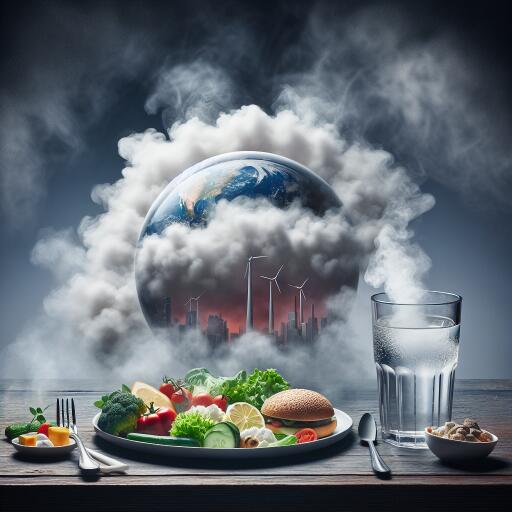
Smog On Our Plates: How Air Pollution Strips Food Of Nutrition – Analysis
We’ve long understood dirty air as a threat to lungs and hearts. Less visible, but no less alarming, is the way the same haze gnaws at our food. Ground-level ozone (O₃), fine particles (PM₂.₅), nitrogen oxides, sulfur dioxide, and volatile organic compounds are steadily eroding plant health, shrinking harvests, and diluting the nutrients in what we grow. As seasonal smog episodes intensify—especially across northern India in winter—the hidden toll on agriculture and nutrition is becoming impossible to ignore.
How dirty air stresses crops
Ozone, a fierce oxidant formed when sunlight drives reactions between NOₓ and VOCs, enters leaves through stomata and sets off oxidative stress. The fallout: damaged chloroplasts, throttled photosynthesis, and disrupted carbon metabolism. Fine particles add another layer of pressure by scattering and absorbing sunlight, dimming the photosynthetically active radiation plants need. Together, these pollutants curb growth, weaken plants’ defenses, and tip fields toward lower yields.
Yields at risk in a warming, fire-prone world
New modeling that factors in future climate conditions finds that wildfire-driven spikes in ozone could markedly depress yields of staple crops worldwide. This reinforces a broader warning: as temperatures rise and fire seasons lengthen, episodic ozone surges will combine with elevated background levels to suppress agricultural output across continents. Projections from research groups in South Asia indicate that, under high-emission scenarios, surface ozone could trim wheat yields by up to 20 percent by mid-century, with rice and maize also taking significant hits. In short, a pollutant once treated as a city problem is fast becoming a farm crisis.
Nutrition diluted: more calories, fewer nutrients
Yield loss is only half the story. Elevated CO₂—often high where agro-industrial emissions cluster—nudges plants to produce more carbohydrates, but at the expense of proteins and key micronutrients like iron and zinc. A large synthesis covering tens of thousands of crop nutrient measurements shows that rising atmospheric CO₂ is linked to measurable declines in micronutrient density even as caloric content edges upward. The result is “hidden hunger”: adequate calories masking subtle but consequential deficiencies.
Ozone’s nutritional fingerprints are less comprehensively mapped but point in the same direction. High O₃ interferes with nitrogen metabolism, a keystone of protein formation, and can reshape how plants allocate micronutrients and secondary metabolites. Pollutants also affect the microbial life in soils, altering nutrient availability and uptake. Field observations of particulate deposition on crops such as wheat and cotton frequently record 20–40 percent drops in chlorophyll—a sign of broader metabolic strain likely to ripple through nutrient profiles. The convergence of these stressors means food may fill the stomach while doing less to nourish the body.
Smoke from fields: burning the future
Crop residue burning starkly illustrates agriculture’s double bind: farming practices that pollute the air rebound onto the fields that produced them. Agricultural air pollution, including ammonia emissions and stubble fires, contributes to a heavy global health burden each year. Beyond human health, smoldering fields sterilize soil microbial diversity, amplify pest pressures, and strip nutrients from agroecosystems. What starts as a quick fix for clearing fields becomes a feedback loop—poorer soils, weaker crops, more inputs, and escalating vulnerability to the very pollution that drove the problem.
India’s winter smog as a stress test
North India’s winter air offers a stark case study. PM₂.₅ levels and AQI frequently soar into hazardous territory across Delhi and the National Capital Region, sometimes even after the main stubble-burning window has closed. Transport emissions, household fuels, industry, and residual agricultural fires together maintain a chronic haze. While some districts report fewer burn events, periodic spikes still load the air over farmland with ozone precursors and particulates. Policy measures have largely targeted urban air, leaving rural and peri-urban pollution entwined with food production insufficiently addressed—despite their direct bearing on yields and nutrition.
Global echoes
The pattern is not unique to South Asia. Modeling work in East Asia suggests that curbing ozone and PM₂.₅ could unlock substantial gains in staple-crop output and overall calorie availability. In North America, rising background ozone has already translated into billions of dollars in annual agricultural losses across wheat, maize, and soy. The geography changes; the vulnerability does not.
What would help
- Cut ozone precursors at source: stricter controls on NOₓ and VOCs from vehicles, industry, and fertilizers.
- End residue burning: scale up in-situ residue management, subsidize mulching and machinery, and reward zero-tillage adoption.
- Manage fire risk: prevention, rapid response, and landscape restoration to dampen wildfire-driven ozone spikes.
- Breed and diversify: invest in ozone- and heat-tolerant varieties, and promote crop rotations that build soil resilience.
- Revive soils: composting, cover crops, and minimized disturbance to restore microbial communities vital for nutrient cycling.
- Monitor smarter: integrate satellite data with ground networks for real-time advisories to farmers on pollution-sensitive operations.
- Link policies: embed air-quality targets within agricultural and nutrition strategies to reflect their shared outcomes.
“Smog on our plates” is not a metaphor. It is a measurable erosion of both how much food we can grow and how nourishing that food is. As chronic pollution and severe smog episodes become more common—particularly in densely populated, farm-dependent regions—only integrated action across air quality, agriculture, and nutrition will keep our fields productive and our diets genuinely healthy.



Leave a Reply