

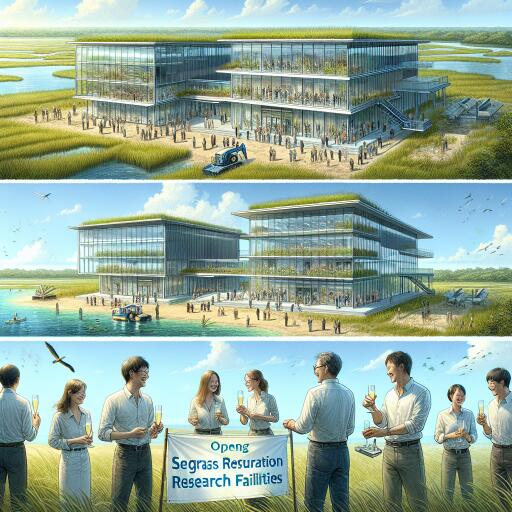
Mote celebrates opening of three seagrass restoration research facilities
Florida’s seagrass future got a major boost with the late-August debut of three purpose-built research hubs at Mote Marine Laboratory & Aquarium. The facilities anchor a comprehensive push to accelerate restoration, strengthen ecosystem resilience, and secure long-term sustainability for seagrass meadows across the state—work fueled by the $10 million Seagrass Restoration Technology Initiative launched in 2023.
A dedicated campus for seagrass innovation
Located at Mote’s Aquaculture Research Park in Sarasota, the new Seagrass Ecosystem Restoration Research Compound unites three complementary facilities: the Ron and Marla Wolf Seagrass Restoration Center for Ocean Sustainability Greenhouse Facility, the Biogeochemical Carbon Sequestration Lab, and the Publix Seagrass Genetics Research Hub. Together, they create an end-to-end pipeline for testing, refining, and scaling restoration techniques designed for Florida’s changing coastal conditions.
The initiative—backed by the Florida Department of Environmental Protection and state leadership—frames a decade-long effort to reverse declines in seagrass habitat. Earlier this year, Mote advanced a second round of funding under the $10 million program, strengthening collaborations that include the University of Florida and other partners focused on cost-effective, environmentally sound restoration approaches.
Why seagrass recovery matters
Seagrass beds are the quiet architects of coastal health. They serve as nurseries for fisheries, buffer shorelines from erosion, filter and improve water quality, and lock away carbon in plants and sediments. Yet in many Florida waters, these meadows have shrunk due to dredging, nutrient-laden runoff, reduced water clarity, and climate-driven stressors.
Mote’s program targets these stressors from multiple angles—genetic diversity and resilience, propagation at scale, and rigorous assessment of biogeochemical dynamics—so that restoration projects can endure in the face of rising temperatures, fluctuating salinity, increased turbidity, and intense grazing pressure.
Three facilities, three complementary missions
-
Ron and Marla Wolf Seagrass Restoration Center for Ocean Sustainability Greenhouse Facility
This controlled-environment greenhouse is built to stress-test seagrass under real-world challenges: salinity swings, heat spikes, cloudy water, and herbivory. By quantifying performance under these conditions, researchers can identify and propagate genotypes most likely to thrive as coastal environments shift. The facility also supports experiments that link plant performance to belowground biogeochemistry, connecting above- and below-sediment responses that influence restoration success. Support for the greenhouse includes philanthropic contributions alongside state and federal funding. -
Biogeochemical Carbon Sequestration Lab
Focused on seagrass and marine sediments, this lab quantifies how restored meadows capture and store carbon over time. The goal: generate robust, field-ready datasets that tie restoration actions to measurable carbon outcomes—laying groundwork for long-term carbon crediting strategies that can help finance and sustain restoration at scale. -
Publix Seagrass Genetics Research Hub
Here, scientists map, catalog, and propagate seagrass genotypes with a higher likelihood of withstanding environmental stress. By pairing genetic insights with on-the-water performance, the team can recommend planting materials tailored to local conditions. This genomics-guided approach is led by Mote researchers including Postdoctoral Research Fellow Dr. Dominique Gallery.
Collaboration as the catalyst
The new compound embodies a model of science-and-technology deployment that connects public agencies, universities, and private philanthropy. The Florida DEP’s Aquatic Preserve Program is partnering with Mote and the University of Florida to prioritize scalable, cost-efficient interventions that fit within the state’s broader restoration roadmap. For communities that depend on healthy bays and estuaries—economically, ecologically, and culturally—this alignment is designed to deliver durable benefits over the coming decades.
Extending science from lab to field
To translate lab breakthroughs into on-the-water gains, Mote has established a new research and restoration site within Bahia Honda State Park in the Florida Keys through a formal partnership with the state environmental agency. The plan includes building and operating a land-based seagrass nursery to support outplanting and experimental trials, while also contributing to education and public engagement at the park. The site will serve as a proving ground for propagation methods, genotype selection, and post-restoration monitoring—critical steps for scaling up restoration intelligently.
A blueprint for the next decade
With the Seagrass Ecosystem Restoration Research Compound now online, Florida gains a living laboratory where genetics, horticulture, and carbon science converge. The approach reimagines restoration as both ecological repair and technological deployment—guided by data, optimized through controlled trials, and validated in the field. If successful, the model promises not just greener seafloors, but stronger coastal economies, clearer waters, and new pathways to finance nature-based climate solutions.



Leave a Reply