

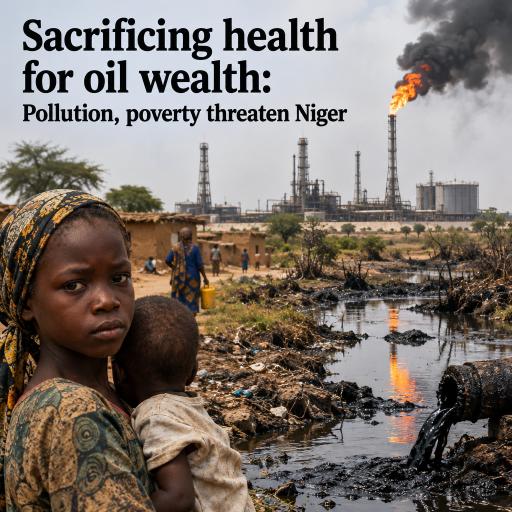
Sacrificing health for oil wealth: Pollution, poverty threaten Niger
In the Niger Delta, the riches drawn from beneath the soil continue to leave many communities with poisoned water, damaged ecosystems and growing fear for their safety. Across parts of Rivers and Delta states, residents living near oil and gas facilities say pollution and infrastructure failures are steadily eroding the natural resources that once sustained them.
What is unfolding in these communities is not just an industrial problem. It is a human crisis. Families that rely on fishing, farming and clean groundwater are being forced to navigate gas leaks, crude contamination and uncertainty over whether their homes remain safe.
A riverine community living with danger
In Bille, a coastal settlement in Rivers State, alarm spread after residents noticed gas bubbling from the ground and nearby waters. What first appeared to be a strange local occurrence has turned into a prolonged emergency, with fears over fire outbreaks, unsafe drinking water and damage to fisheries.
Officials later said early findings pointed to contamination in the first underground water-bearing layer, a troubling sign for a place where groundwater is essential for daily life. For local families, that means a basic need—safe water—has become one more casualty of the oil economy.
Residents have also described shrinking fish catches, fewer periwinkles and visible stress on mangrove habitats. Those losses matter deeply in a region where wetlands serve as nurseries for aquatic life and where household income depends directly on the health of rivers and creeks.
The social toll is just as stark. Daily routines have been disrupted, and some children were reportedly moved elsewhere for safety. Community members have also linked a series of small fires and health scares to the persistent gas emissions.
Questions after a fatal explosion
The risks in Bille became even more disturbing after a young woman died following an explosion in her room. Reports from the community said gas-like odours and sounds from beneath the floor had been noticed before the blast. The death intensified demands for a full, independent investigation into whether ongoing seepage created the conditions for the tragedy.
Residents say the incident exposed what they have feared for months: that invisible emissions can quickly become lethal. Even where a direct scientific link is still under investigation, the need for urgent protection is hard to dispute.
Ageing wells under scrutiny
Regulators investigating the Bille crisis screened dozens of nearby oil and gas wells and found a significant share to be in high-risk categories. Some sites reportedly showed corrosion, while others were inaccessible or affected by vandalism. Investigators also detected gas hissing from certain facilities.
Those findings have sharpened concerns about the condition of old petroleum infrastructure in the Niger Delta. Aged wells, poorly maintained equipment and inadequately sealed abandoned sites can all become pathways for gas or oil to escape into surrounding land and water.
Technical studies are under way to identify exactly where the emissions are coming from, but the scientific process is moving far more slowly than community anxiety. While laboratories analyse samples and agencies compare data, residents remain exposed to possible explosions, polluted water and declining livelihoods.
Ecological damage with economic consequences
The environmental fallout in Bille reaches far beyond the immediate seepage points. If groundwater is contaminated, families may become dependent on externally supplied water for months or years. If mangroves continue to decline, fish breeding grounds could be lost, with effects rippling through local food systems.
For fishing households, that translates into lower catches and falling income. For women involved in collecting shellfish and processing aquatic products, it can mean a severe loss of economic independence. In places where many already live with poverty, pollution compounds hardship.
Scientists and environmental advocates have warned that prolonged gas exposure may also degrade soils and worsen health risks, especially respiratory problems and other illnesses linked to toxic compounds. Their message is straightforward: leaking or abandoned infrastructure should be repaired, secured or dismantled before it becomes a disaster.
Another emergency in Delta State
Bille is not alone. In Uzere, in Delta State, a separate incident involving a damaged oil facility sent crude and gas into the environment, threatening farms, fish ponds, swamps and nearby water bodies. For a community heavily dependent on agriculture and fishing, the implications were immediate.
Local assessments raised concern that petroleum substances continued escaping for an extended period before containment was fully established. Residents feared that rainfall and flooding could spread contamination even farther across productive land and wetlands.
Community leaders warned that a major share of the population depends on farming and fishing for survival. If cropland, ponds and streams are polluted, the damage is not limited to nature; it strikes directly at food supply, household earnings and long-term stability.
Response efforts, but lingering doubts
The operator at Uzere later said it had brought the spill under control, stepped up cleanup operations and relocated more than 100 residents as a precaution. Emergency teams, monitoring exercises and technical sampling were also reported.
But containment is only the first step. Cleaning visible oil does not automatically restore damaged ecosystems, nor does it answer questions about long-term exposure, soil recovery or the safety of local water sources. Independent verification remains essential, especially in regions where official assurances often fail to match lived realities.
These incidents have renewed scrutiny of both oil companies and regulators. Across the Niger Delta, critics have long argued that communities are too often left waiting for investigations while hazardous conditions persist. Delayed reporting, uncertain accountability and weak enforcement only deepen mistrust.
The bigger pattern in the Niger Delta
Taken together, the crises in Bille and Uzere point to a broader structural problem: the oil industry’s profits have not been matched by equal investment in environmental safety, infrastructure integrity and community protection. Wells and pipelines age. Equipment fails. Abandoned facilities remain hazardous. And the people living closest to extraction sites pay the highest price.
This cost is not measured only in hectares of contaminated land or litres of spilled crude. It is measured in school disruptions, burned homes, tainted wells, empty fishing nets and the chronic fear that another leak or explosion may come next.
The Niger Delta has supplied wealth to the nation for decades, yet many host communities still lack the most basic protections: clean water, healthy ecosystems, prompt emergency response and transparent remediation. That imbalance lies at the heart of the region’s environmental injustice.
What must happen next
Authorities need to move beyond short-term crisis management. In affected communities, access to safe drinking water, medical screening and continuous air and water monitoring should be guaranteed immediately. Old, suspended and abandoned oil and gas infrastructure across the region should be independently audited and secured without delay.
Just as importantly, environmental restoration must be transparent and science-based. Communities deserve clear information about the source of pollution, the scale of ecological harm and the timetable for recovery. Where negligence or regulatory failures are established, sanctions and compensation should follow.
For the Niger Delta, the central question is no longer whether oil extraction carries environmental risk. That has been evident for years. The real question is whether the lives, health and livelihoods of host communities will ever be valued as highly as the petroleum beneath their land.



Leave a Reply