

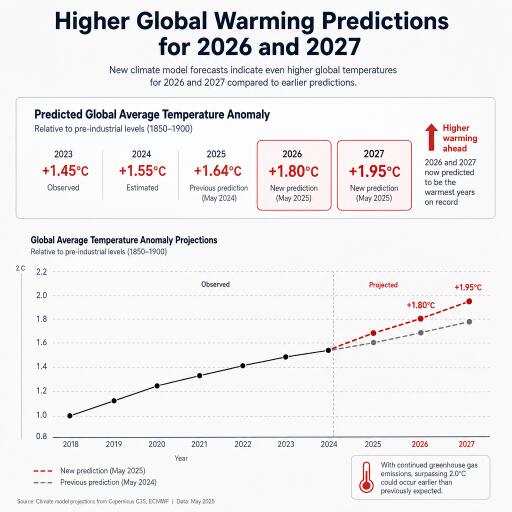
Higher warming predictions for 2026 and 2027
Fresh data and shifting ocean conditions are nudging near-term global temperature outlooks higher. With the first quarter of 2026 now logged and reanalysis pointing to a warm April, updated modeling suggests both 2026 and 2027 are on track to be hotter than previously expected. The main driver of this revision: signs of a powerful El Niño taking shape later this year, potentially rivaling the 2015–2016 event.
What’s changed since the early-year outlook
Multi-model guidance indicates a strong El Niño is likely to mature in late 2026, with a median projected peak anomaly of about 2.7°C in the central-eastern equatorial Pacific (Niño-3.4). While spring remains a season of limited ENSO predictability and the forecast could shift, the current signal is striking. In parallel, year-to-date surface temperatures have run warm enough to lift the 2026 annual projection.
Compared to an early-season estimate, the 2026 global mean surface temperature anomaly is now placed at 1.46°C, with an uncertainty range of 1.36°C to 1.59°C. The previous outlook centered on 1.41°C (1.27°C to 1.55°C). For 2027, the central estimate has risen to 1.61°C, with a wider envelope of 1.40°C to 1.93°C, up from 1.57°C (1.3°C to 1.76°C). These are anomalies relative to the long-term preindustrial baseline commonly used in climate assessments.
How the projections were refined
The initial method at the start of the year relied on a streamlined statistical model linking annual temperatures to the prior year’s anomaly, the final month of the previous year, short-term ENSO forecasts, and a time trend capturing ongoing warming. The updated approach is more comprehensive and makes explicit use of:
- Year-to-date global temperatures (currently January through March 2026)
- The most recent monthly anomaly
- Observed ENSO conditions so far this year
- Forecast ENSO conditions for the remainder of 2026
- A time trend to capture the underlying human-driven warming signal
Uncertainty from ENSO forecasts is folded in using a Monte Carlo sampling framework, which better reflects the real spread of possible outcomes.
The 2027 update also moves from a simple trend-plus-El Niño “add-on” to a formal regression that estimates the typical year-over-year change in global temperature as a function of the long-term trend and the expected ENSO state during September–December—the window when a developing El Niño would likely peak. That estimated change is then applied to the 2026 outlook, with all uncertainties propagated forward. One outcome of this more rigorous treatment is slightly broader error bars for 2027, acknowledging that both the 2026 finish and the El Niño strength remain uncertain.
How well does this approach stack up?
Back-testing against past strong El Niño episodes indicates the method captures the broad magnitude of year-to-year temperature jumps. It tends to slightly underestimate the largest leaps in some earlier events, closely matches the 2016 outcome, and slightly overestimates the recent 2023–2024 shift. As ever, the 2027 result is contingent on where 2026 ultimately lands; a warmer 2026 in this framework typically sets the stage for a warmer 2027.
Odds for records and thresholds
The strengthened El Niño signal and warm start to the year lift the probability that 2026 finishes near the top of the record books. Current estimates suggest:
- About a 56% chance that 2026 is the second warmest year observed
- Roughly a 26% chance it becomes the warmest year to date
- Around a 34% chance that the annual anomaly exceeds 1.5°C
These figures reflect both the warming baseline and the anticipated El Niño contribution, with explicit accounting for forecast uncertainty.
Important caveats
Despite the stronger signal, spring remains a treacherous time for ENSO prediction, and outcomes could shift as new ocean–atmosphere data arrive. Other factors—such as volcanic activity, aerosol changes, and internal variability outside the tropical Pacific—can also nudge annual means. Regardless of ENSO, the dominant backdrop is continued human-driven warming, which ratchets baseline temperatures upward and increases the likelihood of record-challenging years.
What to watch next
Key markers in the months ahead include the evolution of subsurface heat in the equatorial Pacific, trade wind patterns, and sustained warming in the Niño-3.4 region. On land, expect more frequent and prolonged heat episodes during regional warm seasons, with marine heatwaves continuing to amplify humidity and stress on coastal ecosystems. As the year progresses, the balance between the strengthening El Niño and the background warming trend will determine whether 2026 narrowly misses, matches, or surpasses prior records—and how much potential El Niño “carryover” elevates global temperatures in 2027.
Bottom line: signs of a strong late-2026 El Niño and a hot start to the year have edged the 2026 and 2027 global temperature projections upward. While uncertainties remain, the path of least resistance in the climate system continues to point toward new heat milestones.



Leave a Reply