

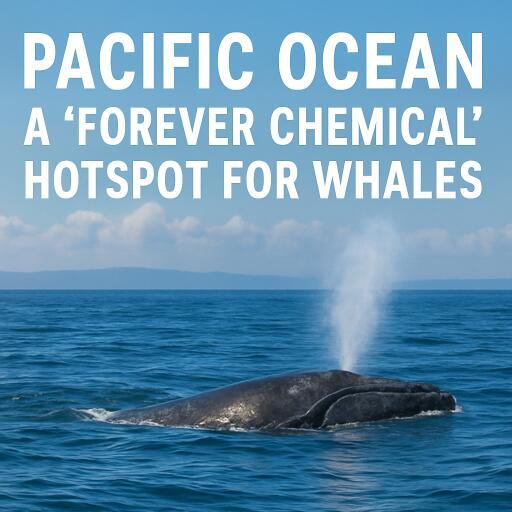
Pacific ocean a ‘forever chemical’ hotspot for whales
Whales and dolphins living in the Pacific are carrying some of the heaviest known burdens of PFAS, a sprawling class of industrial compounds often called “forever chemicals” because they persist in nature for extraordinarily long periods.
A new global comparison of contamination in toothed whales suggests the Pacific has emerged as a major hotspot, with levels in some animals outpacing those reported in many other parts of the world. The findings add to mounting evidence that the ocean’s top predators are becoming long-term reservoirs for pollution created on land.
PFAS, short for per- and polyfluoroalkyl substances, include thousands of synthetic chemicals engineered to repel heat, grease, oil and water. They have been widely used in products such as non-stick coatings, stain-resistant materials and firefighting foams. Their extraordinary durability makes them useful in industry, but it also means they linger in soils, rivers, coastal waters and living tissue rather than breaking down naturally.
For marine mammals, exposure begins far from the open sea. Chemicals released from factories, urban runoff and waste streams can travel through rivers into coastal ecosystems, where they enter marine food webs. Small organisms and fish take them up first, and the contamination intensifies as predators consume prey. Toothed whales and dolphins, sitting near the top of that chain, can end up storing especially high concentrations.
The new assessment drew on more than two decades of sampling and analyzed over 700 liver specimens from stranded toothed whales collected around the world. By combining fresh material with earlier datasets, researchers built one of the clearest global maps yet of PFAS contamination across species and regions.
The pattern that emerged was striking. Pacific populations showed some of the highest concentrations, while animals sampled in the Mediterranean generally registered lower levels. That contrast may reflect major differences in industrial activity, regional chemical use and the timing of restrictions on certain PFAS compounds.
One likely explanation for the Pacific signal is the scale of manufacturing and chemical production that has developed across parts of Asia over recent decades. As industrial output expanded, so too did the pathways for PFAS to enter waterways and coastal seas. Because these chemicals are highly persistent, today’s pollution can also reflect releases from many years ago.
The Mediterranean results do not suggest the region is free from contamination, only that the burden appears lower in comparison. Regulatory action in Europe to limit several PFAS chemicals may have helped curb some exposure, though scientists caution that the family of compounds is vast and replacement chemicals may pose their own risks.
Researchers view toothed whales as valuable sentinels for ocean health. They are long-lived, range widely and feed high in the food web, making them effective indicators of how contamination accumulates across marine ecosystems. What shows up in their tissues can reveal broader pollution patterns that might otherwise remain hidden.
The health implications are troubling. PFAS have been associated with immune disruption, hormone changes and reproductive problems in mammals. In whales and dolphins, scientists are still working to define the full extent of the damage, but concern is growing, especially for species that already face multiple pressures including warming seas, habitat disruption, noise, entanglement and shrinking prey availability.
For animals that mature slowly and produce few offspring, even modest impacts on fertility or calf survival could carry population-level consequences. A species that reproduces gradually has little capacity to quickly recover from losses, making chemical stress one more burden on already vulnerable groups.
The study also points to a larger reality: marine pollution is not evenly distributed. It follows the footprint of human industry, regulation and geography. Some regions become sinks for contamination, shaped by manufacturing intensity, waste management practices, ocean currents and the feeding habits of local wildlife.
That uneven distribution matters for conservation. If certain stretches of ocean are consistently exposing top predators to elevated PFAS levels, those areas may require more targeted monitoring and stronger controls on upstream sources. The contamination of whales is not just a wildlife issue; it is a sign of systemic chemical leakage into the environment.
Even with tighter restrictions, PFAS present a difficult challenge. Many of these compounds remain in ecosystems for years or decades, and removing them at large scale is far more complicated than preventing their release in the first place. Once dispersed through waterways and food chains, they are exceptionally hard to reclaim.
This is why scientists increasingly argue that the most effective strategy is to curb production, phase out non-essential uses and develop safer substitutes before contamination spreads further. Without that shift, PFAS concentrations in the environment are likely to continue building, with ocean wildlife among the clearest witnesses to the problem.
For the Pacific’s whales and dolphins, the message is stark: some of the world’s most iconic marine animals are now carrying a chemical signature of industrial society, one that may remain in the ocean long after the original sources have faded from view.



Leave a Reply