

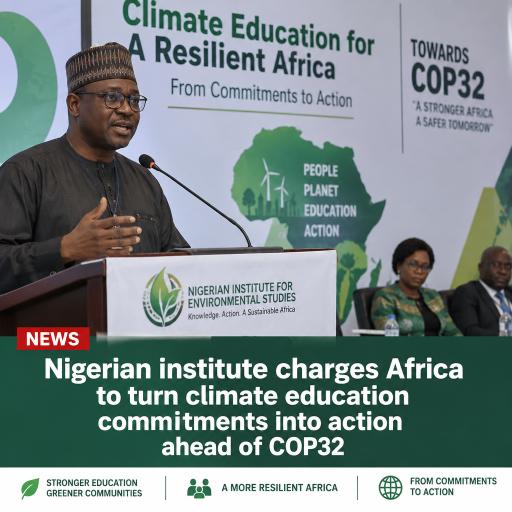
Nigerian institute charges Africa to turn climate education commitments into action ahead of COP32
A Nigerian environmental education institute has urged African governments to convert international climate pledges into funded policies that reshape schools, curricula and teacher training across the continent.
The Institute for Greening Education in Nigeria (IGEN) said Africa’s presence at global climate negotiations must be matched by coordinated national action. It called for long-term financing, clear implementation plans and stronger cooperation among education authorities, climate agencies and development partners.
The appeal follows the conclusion of COP31 in Antalya, Türkiye, where countries remained divided over fossil fuels, climate finance and the speed of emissions reductions. Although the conference ended without a broad political settlement, delegates reached decisions in areas including adaptation and a just transition.
According to IGEN, the result highlights the need for African countries to build climate resilience at home rather than depend solely on progress at international summits. Education, it argued, should be treated as a central climate strategy because young people, teachers and local communities will be responsible for managing worsening environmental risks.
Turning schools into centres of climate resilience
IGEN wants climate change and environmental sustainability incorporated throughout African education systems. This would include revising curricula, improving school infrastructure, training educators and equipping students with practical green skills.
The institute’s priorities align with four major areas of education reform: making school facilities more environmentally sustainable, embedding climate topics in teaching programmes, preparing teachers to deliver climate education and extending learning into surrounding communities.
It also identified youth involvement, teacher leadership, transparent monitoring and institutional accountability as essential. Without measurable targets and designated funding, the institute warned, climate education commitments risk remaining policy statements with little effect in classrooms.
Climate-resilient schools could combine formal lessons with practical measures such as water conservation, waste reduction, tree planting, renewable energy, disaster preparedness and sustainable food production. These initiatives could help learners understand environmental problems while giving communities tools to respond to floods, droughts, extreme heat and ecosystem degradation.
Nigeria’s emerging framework
During COP31, IGEN presented an assessment of efforts to green Nigeria’s education sector and held discussions with education and development stakeholders. The engagements focused on curriculum reform, professional training, green employment skills and infrastructure capable of withstanding climate-related hazards.
One platform highlighted by the institute is Nigeria’s National Greening Schools Programme, backed by the Universal Basic Education Commission. Its climate education intervention is intended to support the inclusion of sustainability principles in schools and strengthen awareness among students and educators.
IGEN has also adopted a five-year strategy covering 2026 to 2030. The plan is expected to guide work on research, teacher development, professional standards, policy design, partnerships and green-skills training.
However, scaling such programmes across Nigeria and the wider continent will require more than pilot projects. Governments would need to coordinate education and climate policies, establish reliable budgets, train sufficient numbers of teachers and ensure that rural and underserved schools are not excluded.
COP32 offers Africa an opportunity
Attention is now turning to COP32, scheduled for Addis Ababa, Ethiopia, from 8 to 19 November 2027. Hosting the conference in Africa could give the continent greater scope to advance education as part of the international climate agenda.
IGEN called for a shared African position developed by governments, education institutions, researchers, civil society organisations and development partners. Such coordination could help countries present common priorities on climate literacy, resilient schools, workforce preparation and financing.
The institute maintained that climate education should no longer be treated as a secondary theme. Instead, it should underpin adaptation, sustainable development and the transition to greener economies.
With Africa facing severe climate impacts despite contributing a relatively small share of historical global emissions, preparing students and communities is increasingly urgent. The challenge before COP32 will be to move from conference declarations to funded programmes that deliver visible changes in schools and everyday life.



Leave a Reply