

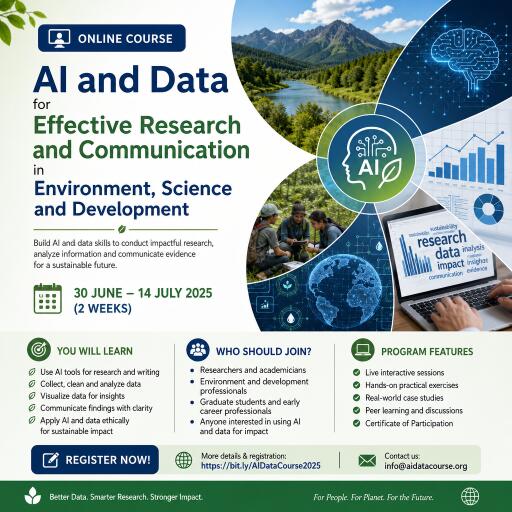
Fwd: Online Course on AI and Data for Effective Research and Communication in Environment, Science and Development | 30 June-14 July
As climate risks intensify and ecological data pours in from satellites, sensors and citizen science, the ability to translate numbers into decisions has never been more vital. A new global online course aims to close that gap by training researchers, communicators and practitioners to use artificial intelligence (AI) and data tools ethically and effectively across environment, science and development.
At a glance
- Schedule: June 30–July 14, 2026
- Workload: Approximately 15 hours
- Delivery: Live sessions on Zoom with a companion learning platform
- Fees: INR 4,000 (India) | USD 100 (global)
Why this matters now
From heatwave attribution to forest-cover change, the pace and complexity of environmental information demand new competencies. AI can rapidly synthesize literature, detect patterns in climate and biodiversity datasets, and help craft targeted outreach for varied audiences, including multilingual communities. Yet impact depends on responsible use—knowing when to deploy a model, how to verify outputs and how to communicate uncertainty. This programme is designed to build those skills so that data moves beyond dashboards to drive real-world action.
What you will practice
- Using AI to accelerate end-to-end research workflows: scoping questions, scanning evidence, drafting and refining outputs.
- Designing data visualizations and multimedia explainers that make complex environmental issues accessible.
- Integrating AI into communication strategies—tailoring messages to audiences, languages and platforms without compromising accuracy.
- Building a practical, responsible-use plan for AI within your project or institution, including verification and ethical safeguards.
Who should join
- Researchers and academics working on environment, science or development topics.
- Science and environment communicators; project managers seeking sharper, evidence-based writing.
- Policy professionals and development practitioners shaping programs and decisions.
- Data analysts and sustainability teams across civil society, government and the private sector (including ESG and corporate communication roles).
Learning design
- Self-paced modules with video lectures, presentations and tutorials supplemented by quizzes and assignments.
- A hands-on project where participants apply tools to a real problem of their choice.
- Structured to fit alongside full-time work or study, with flexible pacing across two weeks.
Curriculum overview
- Module 1 — AI essentials for global challenges: Core concepts, capabilities and limits of AI; opportunities and risks in climate, environment and development contexts.
- Module 2 — Foundations of impactful communication: Principles for clear, inclusive communication; common barriers; frameworks for integrating AI tools without losing rigor.
- Module 3 — AI for research: Formulating and refining research questions; literature mapping and synthesis; effective prompting for high-quality, auditable outputs.
- Module 4 — Data analysis and visualization: Applying AI to clean, analyze and visualize environmental and development datasets; presenting uncertainty and context responsibly.
- Module 5 — Outreach and engagement: Audience-first strategies, multilingual content creation and prompt design for persuasive, ethical storytelling.
Technical requirements
- Computer or laptop
- Reliable high-speed internet connection
What participants gain
- A roadmap to responsibly embed AI into research and communication pipelines.
- Practical experience with tools that save time while improving analytical and narrative quality.
- Skills to transform raw environmental data into insights that inform policy, mobilize communities and guide investment.
Places are intended for a diverse cohort—from labs and newsrooms to field offices and boardrooms—reflecting the cross-sector collaboration required to tackle the climate and development agenda. If your work involves turning complex environmental information into decisions or public understanding, this course is built to help you do it faster, clearer and with greater integrity.



Leave a Reply