

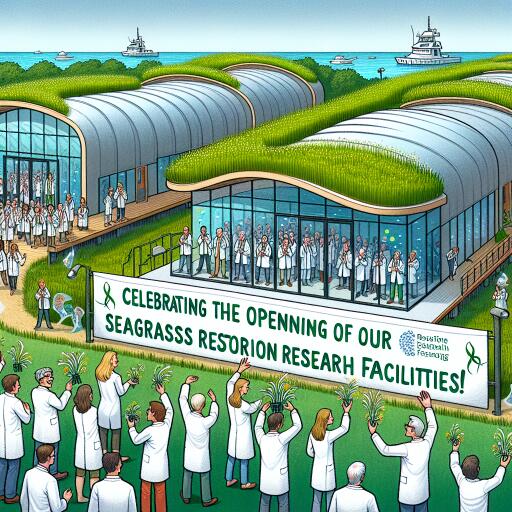
Mote celebrates opening of three seagrass restoration research facilities
On August 25, Mote Marine Laboratory & Aquarium unveiled a trio of advanced research facilities in Sarasota designed to fast-track seagrass recovery across Florida. Housed at the organization’s Aquaculture Research Park on Fruitville Road, the new complex focuses on restoring degraded meadows, boosting ecosystem resilience, and ensuring long-term sustainability for one of the state’s most critical coastal habitats.
Collectively known as the Seagrass Ecosystem Restoration Research Compound (SERRC), the facilities were developed under the Seagrass Restoration Technology Development Initiative, a statewide program launched in 2023 through the Florida Department of Environmental Protection. The goal: develop, test, and deploy restoration tools that are effective, cost-conscious, and environmentally responsible.
Three facilities, one mission
- Ron and Marla Wolf Seagrass Restoration Center for Ocean Sustainability Greenhouse Facility: A controlled-environment hub to accelerate seagrass propagation, stress-test plants for heat and salinity tolerance, and refine scalable outplanting techniques.
- Biogeochemical Carbon Sequestration Lab: A dedicated space to quantify how seagrass meadows store carbon in plant tissues and sediments, link restoration to verifiable “blue carbon” outcomes, and evaluate data frameworks that could underpin long-term financing strategies.
- Publix Seagrass Genetics Research Hub: A genetics engine to safeguard and enhance diversity, identify resilience traits, and guide assisted gene flow so restored meadows can withstand changing conditions.
Earlier this year, Mote distributed a second round of grants through the $10 million initiative to spur innovation among statewide partners and accelerate the transition from pilot projects to wide-scale restoration.
Why Florida’s meadows matter
Seagrass meadows are the quiet workhorses of the coast. They provide nursery habitat for commercial and recreational fisheries, stabilize seafloor sediments, improve water clarity by trapping particles, and store substantial amounts of carbon. Yet many of Florida’s systems have been shrinking under pressure from dredging, nutrient-laden runoff, declining water clarity, and climate-driven stressors.
Science built for scale
Mote’s seagrass program, led by postdoctoral researcher Dr. Dominique Gallery, weaves together genetics, propagation technology, and biogeochemical testing to diagnose loss and design restoration that can scale. The new Sarasota facilities are intended to power Florida’s 10-year Seagrass Restoration Plan by shortening the time between lab discovery and field deployment and by driving down the cost per acre restored.
Collaborations are central to the effort. The Department of Environmental Protection and the University of Florida are partnering with Mote to build a toolkit that is field-ready and environmentally sustainable, from nursery practices to monitoring protocols.
Carbon and community co-benefits
Beyond habitat recovery, researchers are quantifying how restored meadows lock away carbon, an essential piece of the climate puzzle. By pairing rigorous measurements with restoration outcomes, the team aims to inform emerging carbon accounting methods and explore pathways for long-term funding that reward verifiable ecosystem benefits.
Supporters emphasize that the work doesn’t stop at carbon. Thriving seagrass meadows bolster fisheries, enhance water quality, and help buffer coasts from erosion—benefits that ripple through local economies and communities.
From Sarasota to the Keys
To translate lab advances into real-world gains, Mote and the state are establishing a new research and restoration site at Bahia Honda State Park in the Florida Keys. Plans include a land-based nursery to supply resilient seagrass for restoration and expanded education and outreach, giving visitors a window into the science and practice of rebuilding coastal ecosystems.
With the compound now operational, Mote and its partners are positioning Florida for a new chapter in seagrass recovery—one that treats these meadows not just as habitat, but as essential coastal infrastructure for biodiversity, water quality, and climate resilience.



Leave a Reply