

Mahama Launches $10 Billion Initiative for Infrastructure and Job Creation
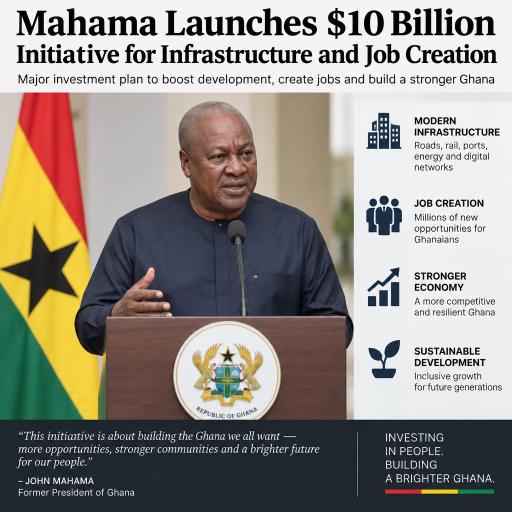
President John Dramani Mahama has unveiled a five-year, $10 billion programme designed to modernise Ghana’s infrastructure, revive unfinished public projects and expand employment opportunities across the country.
Under the Big Push Infrastructure Programme, the government plans to invest approximately $2 billion annually. Road construction and rehabilitation will receive early attention, followed by projects involving schools, healthcare facilities, irrigation systems and other essential public assets.
The initiative is expected to improve connections between communities, markets and production centres. Better transport networks could also reduce travel times and post-harvest losses, although the environmental impact of large construction projects will require careful management.
Investment in employment-intensive industries
Alongside the infrastructure drive, Mahama outlined a separate economic strategy intended to mobilise another $10 billion in domestically financed investment over four years. The funding will be channelled into nine sectors considered capable of generating substantial employment.
Priority areas include agriculture, agro-processing, tourism, energy, pharmaceuticals and textiles. These industries could help Ghana add value to locally produced goods, reduce its dependence on imports and create opportunities for young people.
The administration intends to finance the strategy partly through changes to its fiscal framework. Mahama said the primary balance target agreed with the International Monetary Fund would be adjusted from 1.5% to 0.5%, creating fiscal room equivalent to one percentage point.
According to the president, this additional capacity will be directed towards productive sectors rather than general expenditure. The objective is to stimulate business activity while supporting sustainable job creation.
Economic stability and domestic financing
Mahama said Ghana’s economy was showing signs of stability, pointing to a steadier currency and declining interest rates. He argued that stronger domestic resource mobilisation could allow the country to finance more of its development priorities independently.
However, the scale of the proposed investments makes transparent procurement, effective oversight and careful debt management essential. The long-term value of the programme will depend not only on how much is spent, but also on whether projects are completed efficiently and maintained after construction.
Climate finance remains a major obstacle
The president also raised concerns about the high cost African countries face when seeking finance for climate adaptation. Although the continent is responsible for only a small share of global greenhouse gas emissions, many African governments must borrow at significantly higher rates to address flooding, drought, coastal erosion and other climate-related threats.
Mahama said debt-service payments drain roughly $80 billion from Africa each year, while illicit financial flows account for an estimated additional $90 billion. These losses restrict the resources available for infrastructure, public services and environmental protection.
The challenge has been compounded by a sharp reduction in overseas development assistance. Mahama said such support declined by 23.5% in 2025 and could fall further in 2026. He argued that Africa continues to lose more than $200 billion annually through various financial outflows while receiving less development assistance.
For Ghana, integrating climate resilience into the Big Push will be critical. Roads, irrigation networks, hospitals and schools built today will need to withstand more frequent extreme weather. Environmental assessments, low-carbon construction practices and protection for ecosystems could therefore determine whether the investment delivers durable benefits.
The programme presents an opportunity to address infrastructure gaps while creating jobs and strengthening economic resilience. Its success will ultimately be measured by the quality of the projects, their environmental sustainability and the extent to which communities share in the resulting growth.



Leave a Reply