

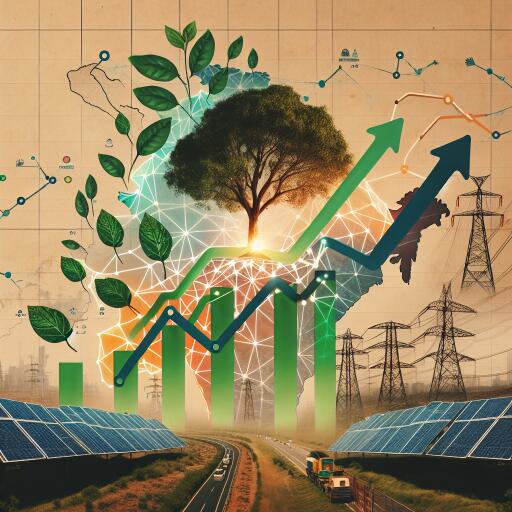
Economic Survey Pushes ‘Growth With Resilience’ Path, Linking Climate Action With India’s Development Goals To 2047
India’s latest Economic Survey sketches a formidable decadal agenda that places climate resilience at the heart of national development. The document argues that reaching developed-economy status by 2047 will not come from choosing between growth and climate action, but from knitting them together into a single, durable strategy.
From trade-off to twin-track strategy
The Survey repositions climate policy as core economic policy. It contends that poverty reduction, job creation, infrastructure expansion and energy security must advance alongside emissions reduction and adaptation. In this framing, a stronger economy is not a rival to climate action; it is the means to better withstand heatwaves, floods, droughts and supply-chain disruptions that climate change is already intensifying.
Central to this approach is “Growth with Resilience,” a pragmatic pathway that prioritizes sequencing and capacity-building over abrupt shifts. The Survey emphasizes:
- Investing in climate-resilient infrastructure and nature-positive planning to reduce future losses from extreme weather.
- Scaling renewable energy at pace while securing grid stability, transmission capacity and storage to avoid volatility.
- Embedding climate risk management in development plans—particularly for agriculture, water, health and urban systems.
- Building institutions and skills to implement, monitor and finance the transition over decades, not just budget cycles.
Resilience begins with development priorities
The Survey’s message is clear: development is part of adaptation. Livelihood security, reliable energy and robust infrastructure expand the capacity of households, firms and governments to absorb shocks. For India, this means doubling down on inclusive growth while integrating climate risk into every sectoral plan—from monsoon-proof logistics and climate-smart agriculture to heat-resilient urban design and coastal protection.
The global context is challenging. As climate politics harden and international support proves uneven, the Survey underscores the importance of domestically anchored solutions and financing models that can scale even when external funds and technologies are slow to arrive.
Cities at the frontline
India’s urban centers generate the bulk of national output, but increasingly confront heat stress, water scarcity, flooding and air pollution. The Survey points toward city-led, locally tailored strategies, recognizing that the needs of a coastal megacity differ sharply from those of inland urban centers.
Key shifts for urban climate leadership include:
- Moving from one-size-fits-all schemes to flexible, outcome-based finance that rewards tangible improvements in air quality, water security and resilient infrastructure.
- Strengthening municipal finances through performance-linked grants, credit enhancement and standardized disclosure to enable city-level green bonds and blended finance.
- Building a pipeline of bankable, climate-resilient projects—from stormwater upgrades to distributed renewable energy and cooling solutions—that can attract private capital at scale.
As preparations gather pace for climate-focused gatherings in Mumbai and beyond, there are signs of growing alignment among public agencies, markets and civil society. Treating climate finance as economic infrastructure—reliable, long-term and countercyclical—can reduce investor risk and accelerate the flow of funds to urban adaptation and mitigation.
Energy transition with reliability
On the power front, the Survey supports fast growth in renewables while giving equal weight to reliability. Storage, flexible generation, advanced forecasting and stronger transmission corridors are presented as non-negotiables to integrate high shares of variable energy without compromising industrial competitiveness or household access.
Complementary measures—energy efficiency across buildings and industry, electrification of transport, and cleaner fuels where electrification is not yet viable—round out a transition designed to protect both growth and grid stability.
Financing resilience
The Survey points to a toolbox that already exists: sovereign green issuances, municipal bonds, viability gap funding, blended finance, and performance-based transfers. The next step is a clear and credible framework that rewards well-governed, well-performing projects and jurisdictions over time. Transparent metrics and regular reporting will be critical to mobilize long-horizon investment from domestic and global pools of capital.
Roadmap to 2047: priorities to scale
- Protect people and assets: invest in climate-resilient housing, transport, water systems and health services, with a focus on vulnerable communities.
- Power the transition: expand renewables alongside storage and grid modernization; double down on efficiency and demand management.
- Back cities to lead: enable outcome-based urban finance, deepen municipal creditworthiness and grow green bond markets.
- Equip institutions: mainstream climate risk into planning, budgeting and regulation; strengthen data, early-warning systems and disaster-response capacity.
- Ensure a just transition: support workers and MSMEs with reskilling, access to finance and technology to cut emissions without sacrificing livelihoods.
By dedicating substantial attention to sustainable development over the coming decade, the Economic Survey redefines climate policy as a pillar of national strategy rather than a peripheral add-on. If implemented with consistency and accountability, “Growth with Resilience” can convert climate risk into an engine for innovation and investment—helping India secure prosperity that endures through the disruptions of a warming world.



Leave a Reply