

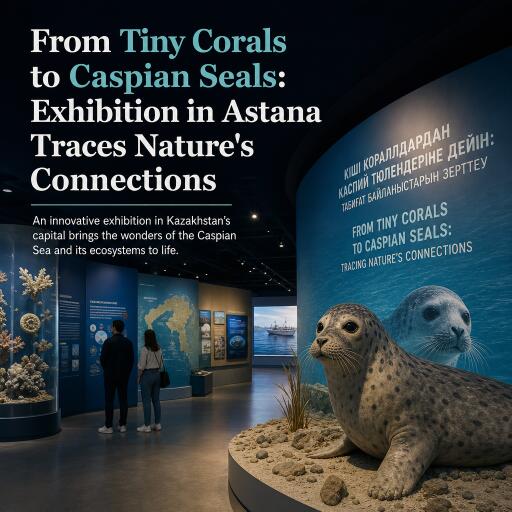
From Tiny Corals to Caspian Seals: Exhibition in Astana Traces Nature’s Connections
From the neon glow of reef-building corals to the quiet haul-out sites of the Caspian seal, life on Earth is bound together by countless, often invisible threads. A new photo exhibition in Astana, opening on Sept. 23 and running through Nov. 1, invites visitors to explore those connections—how microscopic algae, ocean chemistry, and human choices can ripple outward to shape entire ecosystems, including those in Kazakhstan.
Revealing an “Invisible World”
Titled “Invisible World: A City Underwater,” the exhibition immerses audiences in the intricate relationships that sustain marine life. It travels from laboratories and reef flats to the shores of the Caspian Sea, tracing the links between species, habitats, and people. The show underscores a simple idea with far-reaching implications: what happens in one corner of nature rarely stays there.
Engineering a Coral Sunrise
Among the featured stories is a pioneering effort to help corals reproduce under carefully controlled conditions. In a London laboratory, marine biologist Jamie Craggs and collaborators with Coral Spawning International replicated the subtle cues that trigger corals to release their eggs and sperm—timing, temperature, moonlight, even the rhythm of tides. This approach offers a way to produce young corals with robust genetic diversity, a crucial resilience factor as oceans warm and acidify.
The work has since extended to the Seychelles through Nature Seychelles’ Assisted Recovery of Coral (ARC) Programme. Rather than relying on fragments, the project grows corals through sexual reproduction, yielding genetically varied offspring better able to withstand future stress. Early progress is striking: roughly 65,000 young corals have settled and begun to grow, a small but significant foothold for reef recovery.
Why Reefs Matter—Far Beyond Their Colors
At first glance, corals captivate with color, much of it lent by symbiotic algae living inside their tissues. This partnership fuels reef growth, but it is fragile. When waters heat beyond the comfort zone, corals become stressed and expel their algae, turning ghostly white—a process known as bleaching. Prolonged stress can lead to mass mortality.
Reefs are more than beautiful architecture. They anchor ocean food webs, shelter juvenile fish, and help buffer shorelines from storms. Their fate is tied to the stability of fisheries, coastal economies, and biodiversity far beyond the tropics. As one exhibition contributor from Canon’s Kazakhstan office noted, the lesson resonates even in a landlocked nation: changes sweeping through distant seas can reverberate through climate, trade, and ecosystems closer to home.
Signals from the Caspian
Those reverberations are visible in Kazakhstan’s own waters. The Caspian seal—found nowhere else on the planet and listed in Kazakhstan’s Red Book—inhabits a sea in flux. Long-time field research led by scientist Assel Baimukanova documents what these changes look like on the ground (and ice): seals adjusting their resting sites, altered social behavior, and growing pressures from shipping, fishing activity, pollution, and a warming climate.
Seals act as sentinels. Their health reflects the health of the Caspian Sea, offering scientists an early warning system for ecological stress. Observing these animals over time can reveal shifts in prey availability, contaminant exposure, and habitat quality—insights that inform conservation and policy. Exhibitions like this one help bridge lab and landscape, bringing complex science into public view and stirring a broader conversation about stewardship.
Art, Science, and an Underwater Walk
The exhibition gathers a diverse group of contributors. Photographs by Mirgaliy Baimukanov, Dmitry Malakhov, wildlife photographer Vladislav Yakushkin, and birdwatcher Gennady Dyakin capture life above and below the waterline, from fleeting animal encounters to quiet ecological patterns. The collection also features work by scientist and photographer Assel Baimukanova, whose images of Caspian seals open an intimate window onto a species under pressure. Designers Vladimir Timokhanov and Timofei Bannikov add finely rendered illustrations of rare fish, translating field notes into striking visual narratives.
Beyond still images, a virtual reality experience invites visitors to “step into” a reef, drift among branching corals, and witness the bustle of life that so often goes unnoticed. The technology complements the photographs, offering a visceral sense of scale—from the microscopic algae that energize corals to the complex communities that reefs support.
One Planet, Many Currents
“Invisible World: A City Underwater” ultimately asks a deceptively simple question: how do our choices, large and small, echo through ecosystems we may never see? The answers unfold across coral spawning tanks, tropical bays, and the wind-brushed surface of the Caspian. By linking these stories, the exhibition reframes distance—not as separation, but as a network of currents, migrations, and feedbacks that bind oceans to inland seas, and global biodiversity to local responsibility.
On display in Astana through Nov. 1, the show offers a rare chance to witness the hidden architecture of life—and to consider how safeguarding reefs and seals alike can help steady the living systems we all depend on.



Leave a Reply