

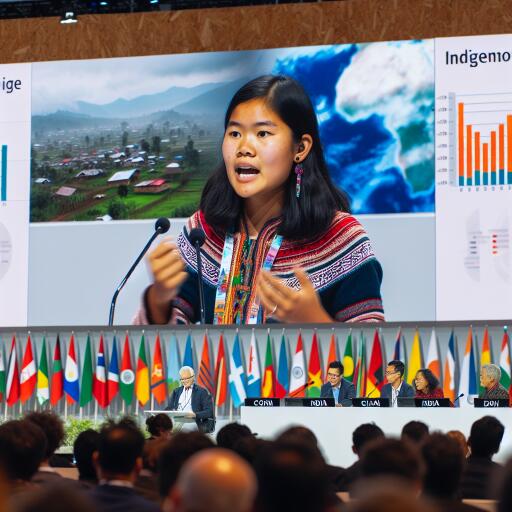
Nagaland’s Chubbamenla Jamir leads Indigenous voices at Asia Climate Summit
Quy Nhon, Vietnam — As climate hazards intensify across Asia’s most fragile landscapes, Dr. Chubbamenla Jamir of Nagaland stepped to the fore at a regional climate summit in Quy Nhon, held from 25–27 November 2025. The Director of the Native Foodscape Foundation (Delhi) and a Board Member of the Asian Mountain Academic Network used the platform to push for policies that place Indigenous mountain communities at the heart of climate decision-making.
Over three days, climate researchers, policy architects and regional practitioners convened to examine rising risks and forge collaborative pathways. Dr. Jamir’s interventions repeatedly redirected attention toward the lived realities of people who inhabit Asia’s highlands—communities contending with shifting rainfall, destabilized food systems, thinning forests, and biodiversity loss. Drawing on years of work at the interface of food systems, ecology and traditional knowledge, she argued that resilience will remain elusive unless strategies are designed with, and accountable to, the people most exposed.
From science to society: connecting the dots
The summit was structured around a Science–Impacts–Society approach, emphasizing that climate intelligence must connect with community priorities and public policy. In sessions focused on the multi-scale climate–air–water nexus, Dr. Jamir highlighted how warming and variability are cascading through mountain watersheds—altering springs and streams, reshaping forest resources, straining agriculture, and affecting public health. She urged responses that recognize interdependence across ecosystems and cultures, and that function across scales—from village to basin to region—rather than in isolated, sector-by-sector silos.
Co-creating solutions with mountain communities
A central outcome of the gathering was to chart joint pilot efforts that could accelerate adaptation across Asia. In those discussions, Dr. Jamir pressed for power-sharing in project design and evaluation. Pilot initiatives, she stressed, should move beyond extractive data collection to models where Indigenous peoples are knowledge partners and decision-makers. Only then can interventions reflect local ecological insight, strengthen cultural continuity and deliver benefits that last.
Building a coalition for action
The workshop was convened by a coalition of regional and global partners, including the World Climate Research Programme’s Coordinated Regional Climate Downscaling Experiment (WCRP-CORDEX), the Swedish Meteorological and Hydrological Institute, Future Earth, the UK Met Office’s WISER Asia Pacific programme, the Manila Observatory, and other regional collaborators. Their shared goal: align cutting-edge climate science with equitable, evidence-based pathways that respond to Asia’s accelerating risks.
A rising voice from Northeast India
Dr. Jamir’s presence in Quy Nhon followed a strong showing at the International Mountain Conference earlier this year, where she helped bring global attention to the ecological fragility and cultural richness of Northeast India’s highlands. That momentum carried into Vietnam, where she again positioned Indigenous stewardship—rooted in adaptive resource management and deep place-based knowledge—as a cornerstone of climate resilience.
Why Indigenous expertise matters now
The institutions behind the summit are closely tied to efforts that inform international climate and risk reduction agendas, including the Paris Agreement, the UNFCCC process, the Sendai Framework, and the Sustainable Development Goals. Within that context, Dr. Jamir’s contributions underscored a fundamental shift: climate policy is strongest when it blends robust science with Indigenous ways of knowing that have sustained landscapes for generations. That synthesis can guide water governance, forest restoration, agroecology and public health in ways that are both credible and just.
In Quy Nhon, the message landed with clarity. Mountain communities have protected Asia’s headwaters, forests and biodiversity through centuries of stewardship. As the climate crisis deepens, their voices and leadership are not optional—they are essential. By elevating those voices and insisting on co-created solutions, Dr. Jamir helped set a tone for climate action that is rigorous, inclusive and ready to scale.



Leave a Reply