

Indian Army Intensifies Search Efforts After Deadly Himalayan Flood
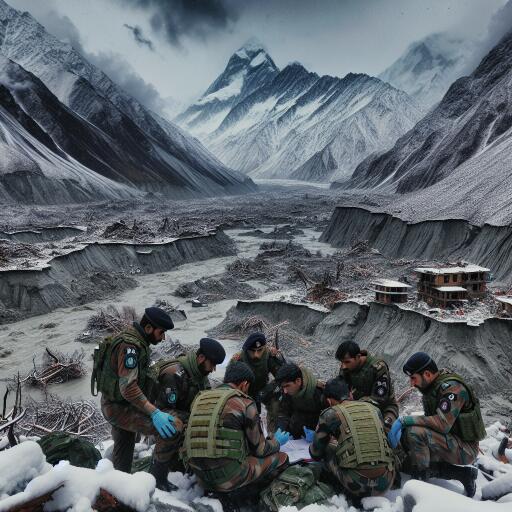
In the wake of devastating flash floods that swept through the narrow valleys of the Himalayas, the Indian army has ramped up its search and rescue operations. Utilizing sniffer dogs, drones, and robust earth-moving machines, efforts to locate the missing continue in earnest following a catastrophic surge of muddy water and debris.
The disaster unfolded when an overwhelming wall of water and debris descended upon the town of Dharali in Uttarakhand state. The torrent has tragically claimed at least four lives, and over 50 people remain unaccounted for. The calamity highlights the looming threat of climate change, which experts suggest is amplifying the frequency and intensity of such natural disasters. While monsoon-triggered floods and landslides are common between June and September, urban development and rising global temperatures are compounding their impact.
Torrential rains characteristic of the monsoon season are hindering rescue activities, damaging communication lines, and complicating coordination efforts. Nonetheless, the tally of missing individuals has seen a decrease, as military personnel and rescue teams manage to reach trapped people in isolated areas. Initially, around 100 individuals were reported missing late on Tuesday.
An official from the National Disaster Response Force, Mohsen Shahedi, stated, “The search for the missing is ongoing.” Harrowing footage shared on Indian news outlets displayed the terrifying wave of water as it obliterated apartment complexes within the tourist-centric region.
According to Shahedi, the town of Dharali alone accounts for over 50 missing individuals, with 11 soldiers reported missing from the nearby village of Harsil. “Additional army detachments, provided with tracker dogs, drones, and earthmoving tools, have been dispatched to expedite the rescue work,” the army reported.
In addition to ground operations, military helicopters are delivering vital supplies and evacuating stranded residents, despite adverse weather conditions, including rain and fog, complicating flight operations.
Uttarakhand’s Chief Minister, Pushkar Singh Dhami, attributed the flood to an intense “cloudburst” and emphasized that rescue efforts are being conducted on a critical “war footing.” Videos capture scenes of individuals desperately fleeing from the onrush of debris as buildings crumbled in the floodwaters’ wake.
A local resident, Suman Semwal, recounted to a national newspaper how his father saw the flood surge into Dharali with a foreboding “rumbling noise,” stemming from higher ground. “The scale was beyond comprehension,” Semwal described. “They tried to shout, but the roar of the waters drowned everything out,” he added, detailing the abrupt onslaught of the floodwaters that struck within seconds.
Massive amounts of mud coated the area, reaching depths of up to 50 feet in some locations, entombing structures in its path. Images shared by rescue teams reveal the arduous process of manually clearing rock debris and utilizing heavy machinery to forge accessible routes.
Weather services have cautioned that principal rivers throughout Uttarakhand are breaching danger thresholds, prompting authorities to relocate residents to higher ground.
Last year, the World Meteorological Organization highlighted that escalating incidents of severe floods and droughts signal a growing unpredictability in the Earth’s water systems due to climate change.
Hydrologist Manish Shrestha noted that the 270 millimeters (10 inches) of rainfall recorded in just 24 hours qualifies as an “extreme event.” Citing the International Center for Integrated Mountain Development, Shrestha expounded on the intensified impact such rainfall has in mountainous regions compared to plains. “These significant rainfall events are becoming more prevalent and may be associated with climate change,” he asserted.
Echoing the sentiments of caution, Harjeet Singh, a climate activist from the Satat Sampada Climate Foundation in New Delhi, affirmed that “irresponsible and haphazard construction under the guise of development is undermining our natural defenses.” He issued a stark reminder: “Global warming is invigorating our monsoons, catalyzing extreme rain. The catastrophic damages serve as an urgent wake-up call.”
As rescue efforts persist, the grim reality of climate change is underscored, serving as an imperative reminder of the urgent need for sustainable development and climate action.



Leave a Reply