

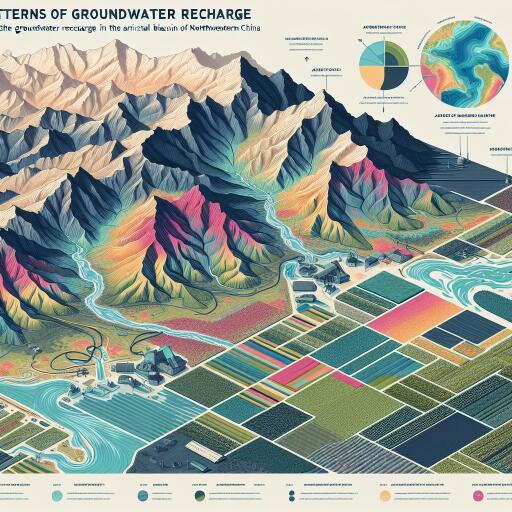
Groundwater Recharge Patterns in NW China’s Agricultural Basin
Deep within northwest China lies a vast agricultural drainage basin, pivotal for not only agriculture but also the complex hydrological systems that govern groundwater resources. Recent investigations into the characteristics and factors shaping groundwater recharge in this region uncover urgent insights essential for maintaining ecological balance and agricultural productivity.
Groundwater recharge — a crucial mechanism where surface water infiltrates underground aquifers — plays a fundamental role in sustaining environmental health and agricultural success in arid regions like northwest China. The variability of recharge rates across time and geographical space hinges on a mix of climatic, land use, geological, and human activities. Advanced analytical techniques now allow for more detailed mapping and understanding of these variations, vital for a region beset by water scarcity.
The comprehensive analysis at the heart of this work integrates hydrological datasets with satellite imagery, revealing the nuances of how groundwater recharge responds seasonally, yearly, and geographically within the drainage basin. This dynamic water environment, with its myriad drainage channels and irrigation frameworks, reacts sensitively to fluctuations in precipitation, evapotranspiration, and human-assisted water management.
A notable discovery from this research is the identification of specific hotspots where recharge rates are markedly higher. Favorable conditions such as porous and permeable soils, and proximity to lakes and wetlands enhance infiltration. In stark contrast, areas characterized by compacted soils or intensive farming exhibit reduced recharge, underscoring the adverse impact of extensive land use.
Seasonal patterns emerge prominently, with the spring thaw and early summer seeing peak recharge rates due to optimal rainfall and moderate evapotranspiration demands. However, climate-induced interannual variability complicates this scenario. Drought years or delayed rains precipitate a sharp decline in recharge, intensifying the long-term pressures on groundwater reserves critical for agriculture.
Human influences, including the extent of groundwater extraction and efficiency of irrigation practices, significantly impact recharge dynamics. Inefficient irrigation systems promote excessive runoff and evaporation, curtailing infiltration, whereas water-saving technologies can facilitate greater subsurface percolation. These management practices offer a controllable measure to either exacerbate or alleviate groundwater depletion.
Furthermore, climatic parameters such as temperature, wind speed, and humidity dynamically influence the delicate balance between surface water availability and soil moisture retention. Rising temperatures trigger higher evapotranspiration rates, reducing net water available for recharge — a pattern reflected globally but meticulously documented here.
Integrating satellite data with rigorous ground-based hydrological measurements provides a holistic view of how landscape alterations, driven by agricultural expansion, reshape the water cycle. This approach offers a replicable framework for harmonizing agriculture with groundwater preservation on a broader scale.
The implications for regional water management are profound, as northwest China faces increasing challenges from climate change, population growth, and heightened irrigation needs. By understanding recharge variability and its driving factors, more precise interventions can be tailored to balance agricultural demands with sustainable groundwater use.
Adaptive management responsive to real-time hydrological feedback is crucial. This involves predictive modeling, continuous monitoring, and flexible water policies that adjust to forecasted recharge, thereby protecting this invaluable natural resource.
Beyond scientific findings, this study highlights the socio-economic impact of groundwater recharge management. The livelihoods of farming communities depend intensely on water availability, with fluctuations translating into harvest unpredictability and economic fragility. Integrating social considerations into hydrological models could advance equitable resource distribution and informed decision-making.
Forward-thinking strategies should incorporate multidisciplinary research linking hydrology, soil science, climate modeling, remote sensing innovations, and socio-economics to enhance predictions under varying environmental conditions. Collaborative efforts will be key in anticipating and addressing the effects of accelerated environmental changes worldwide.
This research exemplifies how detailed regional assessments can illuminate wider global challenges, particularly groundwater management — a crucial but often overlooked water reserve. As the globe grapples with increasing water demand and climatic shifts, insights from such localized studies become all the more valuable.
Ultimately, this work provides a detailed snapshot of how interactions among natural and anthropogenic factors govern groundwater patterns. The insights garnered offer not only academic enrichment but serve as critical tools for policymakers, farmers, and environmental advocates seeking to protect groundwater resources under mounting pressures.
Using advanced spatial and temporal analysis techniques, this investigation lays the foundation for more informed water governance transcending conventional approaches. It is a substantive call for continued investment in monitoring infrastructure, interdisciplinary research, and community engagement to tackle the intertwined issues of food security and water sustainability in a crucial agricultural region of China.
Though focused on northwest China, the relevance of these findings extends beyond, providing valuable insights and methodological approaches applicable to arid and semi-arid agricultural zones globally. As we face growing urgency in addressing global water security challenges, detailed analyses like this are crucial in shaping resilient and sustainable future pathways supported by science and inclusive stewardship.



Leave a Reply