

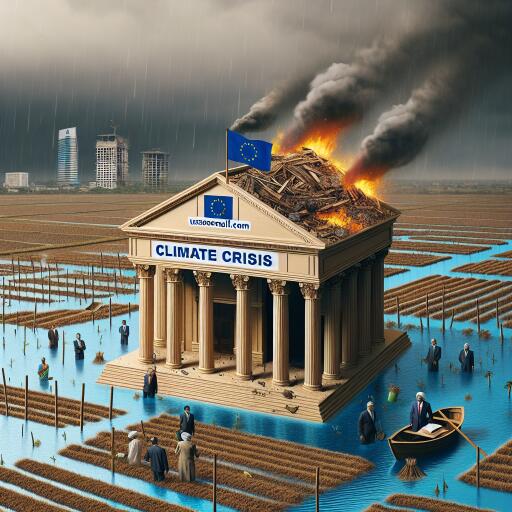
Why Pakistani farmers are suing two German firms for lethal 2022 floods | Climate Crisis | USAEMALL.com
On the wall of a village school in Baid Sharif, Dadu district, a pale brown line still marks where the waters stopped rising. For farmers here, that watermark is a memory carved into cement: a reminder of the night the river widened into an inland sea and swallowed homes, fields, and the certainty of the next harvest.
In 2022, Pakistan endured the most destructive floods in its recorded history. More than 30 million people were displaced, over 1,700 lives were lost, and millions of acres of cropland were swamped. Damage and economic losses were estimated at around $40bn. In Sindh, where agriculture underpins rural livelihoods, entire communities watched their granaries dissolve and their soils turn to sludge.
From inundated fields to a German courtroom
Nearly four years on, 39 smallholder farmers from Sindh are pursuing a novel legal strategy: they have filed a civil suit in Heidelberg against two major German corporations—RWE, a leading European power producer, and Heidelberg Materials, one of the world’s largest cement manufacturers. The claim argues that the companies’ historic greenhouse gas emissions contributed to planetary warming, intensifying monsoon rains and amplifying the floods’ severity in Pakistan.
The farmers’ counsel, a European human rights and environmental legal group, says Germany’s judiciary has become a key venue for transboundary climate litigation. The case contends that physical distance does not dilute responsibility: emissions released in industrial hubs can drive harm thousands of kilometers away by loading the atmosphere with heat-trapping gases.
Researchers have long documented that a relatively small set of fossil fuel and cement producers account for a large share of industrial greenhouse gas emissions. The plaintiffs say the defendants fall within that cohort and are seeking a share of damages proportionate to their contribution to climate change, as well as practical measures that would help rural communities adapt and rebuild.
What’s at stake beyond one lawsuit
Advocates describe the case as a test of how courts can assess causation and apportion climate responsibility. If accepted, it could influence future negotiations over loss and damage finance and shape how liability is understood when emissions and impacts are separated by borders and decades.
Germany has already seen a growing wave of climate and corporate accountability claims. A decade after a deadly 2012 factory fire in Karachi sparked cross-border litigation and compensation discussions with a German buyer, lawmakers introduced a supply chain law in 2023 aimed at curbing labor and human rights abuses tied to companies’ global operations. While that statute does not directly govern climate liability, it signals that obligations can travel along transnational value chains.
Company responses and legal headwinds
RWE has criticized such climate lawsuits as attempts to move policy debates into courtrooms, warning they could chill investment and undermine legal certainty for firms that comply with existing regulations. Heidelberg Materials has acknowledged receiving legal notice in the Pakistan case but has not publicly detailed its position on the suit.
Any trial would likely probe complex questions: how to attribute a portion of a specific disaster to long-term emissions; what share of liability, if any, belongs to public authorities and national infrastructure shortcomings; and which remedies are feasible and fair. Courts elsewhere have begun to entertain these ideas—signaling in principle that emitters could face responsibility for climate harms—though outcomes vary and evidentiary thresholds remain high.
Lives remade by water
In Dadu, the legal arguments feel abstract next to the daily arithmetic of survival. One farmer recalls hauling sacks of grain to a narrow ribbon of road that stayed dry while the village drowned. He slept beside the pile for weeks to keep it safe. Much of what he salvaged later spoiled.
Villagers describe patchy public support in the aftermath and say many families relied on charity to eat and to patch roofs. Some still live in tents on raised ground. With limited faith in local courts—where disputes can languish for years—the farmers see a distant bench as their best shot at redress, or at least at visibility.
They say compensation would stretch beyond individual claimants: it could help rebuild homes, repair irrigation channels, and restore soils stripped of nutrients by standing water. A few speak about buying salt-tolerant seed varieties and better storage to protect future harvests. Others want training and tools to adapt to an era of hotter summers, erratic rains, and sudden floods.
Accountability abroad, resilience at home
Environmental advocates in Pakistan support efforts to hold major emitters to account but insist that domestic choices matter, too. Even with the country’s relatively small contribution to global emissions, they argue, policies that lock in coal power or ignore industrial pollution undercut resilience. Strengthening local governance, modernizing flood management, and investing in climate-smart agriculture, they say, must move in step with international claims for justice.
That dual track—seeking responsibility from afar while rebuilding at home—reflects a broader reality of the climate crisis: those who did least to cause it often bear the steepest costs, and the tools to manage risk are unevenly distributed.
Waiting on a ruling—and the rains
The Heidelberg court is reviewing the farmers’ complaint. However it proceeds, the case highlights a legal frontier where science, equity, and accountability collide. A judgment or even a rigorous evidentiary process could shape strategies from boardrooms to village councils.
Back in Baid Sharif, the watermark doesn’t fade. As another monsoon approaches, farmers are planting again, measuring the sky against the memory of that terrible season. They say the lawsuit is a bid for fairness, but they also know that, win or lose, their resilience will still be tested on the land—one harvest, one flood, one dry patch of road at a time.



Leave a Reply