

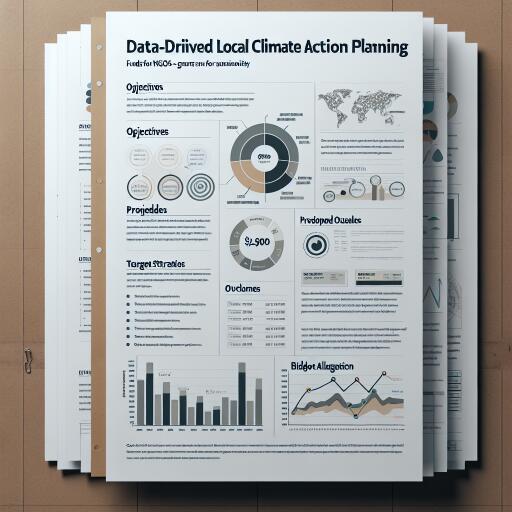
A Sample Grant Proposal on “Data-Driven Local Climate Action Planning” – fundsforNGOs – Grants and Resources for Sustainability
As heatwaves intensify, storm patterns shift, and sea levels creep upward, municipal leaders face decisions that can no longer be made on intuition alone. This proposal outlines a practical, community-centered approach to equip local governments with the data, tools, and capacity to craft actionable climate plans that reduce emissions, protect vulnerable populations, and guide resilient investment.
Problem Statement
Across towns and cities, climate information exists but is rarely integrated into everyday planning. Many municipalities operate with outdated datasets, limited analytical capacity, and fragmented systems. The consequences include misdirected resources, inequitable outcomes for low-income and marginalized communities, and climate strategies that lack prioritization, timelines, and measurable targets.
Overall Goal
Enable evidence-based, inclusive local climate action planning that links risk, emissions, and social vulnerability data to concrete policies, budgets, and projects.
Specific Objectives
- Build local capacity to collect, manage, analyze, and interpret climate and socio-economic data.
- Develop integrated climate action plans with clear mitigation and adaptation targets, timelines, and indicators.
- Institutionalize community participation—especially from frontline groups—throughout planning and monitoring.
- Establish data governance, open-data practices, and reporting that foster accountability and learning.
Approach
The project combines technical assistance, participatory processes, and low-cost digital tools to convert raw information into policy-ready insights. It emphasizes co-design with local staff and communities to ensure plans are feasible, equitable, and budget-aligned.
Key Activities
- Baseline Assessment: Map existing datasets, gaps, and workflows; review current plans and regulations.
- Data Infrastructure: Set up shared data standards, metadata, and a centralized repository; provide simple dashboards for non-technical users.
- Risk and Emissions Analysis: Develop local hazard maps; compile greenhouse gas inventories; identify major sources and exposure hotspots.
- Prioritization Framework: Apply a multi-criteria approach that weighs emissions reduction, risk reduction, cost, co-benefits, and equity.
- Participatory Planning: Conduct workshops, focus groups, and street-level surveys to capture lived experience and local knowledge.
- Action Plan Drafting: Define measures, timelines, responsible agencies, funding pathways, and measurable indicators.
- Budget Integration: Align actions with municipal budgets and identify external finance opportunities.
- Monitoring and Reporting: Create a results framework, open-data portal, and performance scorecards.
Data and Tools
- Datasets: Historical weather, climate projections, flood and heat risk, land use, transport, building energy, waste, demographics, health, and social vulnerability.
- Tools: Open-source GIS, basic statistical software, emissions calculators aligned with recognized protocols, and accessible dashboard platforms.
- Standards: Clear documentation, reproducible methods, and versioned datasets to ensure continuity across administrations.
Community and Equity Commitments
- Targeted outreach to neighborhoods facing the highest risk or energy burden.
- Co-created indicators that track benefits such as reduced heat exposure, safer mobility, and affordable access to clean energy.
- Compensation for community participation, childcare and translation at meetings, and mobile engagement for residents with limited internet access.
Monitoring, Evaluation, and Learning
- Outputs: Staff trained; datasets standardized; dashboards launched; climate inventories completed; plan approved by council.
- Outcomes (1–3 years): Priority projects funded; measurable emissions reductions from key sectors; reduced exposure to heat and flooding for high-risk groups.
- Indicators: Emissions by sector, share of budget aligned with climate actions, number of residents engaged, percentage of actions on track, and equity metrics.
- Learning Cycle: Quarterly data reviews, annual public reports, and adaptive management to refine actions.
Governance and Partnerships
- Lead Agency: Municipal sustainability or planning department, with defined roles for public works, transportation, housing, and finance.
- Advisory Group: Community leaders, youth representatives, small business, academia, and utilities.
- Technical Partners: Local universities or research centers providing analytics and quality assurance.
Timeline and Budget Snapshot
- Months 1–3: Baseline assessment, data governance setup, training plan.
- Months 4–9: Analysis, community engagement, prioritization framework.
- Months 10–15: Draft plan, budget integration, pilot projects scoped.
- Months 16–18: Final plan adoption, dashboards live, M&E framework launched.
Budget categories include personnel and training, data acquisition and tooling, community engagement, analysis and modeling, and monitoring and communications. Cost-sharing by municipal departments strengthens long-term ownership.
Expected Results
- A citywide, evidence-based climate action plan with sector-specific targets and timelines.
- Institutional systems that maintain high-quality, accessible data.
- Financing-ready project pipeline for mitigation and resilience.
- Transparent reporting that builds public trust and supports course-correction.
- Demonstrable benefits for vulnerable communities and improved climate preparedness across the city.
Sustainability and Scale
The project embeds skills within municipal teams, uses open tools that avoid vendor lock-in, and establishes policies for data stewardship. Peer learning among neighboring jurisdictions enables replication and cost savings. Over time, the city can integrate climate metrics into procurement, zoning, and capital planning, mainstreaming action beyond the project window.
Risk Management
- Data Gaps: Use best-available proxies and document assumptions; update as new data arrives.
- Staff Turnover: Provide comprehensive documentation, modular training, and cross-department capacity.
- Political Shifts: Anchor actions in co-benefits like public health, cost savings, and job creation.
- Community Fatigue: Schedule predictable engagement, close feedback loops, and show visible early wins.
Conclusion
Data alone does not deliver climate progress—people, processes, and accountability do. By uniting rigorous analysis with inclusive participation, this proposal gives local governments a clear path from climate ambition to measurable results, ensuring that every decision is informed, equitable, and resilient.



Leave a Reply