

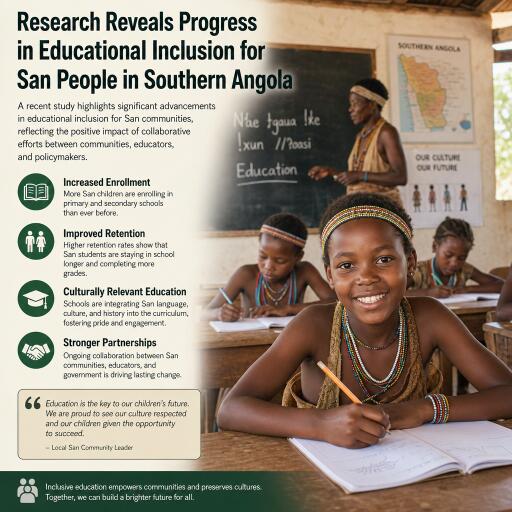
Research Reveals Progress in Educational Inclusion for San People in Southern Angola
A new field study by the Center for Research and Development in Education (CIDE) at ISCED-Huila finds that access to schooling for San communities varies sharply across southern Angola. Huila province shows comparatively better inclusion than neighboring Cunene and Cubango, yet high levels of educational exclusion persist across all three regions.
Conducted over two years, the research engaged 975 San households—comprising 3,735 people—across multiple municipalities. The results were presented at a technical seminar held in the three provinces, underscoring that meaningful gains in education remain uneven and fragile without tailored public policies.
Uneven progress by province
Huila represented about 60 percent of the total sample, with surveys in Cacula, Chibia, Lubango, Jamba, Quipungo, and Matala. While Huila is comparatively ahead, the figures reveal deep gaps: 65.9 percent of San people surveyed there reported having no formal education, and roughly 30 percent had experienced some level of schooling. Within the province, the picture is far from uniform—Jamba Mineira and Chibia stand out for severe exclusion, with more than 90 percent of respondents lacking formal education.
In Cunene, exclusion is even starker. Data from Cuanhama, Cuvelai, and Namacunde show that 98.8 percent of those surveyed had never attended formal school. A compounding barrier emerged in Namacunde, where many San people lack civil identification documents, further restricting access to schooling, social protection, and basic services.
In Cubango, the study covered Menongue and Cuito Cuanavale. Researchers observed a strong reliance on gathering and small-scale subsistence activities. According to the study coordinator, Vladi Pereira, wild fruits, honey, and mushrooms remain central to food security, while agriculture and livestock provide the economic backbone for many families.
Water insecurity and its ripple effects
The research illuminates an environmental dimension that directly intersects with education. Around 80 percent of surveyed families depend on untreated water drawn from streams and unprotected wells, often walking significant distances to collect it. Time lost to water collection reduces children’s study hours and school attendance, and exposure to waterborne illness compounds absenteeism—especially in remote settlements.
These challenges are intensified by climate variability. Recurrent drought and erratic rainfall amplify pressure on natural resources, pushing families to prioritize immediate survival over long-term investments like schooling. Water stress also undermines local agriculture and livestock, reinforcing cycles of vulnerability that disproportionately affect Indigenous communities such as the San.
Culture, climate, and continuity
The findings suggest that shifts in diet and livelihoods—driven in part by changing environmental conditions—are reshaping traditional practices. As hunting-and-gathering landscapes are altered by climate stressors and as market foods become more prevalent, cultural continuity faces mounting pressures. Community leaders and researchers warn that without safeguards for land access, nutrition, and education, the San face profound risks to their way of life and cultural survival.
Key takeaways
- Huila leads the three provinces in educational inclusion for San communities, but exclusion remains high overall.
- Cunene shows the most severe educational exclusion, with 98.8 percent of surveyed individuals reporting no formal schooling.
- Lack of civil identification—particularly noted in Namacunde—blocks access to education and essential public services.
- In Cubango, reliance on wild foods persists alongside small-scale farming and livestock, reflecting both cultural resilience and environmental constraints.
- Roughly 80 percent of families surveyed use untreated water sources, affecting health and school attendance.
What needs to change
The study points to a package of targeted measures that could accelerate inclusion while respecting cultural identity:
- Mobile and community-based schools that move with families and align with seasonal livelihoods.
- Expanded civil registration campaigns to ensure every person has the documents needed to enroll in school and access healthcare and social programs.
- Safe water infrastructure—protected wells, boreholes, and water purification—to reduce illness and the time burden of water collection.
- Health services tailored to remote communities, including mobile clinics and vaccination outreach.
- Culturally relevant curricula and instruction in local languages to improve learning outcomes and school retention.
Why it matters now
Education is a critical lever for resilience in the face of climate change. For San families in southern Angola, inclusive schooling—paired with secure access to water, health, and identity documents—can open pathways to better livelihoods while sustaining cultural knowledge. As the study highlights, modest advances in Huila demonstrate what is possible, but the scale of exclusion in Cunene and persistent barriers across Cubango signal the urgency of a coordinated response.
Turning research into action will hinge on long-term investment and partnerships rooted in community priorities. With locally informed policies and climate-smart services, educational inclusion for the San can move from fragile progress to lasting change.



Leave a Reply