

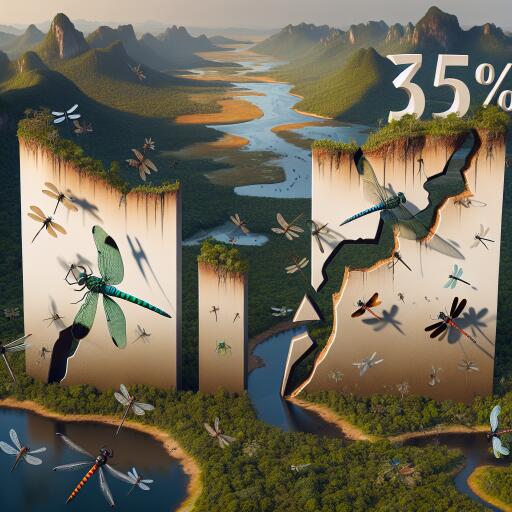
35% gap in new odonate study indicates mounting ecological stress in Western Ghats
A sweeping two-year assessment of dragonflies and damselflies across the Western Ghats has uncovered a striking shortfall in species detections, pointing to deepening freshwater stress in one of the world’s most celebrated biodiversity hotspots. Covering 144 sites from Gujarat to Kerala between February 2021 and March 2023, the survey documents 143 odonate species—substantially fewer than the roughly 200 historically reported from the region. The gap, approaching a third of expected diversity, signals accelerating ecological strain across rivers, streams, ponds, lakes, and wetlands.
Odonates are highly sensitive to water quality, habitat structure, and flow regimes; their life cycles are tightly bound to freshwater habitats. When these insects vanish or decline, it often precedes broader ecosystem failures affecting fish, amphibians, birds, and people who depend on clean water. The new dataset, generated through extensive fieldwork by collaborating researchers from Pune and a national odonate network, offers a rare, standardized baseline for the entire mountain chain.
Key findings at a glance
Despite difficult access, complex terrain, and permitting hurdles, the team confirmed 143 species across varied habitats, including 40 species found nowhere else on Earth. Yet this tally falls well short of historical expectations, revealing a notable contraction in observed diversity.
- Maharashtra: 105 sites surveyed; 100 species recorded, including 12 endemics.
- Kerala: 14 sites; 83 species, 33 endemics.
- Karnataka: 17 sites; 64 species, 6 endemics.
- Goa: 3 sites; 35 species, 4 endemics.
- Gujarat: 5 sites; 18 species, no endemics.
A pronounced north–south gradient emerged: diversity is consistently higher in the southern Western Ghats and relatively lower in the northern ranges. This pattern aligns with long-standing differences in rainfall, habitat continuity, and human pressure, but it also flags recent losses and fragmentation where development has accelerated.
Three species detected—Elattoneura souteri, Protosticta sanguinostigma, and Cyclogomphus ypsilon—are currently listed as Vulnerable on the IUCN Red List. A large portion of recorded taxa remain Data Deficient or Not Evaluated, underscoring how little is still known about the conservation status of freshwater invertebrates in the region.
Signals from a stressed freshwater network
Multiple, overlapping threats are converging on the Western Ghats’ aquatic corridors and headwaters:
- Linear infrastructure—highways, railways, and transmission lines—slices through riparian zones, isolating breeding habitats and altering microclimates.
- Hydropower and water diversion projects reshape flow regimes, strand larvae, and simplify channel structure essential for odonate life cycles.
- Pollution from settlements, mining, and agriculture degrades water quality and boosts eutrophication, reducing habitat suitability.
- Land-use change, including rapid urbanization and plantation expansion, removes riparian vegetation and increases sedimentation.
- Unregulated tourism intensifies trampling, littering, and disturbance at sensitive springs and streams.
- Forest fires and heat extremes—exacerbated by climate change—compound drought stress and disrupt seasonal cues for emergence and breeding.
Taken together, these pressures explain both the overall shortfall in detections and the sharper declines outside well-forested, high-rainfall refuges. Because odonates respond quickly to water quality and habitat configuration, their contraction is an early alarm for broader freshwater biodiversity loss.
From warning to action
The study’s standardized approach across 144 sites provides a crucial reference point for tracking recovery or further decline. To turn the warning into a restoration agenda, the following priorities emerge:
- Protect and restore riparian buffers with native vegetation to stabilize banks, shade channels, and improve water quality.
- Maintain environmental flows and microhabitat diversity in regulated rivers; retrofit small barriers with nature-friendly designs to reconnect breeding sites.
- Strengthen water-quality monitoring and pollution control, especially near mining belts, tourist hotspots, and expanding towns.
- Plan infrastructure with ecological safeguards—wildlife overpasses/underpasses, minimized river crossings, and strict setbacks from streams and wetlands.
- Target conservation in endemism-rich southern landscapes while prioritizing habitat recovery in the north where losses appear greatest.
- Close knowledge gaps: update IUCN assessments, expand surveys into understudied basins, and apply tools like environmental DNA to detect elusive species.
- Mobilize citizen scientists for seasonal counts and photography-based records, building fine-scale distribution maps that guide micro-reserves.
Beyond biodiversity, these measures yield co-benefits: cleaner drinking water, reduced flood risk, carbon storage in riparian forests, and resilient livelihoods for communities that depend on steady, unpolluted flows.
Spanning February 2021 to March 2023, the survey stands among the most comprehensive recent audits of freshwater insect diversity in the Western Ghats. The findings were formally published in April 2026 and are intended to inform policy and on-ground action. With a robust baseline now in place, the next few monsoon cycles will be pivotal: targeted protection and restoration could quickly be reflected in odonate rebounds, while continued neglect is likely to widen the gap. The choice—measured in wings over water—will be visible soon.



Leave a Reply