

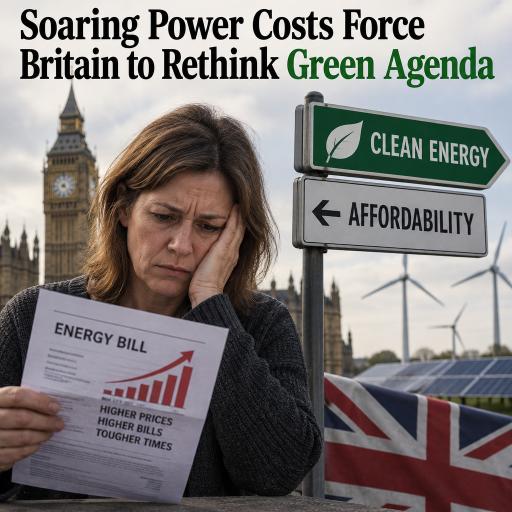
Soaring Power Costs Force Britain to Rethink Green Agenda
Britain’s energy strategy is entering a more pragmatic phase as ministers place affordable power at the centre of economic and climate policy. The government still presents renewable energy as essential to long-term security, but it is increasingly acknowledging that the transition cannot succeed if households and manufacturers are overwhelmed by electricity costs.
Chancellor John Healey has outlined a shift in emphasis, promising to bring UK energy prices closer to those paid in Europe. Clean power remains part of that objective, although affordability is now being treated as the immediate priority rather than an assumed consequence of decarbonisation.
The change is already testing Labour’s environmental commitments. Energy Secretary Miatta Fahnbulleh approved the Jackdaw gas project despite concerns about continued fossil-fuel development. Ministers must also decide the future of the Rosebank oil field, exposing tensions between economic and energy-security arguments and Labour’s pledge not to issue new oil and gas exploration licences.
Several Labour MPs oppose further development at Rosebank, warning that new production could undermine the credibility of the government’s climate programme. Supporters of domestic extraction counter that Britain will continue using oil and gas during the transition and should avoid becoming more dependent on imports.
International instability has made the debate more urgent. Rising global energy prices have renewed concerns about exposure to volatile gas markets, while the government is under pressure to ease living costs and protect industries competing with companies in countries where electricity is significantly cheaper.
Industry Struggles With an Electricity Price Gap
British manufacturers face some of the highest power costs among advanced economies. Available estimates suggest that industrial electricity can cost around twice as much as in parts of Europe and several times more than in the United States. That disadvantage is particularly damaging for steel, chemicals, glass, ceramics and other energy-intensive sectors.
The government plans to offer roughly 10,000 qualifying businesses electricity discounts of up to 25 percent from April. The support would be financed partly through public funds, exemptions from existing charges and closer alignment between British and European carbon markets.
However, targeted relief does not resolve the broader structural problem. Many companies outside the most energy-intensive categories must still pay substantial taxes, network charges and climate-policy costs. These expenses can account for more than a third of the electricity price faced by some businesses.
One increasingly prominent proposal is to remove environmental and social levies from electricity bills and finance them through general taxation. Supporters argue that lowering the unit price of power would encourage factories, transport systems and heating networks to switch away from fossil fuels. In their view, charging electricity consumers for much of the transition creates a contradiction: the government wants widespread electrification while making electricity comparatively expensive.
Net Zero Meets Political Resistance
The affordability dispute is also reshaping other policies. Ministers are considering easing electric-vehicle sales requirements to reduce pressure on carmakers. Fahnbulleh has also indicated that the ambition to remove nearly all fossil fuels from electricity generation by 2030 may have to be reconsidered if the cost problem cannot be solved.
Such moves could alarm climate campaigners, who argue that delay would prolong dependence on gas and increase future exposure to price shocks. Clean-energy investment requires stable targets, and repeated policy changes could discourage developers from financing wind farms, grids, storage and low-carbon industrial infrastructure.
Opposition parties have called for net-zero rules and levies to be reduced or abolished, claiming this could produce substantial household savings in future decades. Yet abandoning or slowing climate policy carries costs of its own. Greater reliance on internationally traded gas would leave consumers vulnerable to geopolitical crises, while severe warming could damage infrastructure, agriculture, public health and government finances.
A Difficult Balance for Government
The central challenge is therefore not simply whether Britain should pursue net zero, but how the transition should be funded and sequenced. Moving policy costs from electricity bills to taxation could reduce prices for businesses and encourage electrification, but it would also transfer the burden to public finances and taxpayers.
Prime Minister Andy Burnham’s discussions with European and international leaders will be closely watched for progress on carbon-market cooperation and energy trading. Better coordination with neighbouring markets could lower costs, although it cannot substitute for domestic reforms to planning, grid connections and electricity pricing.
Britain’s ambition to revive manufacturing will be difficult to achieve while companies face a persistent energy disadvantage. At the same time, weakening climate targets without a credible alternative could deepen dependence on fossil fuels and increase long-term economic risks.
The government’s emerging position reflects that dilemma: clean energy remains the destination, but affordability is becoming the test by which every step of the journey will be judged.



Leave a Reply