

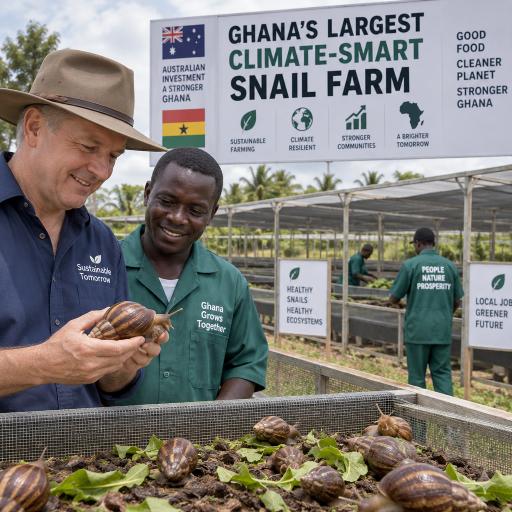
Australian investor builds largest climate-smart snail farm in Ghana
A high-tech snail farm established with Australian investment is positioning Ghana’s Central Region as an emerging centre for climate-resilient heliculture.
Located at Apam, the one-acre greenhouse is described by its developers as Ghana’s largest climate-smart snail production facility. It can accommodate approximately 20,000 snails, primarily from the Achatina genus, and could eventually expand to 10 acres.
The idea reportedly took shape after the investor visited Ghana and sampled snails served with fufu. That culinary experience developed into an agribusiness project intended to address persistent shortages in the domestic snail market.
Technology supports farm management
The facility combines controlled production with digital and renewable-energy systems. Solar-powered surveillance cameras allow activities to be monitored remotely, while Wi-Fi connectivity supports day-to-day management. The site also includes an administrative office and accommodation for employees.
Maintaining a stable environment inside the greenhouse can help protect snails from excessive heat, fluctuating rainfall and other conditions that may affect growth and survival. Such controls are becoming increasingly relevant as climate change places additional pressure on conventional food-production systems.
A laboratory for extracting snail slime has also been installed and is expected to begin operating. Snail mucin is widely used in skincare and cosmetic products, offering the business a potential revenue stream beyond meat production.
Serving food and cosmetic markets
The farm plans to supply snails to local markets, hotels and traditional food vendors while exploring opportunities in international markets. Its developers say the investment could help narrow the gap between Ghana’s strong demand for snails and limited domestic supply.
Despite the popularity of snail dishes, local production has not consistently met consumption needs. Traders therefore source part of their stock from neighbouring Côte d’Ivoire. Expanding commercial farming could reduce that dependence while creating rural employment and new processing opportunities.
Interest in heliculture—the managed breeding and rearing of snails—is growing in Ghana. Compared with many conventional livestock enterprises, snail production can require less land and lower initial capital. The animals also need relatively modest quantities of feed and space, although successful farms must carefully manage humidity, temperature, hygiene and stocking density.
Potential for a regional industry
Greater investment in breeding, processing, farmer training and market infrastructure could help Ghana become a significant supplier within West Africa and farther afield. Expansion, however, will need to follow responsible environmental practices, including careful handling of waste, efficient water use and measures preventing farmed snails from escaping into surrounding ecosystems.
The international edible-snail market is estimated to be worth more than US$600 million and could approach US$1 billion by 2033. Demand is being supported by consumers in Europe, Asia and the Middle East, alongside established African markets.
For Ghana, climate-smart snail farming could offer a way to diversify agriculture, strengthen local food supply and develop value-added products for the cosmetics sector. The Apam project’s long-term contribution will depend on whether it can scale sustainably while maintaining reliable production and access to profitable markets.



Leave a Reply