

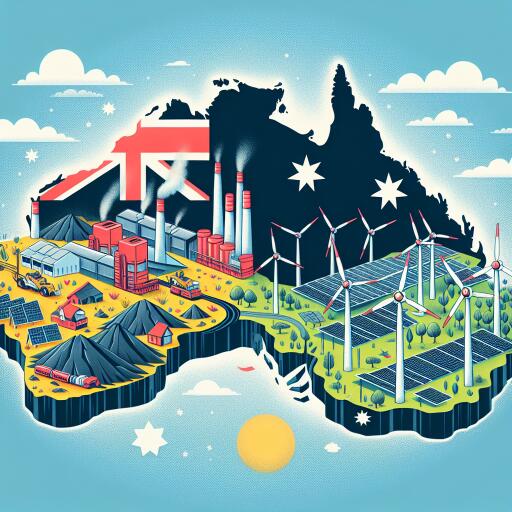
Pivot Australia. Can the Lucky Country Transition to Plucky on Energy?
In a pivotal moment for Australia’s climate policy, the arrival of the United Nations’ premier climate official has sparked renewed discussions on emissions reduction. Despite the national government’s ongoing greenlighting of new coal and gas initiatives, these conversations highlight a crucial crossroad for the country.
Recently, the Environment Minister clandestinely approved two additional gas projects, increasing the number of fossil fuel initiatives sanctioned by the administration to 20 since 2022. This comes amid growing global consensus on halting new fossil fuel ventures.
Addressing a conference organized by the Smarter Energy Council, UN Climate Change Executive Secretary Simon Stiell urged Australia to take bold steps towards economic transformation that aligns with a global shift towards decarbonization.
“Don’t settle for what’s easy – bog standard is beneath you. Go for what’s smart by going big. Go for what will build lasting wealth and national security. Go for what will change the game and stand the test of time,” Stiell emphasized.
Stiell’s plea coincides with internal political maneuvers, as advocates within the government push legislation to abandon the 2050 net zero target, crystallizing ideological rifts within the reigning coalition. The Australian government is currently calibrating its 2035 emissions target—a definitive indicator of its commitment to global climate actions and disengagement from the deeply-entrenched fossil fuel dependency.
According to climate finance expert Tim Buckley, the 2035 emissions target is a critical opportunity for alignment with the clean energy metamorphosis sweeping across the globe, offering substantial economic and strategic advantages.
“Persisting in the fossil-fuel mindset risks isolation. Global responsibility and a commitment to scientific evidence are essential for fostering international cooperation and maintaining the planet’s habitability.
The aspiration to host COP31 necessitates an exhibition of dedication and proactive climate agendas, affirming alliance to shared environmental commitments,” Buckley elaborates.
Intensified calls for assertive climate actions reverberate not only from environmental scientists but also from judicial avenues. The International Court of Justice recently clarified states’ legal obligations under international climate frameworks, underscoring commitments to keeping global warming below 1.5°C. These judicial findings have tangible implications for Australia’s climate responsibilities.
“Given a prolonged lapse in corrective actions (2013-2022), Australia is perilously close to losing its chance to significantly contribute to keeping global warming at bay,” notes the Climate Council.
They further elucidate that to meet the Paris Agreement’s 1.5°C ambition, Australia must not only advance domestic climate initiatives but also stem further fossil fuel dependencies, potentially nurturing nascent green industries like green steel production.
Australia’s economic trajectory stands at a crossroads due to shifting dynamics among its prime trade partners, notably China. Buckley highlights the urgency of adaptation in light of China’s rapid green energy insurgence.
“Australia needs to appreciate that our principal trade associate is embracing decarbonization with unprecedented swiftness. As China reshapes global energy frameworks, Australia must match their fervor to avoid obsolescence.
China’s leadership in spearheading zero emissions technologies—spanning solar, batteries, and EVs—is backed by ambitious strategies and goals. Australia must pivot decisively to remain a notable player on the world stage,” he elaborates.
Buckley posits that Australia’s prolific renewables could empower the nation to emerge as a green industrial leader, transitioning from exporting basic iron ore to commanding exports in processed green iron, fostering economic incentives through transformative investments and trade alliances with energy-forward nations like Germany, China, and Japan.
Acknowledging Australia’s footprint as the third-largest fossil fuel exporter and subsequent emissions links, The Australia Institute cautions that the growth of fossil fuel export emissions starkly eclipses their economic contributions.
“Ceasing support and proliferation of fossil exports would inflict minimal economic dislocation yet drive substantial emissions reduction. Economically, we might even find an uptick in savings.”,
The Institute notes, accentuating potential economic resilience against perpetuated fossil fuel dependency.
Buckley underscores the need for deliberate action to dissipate sustainable economic risks, driven by fossil fuel alignments.
“Inaction risks economic stagnation and geopolitical disengagement. Political stability affords Australia a unique vantage to champion clean energy transitions, fostering rapid economic realignment, ensuring continued prosperity as a ‘lucky country,’ and evading the polarizing extremities seen elsewhere,” emphasizes Buckley.



Leave a Reply