

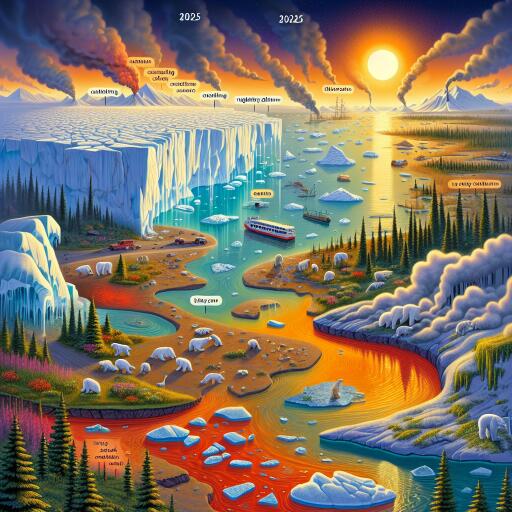
From record warming to rusting rivers, 2025 Arctic Report Card shows a region transforming faster than expected
The 2025 Arctic Report Card paints a stark picture: ocean and air temperatures are shattering records, sea ice is thinning and retreating, ecosystems are reorganizing, and thawing ground is turning rivers orange. The pace and breadth of change point to a region transforming faster than anticipated, with consequences that reach far beyond the Arctic.
Ocean heat fuels stronger storms and a weakening ice shield
Sea surface temperatures across the Arctic margins surged in August 2025, with the Bering Sea standing out as a hotspot. That excess heat provided the energy for a powerful autumn cyclone that tore into western Alaska with hurricane-force winds and severe coastal flooding, damaging communities including Kipnuk and Kwigillingok. As the North Pacific warms, these intense cyclones are pushing farther north and maintaining strength longer; notably, three such powerful storms have reached the region in the past four years.
At the same time, the Arctic Ocean is undergoing “Atlantification,” as warmer, saltier Atlantic waters penetrate farther into the basin. This erodes the natural layering that once insulated sea ice from deeper heat. The result: faster sea-ice melt, shifting timing and composition of phytoplankton blooms at the base of the food web, and higher risk of harmful algal blooms in waters that once were too cold to support them.
Borealization at sea: Northward shift of species
With less ice and warmer waters, boreal (southern) species are moving north while Arctic specialists lose ground. In the northern Bering and Chukchi seas, the abundance of Arctic-associated species has declined sharply—by about two-thirds in the northern Bering and by roughly half in the Chukchi—while populations of boreal fish and invertebrates expand. This ecological reshuffling reverberates through food webs and challenges fisheries management and subsistence practices that depend on predictable seasonal patterns.
Greener tundra, but growing scars
On land, satellite data show tundra vegetation productivity reached a record high in 2025. Longer growing seasons and warmer temperatures are extending plant activity and, in some areas, boosting shrub growth. Yet this greening is not uniform. Extreme weather and insect outbreaks are triggering localized “browning,” and wildfires are carving fresh scars into landscapes that historically burned infrequently.
Another severe fire season
Summer 2025 was the fourth year in a row with extensive Arctic and sub-Arctic wildfires. More than 4,000 square kilometers burned in Alaska, and over 13,600 square kilometers burned in Canada’s Northwest Territories. Beyond immediate destruction, these fires worsen air quality, release large pulses of carbon, destabilize permafrost by removing insulating vegetation and surface organic layers, and transform wildlife habitat.
Permafrost thaw is rusting rivers
Permafrost—the frozen ground that underpins much of the Arctic—is thawing rapidly. As soils warm and hydrology shifts, iron and other minerals are mobilized and flushed into streams. More than 200 watersheds in Arctic Alaska now show striking orange discoloration. These “rusting” waters are often more acidic and carry elevated levels of metals that can contaminate drinking water, degrade fish habitat, and threaten food security for communities relying on local resources.
In Kobuk Valley National Park, a tributary of the Akillik River abruptly turned orange, its acidity spiking. Fish species such as Dolly Varden and slimy sculpin suffered die-offs following the change. Similar events raise alarms about cascading impacts as thaw-driven chemistry alters freshwater ecosystems across the region.
Watching change in real time: the need for robust monitoring
The speed and complexity of Arctic change demand strong, sustained observing systems. Yet many government-supported networks face funding gaps and aging infrastructure, creating vulnerabilities just as the need for high-quality data grows. Reliable monitoring underpins weather and sea-ice forecasting, ecosystem stewardship, community safety, and climate accountability.
Amid these challenges, Indigenous-led observation offers a promising model. On St. Paul Island in the Bering Sea, the community has spent more than two decades building and operating a locally driven system that tracks environmental conditions—from mercury in traditional foods to coastal erosion and fish habitat—while retaining control over the data and how it is shared. By integrating local expertise with scientific partnerships, they are improving situational awareness and building resilience tailored to local priorities.
A triple crisis converges in the Arctic
The Arctic’s transformations reflect the intertwined crises of climate change, biodiversity loss, and pollution. Ocean warming is accelerating sea-ice decline and pushing species north; fire and extreme weather are reshaping landscapes; and thawing permafrost is releasing contaminants into waterways. These shifts are already affecting communities, economies, and cultural practices within the region—and they are sending ripples across the globe by altering weather patterns, fisheries, and carbon feedbacks.
The next two decades will be decisive. Cutting greenhouse gas emissions remains essential to slow the drivers of change, while investment in monitoring, adaptation, and Indigenous leadership can help navigate what is already underway. The 2025 Arctic Report Card is clear: the Arctic is changing faster than expected, and the world must keep pace.



Leave a Reply