

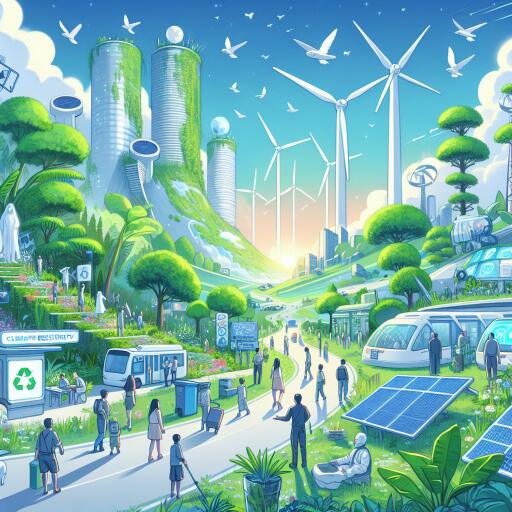
Government Sets 2030 Targets for Climate Resilience and Resource Management
The government has unveiled an ambitious national plan designed to combat climate change, enhance natural resource management, and safeguard the environment. The strategy outlines definitive goals to be reached by 2030, including the establishment of infrastructure resilient to climate challenges and bolstering capabilities for disaster prevention and adaptation.
Central to the plan is the emphasis on fostering resilience across natural ecosystems, the national economy, and local communities, with significant investments earmarked for intelligent adaptation strategies. Enhanced forecasting and early warning systems are slated for development to mitigate the impacts of severe weather events, with a marked focus on ensuring human safety during such occurrences as storms and floods. The initiative endeavors to ensure that the majority of households situated in disaster-prone areas will have access to secure and safe housing.
Regarding emissions reduction, the plan aims to curtail greenhouse gas emissions in contrast to ‘business-as-usual’ projections. It emphasizes energy conservation and advocates for a significant increase in the integration of renewable energy sources within the national energy framework.
In the realm of natural resource management, there will be an acceleration in the mapping of vital mineral and marine resources, an expansion of geological surveys, and thorough assessments of coastal and offshore regions. Sustainable water usage stands as a priority, featuring stricter regulations, more efficient irrigation practices, and efforts to minimize water losses. The strategy involves tackling water scarcity and drought during dry seasons, focusing particularly on the south-central region, Central Highlands, Mekong Delta, and remote island communities.
Additionally, the initiative includes preserving 3.5 million hectares of land designated for rice cultivation, aiming to ensure food security and foster economic development. Environmental protection forms a critical component of the government plan, calling for all industrial zones to deploy centralized wastewater treatment systems compliant with national standards. More than half of the domestic wastewater from second-tier and higher urban areas is anticipated to be treated adequately.
Efforts to rehabilitate contaminated land, notably regions still heavily polluted by toxic chemicals and dioxins from wartime, will be intensified. Improvement in air quality across urban centers and densely populated areas is targeted, with expanded access to clean water for both rural and urban inhabitants.
National campaigns will be stepped up to raise public awareness, promoting a common understanding and proactive stance towards climate change and environmental issues. The government is advocating for a broad shift towards sustainable consumption, green growth, low-carbon development, and support for the circular economy. A particular focus will be placed on environmental education for children, beginning at the primary school level.
The strategy also plans to revise and reinforce legal frameworks surrounding climate action and environmental governance. A new national strategy is set to be devised to tackle non-traditional security threats by 2030, with a vision extending to 2045. Administrative structures on both central and local levels will be optimized to enhance efficiency and responsiveness in climate and environmental management.
To ensure policy coherence across sectors and regions, integrated policy mechanisms and inter-agency coordination will be improved alongside financial instruments and market-based tools aimed at resource mobilization for climate resilience and environmental protection. Important environmental legislations, including those pertaining to meteorology, hydrology, energy efficiency, marine resources, biodiversity, and forestry, will be revised.
The national strategy for green growth is set for diligent implementation through 2030, with a sustained long-term vision to 2050. Pilot models showcasing green urban and rural economies will be promoted and scaled up, alongside initiatives supporting sustainable production and consumption.
Moreover, the government will prioritize investments addressing environmental degradation, biodiversity loss, and resource depletion with the overarching goal of realizing net-zero emissions. Comprehensive programs and projects are to be introduced during the 2026-2030 period to address pressing environmental challenges and progress national climate adaptation efforts.
The country will pursue its national circular economy action plan through 2035, with ministries and localities developing tailored roadmaps linked to digital transformation. Research and pilot projects will direct sector-wide adoption as the government examines material usage to formulate sustainable resource policies.



Leave a Reply