

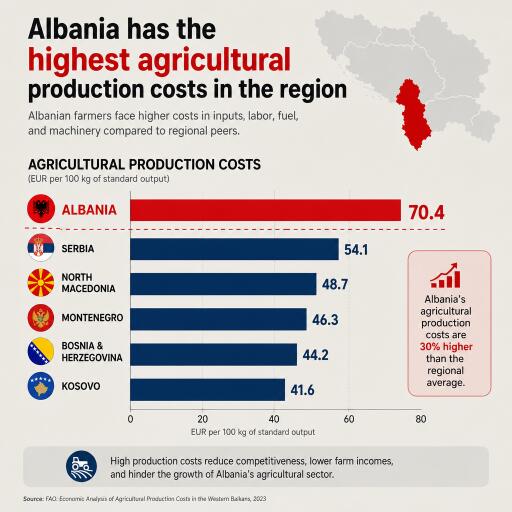
Albania has the highest agricultural production costs in the region
Albania’s farmers are grappling with some of the steepest production costs in the Western Balkans. Heavy dependence on imported inputs, limited public support, a shrinking rural workforce, and fragile irrigation and storage networks are inflating the cost of every kilo harvested—leaving domestic produce exposed to cheaper competition from neighboring countries.
Imported inputs, imported risks
A large share of farm budgets in Albania goes to seeds, chemical fertilizers, and plant protection products—many of them sourced abroad. That reliance directly ties costs to volatile global markets, currency swings, and transport expenses. When international prices surge or shipping becomes more expensive, Albanian farmers feel it immediately at the farm gate.
Smallholdings dominate the sector and rarely command bulk discounts. Without the leverage of scale or strong cooperative purchasing, they often pay retail rates for essentials—eroding the thin margins that keep family farms afloat.
A subsidy gap that changes the math
Direct public support to agriculture in Albania lags far behind regional peers. While neighboring countries typically provide more than €50 per hectare in direct assistance, support in Albania has historically amounted to only a few euros per hectare—a gap of roughly eighteenfold.
This disparity shapes market outcomes. Elsewhere in the region, subsidies can help offset the price of inputs, fuel, or on-farm investments, allowing products to reach shelves at more competitive prices. In Albania, by contrast, farmers shoulder a far greater share of their costs alone, leaving them at a disadvantage against subsidized fruit, vegetables, grains, and dairy arriving from next door.
Climate pressures meet weak irrigation
Rising temperatures, erratic rainfall, and longer dry spells are tightening the screws on production costs. In many areas, outdated or incomplete irrigation systems make fields vulnerable to drought. When a season turns dry, yields can plunge while fixed costs—land preparation, seed, fertilizer, and crop protection—remain unchanged. The result is a higher cost per unit and greater financial risk.
Environmental externalities add further hidden costs. Soil degradation, inefficient water use, and extreme weather-related losses pile pressure on farms with limited capacity to invest in resilience. Without modern water management, precision application of inputs, and better soil health practices, each shock hits harder and recovery takes longer.
Labor is scarce and getting pricier
Depopulation of rural areas and outward migration have thinned the pool of available farm workers. The crunch is acute during peak periods—planting, pruning, and harvest—when demand for labor spikes over a few hectic weeks.
To secure crews, farmers are paying higher daily wages. Yet even with higher pay, orchards and fields sometimes go partially unharvested because there simply aren’t enough hands. Missed harvest windows translate directly into losses, undercutting annual income and compounding the effect of already elevated input costs.
Competing uphill in regional markets
Albanian produce competes not only with European Union goods but also—more immediately—with output from Serbia, North Macedonia, and other Western Balkan neighbors. Where farmers benefit from steadier subsidy schemes, better aggregation, or more developed irrigation, they can often deliver lower prices or more consistent quality. Albanian producers, carrying higher per-unit costs, struggle to match those terms, particularly in wholesale markets and supermarket supply chains that prize reliability and price stability.
What would ease the burden
- Stronger, smarter support: Targeted direct payments per hectare or per product, coupled with co-financing for efficiency upgrades (e.g., drip irrigation, fertigation, covered storage, and cold chains), can lower unit costs and stabilize supply.
- Collective purchasing power: Farmer cooperatives or purchasing groups can negotiate better prices for inputs, slash transport costs, and facilitate shared machinery use—especially for smallholders.
- Water resilience: Rehabilitating canals, introducing pressurized systems, and promoting water-saving technologies reduce climate risk and cut energy and fertilizer losses.
- Soil and input efficiency: Precision application, improved soil organic matter, and integrated pest management help trim spending on fertilizers and pesticides while protecting long-term productivity.
- Labor solutions: Seasonal work programs, training, mechanization support (e.g., harvest aids), and incentives to retain rural workers can ease peak-season shortages.
- Risk management: Crop insurance, early warning systems, and access to affordable credit buffer farms against climate shocks and price volatility.
Albania’s farmers are resilient, but resilience alone cannot carry the cost of structural disadvantages. Narrowing the subsidy gap, modernizing irrigation, improving market organization, and investing in climate-smart practices would lower production costs and help domestic food compete on price and reliability. Without those steps, imports backed by stronger support systems will continue to chip away at Albania’s share of its own market.



Leave a Reply