

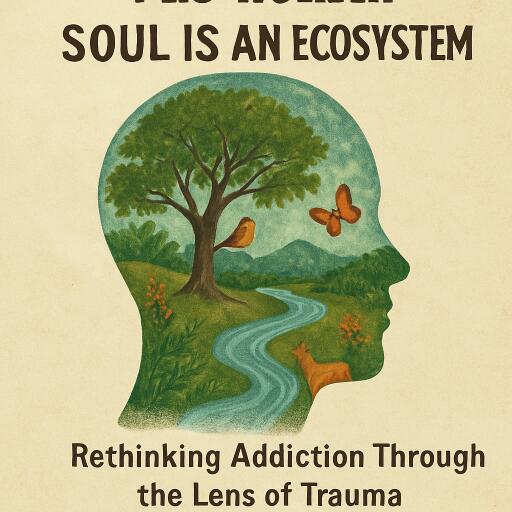
The Human Soul Is an Ecosystem: Rethinking Addiction Through the Lens of Trauma
“It is a sign, a signal, a symptom of distress. It is a language that tells us about a plight that must be understood.”
Society has become adept at spotting visible breakdown while ignoring the deeper conditions that create it. In environmental science, when a wetland dries out or a forest loses resilience, the response is not to blame the surface symptoms. Researchers look beneath them: at soil depletion, disrupted water cycles, species loss, and long-building stress. Human suffering deserves the same depth of attention.
When addiction enters a person’s life, public conversation often narrows immediately to behavior. Why can’t they stop? Why repeat something that causes harm? Why choose what is clearly destructive? These questions focus on the outward pattern while missing the hidden terrain beneath it. A more revealing question is not why the addiction exists, but what pain it is trying to soothe.
This reframing changes everything. Addiction can be understood not simply as recklessness, vice, or bad judgment, but as an attempt to manage distress. The behavior may be dangerous, compulsive, and devastating, but it often begins as a survival strategy. What appears irrational from the outside may have emerged as a form of relief in a life shaped by fear, neglect, instability, or emotional injury.
The inner life of a person resembles an ecosystem. It depends on conditions that support growth: safety, attachment, affection, trust, and meaning. These are not sentimental extras. They are as essential to psychological development as water and biodiversity are to a living landscape. When these foundations are present, people are more likely to develop emotional regulation, self-worth, and resilience. When they are missing, the mind and body adapt in whatever ways they can.
In nature, adaptation is not failure. A river changes course after repeated pressure. A tree twists toward light when the canopy closes above it. Human beings also bend in response to their surroundings. Some become constantly alert to danger. Some shut down emotionally. Some seek control through perfectionism. Others reach for numbness, distraction, or chemical escape. Addiction belongs to this continuum of adaptation.
The heartbreaking part is that a strategy that helps someone survive one chapter of life can later trap them in another. A substance may quiet panic, mute traumatic memories, or create a fleeting sense of comfort where none existed before. For a time, it works. That temporary relief is one reason addiction can take hold so deeply. It is not simply about chasing pleasure; often it is about escaping anguish.
Neuroscience supports this understanding. Early trauma and prolonged stress can alter the development of brain systems involved in impulse control, emotional balance, and decision-making. Addiction further destabilizes these very circuits. The result is a cruel loop: the brain is expected to choose health while carrying injuries that make regulation far harder. In that context, punishment and shame are blunt tools. They confuse wounded functioning with moral deficiency.
This does not minimize the damage addiction causes. It can devastate families, health, livelihoods, and communities. But acknowledging harm is different from reducing a person to their most visible behavior. If addiction is a response to pain, then condemnation alone will never reach its source. Silencing a signal is not the same as understanding the emergency it announces.
Many people who live with addiction describe an inner emptiness that feels relentless. The substance or behavior becomes less a source of excitement than a barrier against that void. In this sense, addiction is often not about desire in the ordinary sense. It is about protection from unbearable absence, grief, fear, or loneliness. The compulsion becomes a shield, however costly it may be.
This pattern extends far beyond drugs or alcohol. People can become dependent on work, status, romance, gambling, digital stimulation, shopping, or approval. The surface forms differ, but the underlying mechanism may be familiar: an effort to regulate emotional pain, to feel briefly soothed, or to avoid confronting a wound that has never fully healed.
There is an ecological lesson here. Restoration does not begin with accusation. It begins with curiosity about what has been lost and what must be repaired. Which bonds were severed? Which protective systems failed? Which nutrients, buffers, or relationships disappeared? Human healing may require a similar approach. Rather than asking how to better control struggling people, societies might ask how to create conditions in which fewer people are driven toward compulsive escape.
That means looking upstream. It means protecting children from chronic stress and violence. It means valuing secure attachment and emotional development as much as academic performance. It means building health systems that treat trauma as central rather than incidental. It means communities that respond to suffering with dignity instead of stigma. And it means recognizing that isolation, inequality, and instability are not just social problems; they are risk factors that shape the human nervous system.
Recovery, then, is not merely the stopping of a substance or behavior. It is the rebuilding of an inner habitat. It involves restoring trust, connection, safety, and self-understanding. Just as degraded land cannot recover through force alone, injured people rarely heal through humiliation. Supportive relationships, compassionate care, and meaningful belonging are not soft alternatives to treatment; they are often part of the treatment itself.
The broader question raised by addiction is one that reaches into public health, education, family life, and culture: how do human beings heal? The answer is unlikely to be found in blame. Healing becomes more possible when pain is recognized, when survival strategies are understood in context, and when people are met as more than the symptoms they display.
Nature offers a clear metaphor. Life tends toward renewal when the right conditions return. Forests regenerate. Wetlands revive. Soil recovers. Human beings, too, possess a remarkable capacity for repair. But that capacity is easier to reach when the environment around them supports it. To rethink addiction through trauma is not to excuse destruction. It is to see more clearly what suffering is trying to say—and what restoration truly requires.



Leave a Reply