

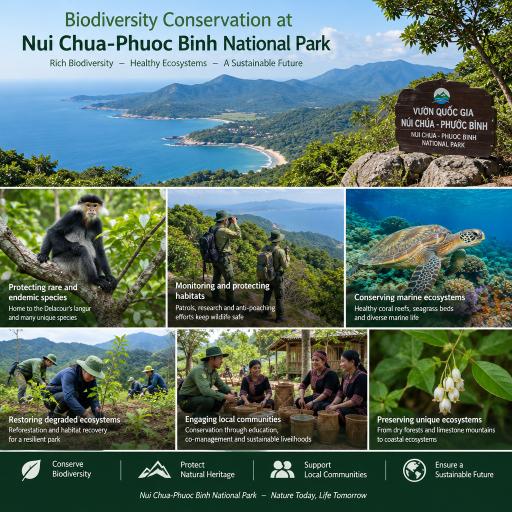
Biodiversity conservation at Nui Chua-Phuoc Binh National Park
In the forests of Nui Chua-Phuoc Binh National Park, conservation increasingly depends on a blend of field experience and modern technology. Hidden among trees and along wildlife trails, camera traps and digital monitoring tools are helping conservation teams document rare species, understand ecological patterns, and respond more quickly to threats facing one of Viet Nam’s most diverse protected landscapes.
The park contains an exceptional mix of habitats, including dry forest, evergreen forest, mountain ecosystems, and stream corridors. This variety of terrain and climate supports a remarkable concentration of life, from plants adapted to harsh conditions to elusive mammals and birds that are rarely seen directly by people. The ecological richness of the area makes it both scientifically important and highly sensitive to disturbance.
To protect this landscape, rangers and conservation staff carry out demanding patrols across steep, remote ground. Their work is now reinforced by motion-activated camera traps placed in strategic locations. These devices are installed only after teams study animal signs such as footprints, feeding traces, pathways, and watering points. Once fixed to tree trunks, the cameras operate day and night, capturing wildlife activity without continuous human presence and reducing disruption to natural behavior.
The result is a steady flow of visual evidence that would be difficult to gather through direct observation alone. Over monitoring periods that often last several months, the cameras record thousands of images. These files become a valuable scientific archive, revealing which species are present, when they are active, and which parts of the forest they use most frequently. This information allows conservation managers to compare data over time and identify habitats that need stronger protection.
Monitoring in the park has documented a number of rare and threatened animals, including gaur, silver-backed chevrotains, black-shanked douc langurs, Asiatic golden cats, and Sunda pangolins. Records like these do more than confirm species presence. They help build a clearer picture of population trends, movement patterns, and habitat preference, all of which are essential for planning effective long-term conservation strategies.
Camera traps are only one part of a broader technological system. Conservation teams also use unmanned aerial vehicles to inspect hard-to-reach zones, particularly where rugged slopes and dense vegetation make ground access difficult. In parallel, smart forest monitoring platforms and digital patrol tools help staff map patrol routes, log incidents, track forest change, and identify hotspots where illegal activity or ecological disturbance may be emerging.
Together, these technologies are changing the way protected areas are managed. Instead of relying mainly on occasional sightings or fragmented reports, park authorities can work with continuous, location-based data. That shift supports a more systematic model of conservation, one based on measurable evidence and long-term monitoring rather than intuition alone.
Another important part of the park’s conservation work involves preserving genetic and scientific records through specimen collections. Plant and animal samples are catalogued and stored as reference materials for taxonomic study, biodiversity assessments, and research into distribution and physical characteristics. Properly documented specimens serve as biological snapshots, helping scientists compare species across time and detect shifts linked to environmental change.
Current records indicate that the park is home to roughly 1,971 plant species and 867 animal species. Many are considered rare, threatened, or of high conservation priority. This abundance is not only a matter of numbers. Each species contributes to the resilience of the wider ecosystem. Herbivores influence vegetation dynamics, predators regulate prey populations, and birds and mammals transport seeds across the landscape, supporting forest regeneration.
When one species declines, the consequences can spread through the ecological network. For that reason, conservation in Nui Chua-Phuoc Binh must go beyond protecting individual animals. It also requires safeguarding habitats, preventing forest fragmentation, and maintaining biological corridors that allow wildlife to move, feed, breed, and adapt.
To do this, conservation teams combine information from camera traps, GPS-based mapping, field observations, and patrol reports. By comparing where and when animals appear, researchers can identify key habitats, likely movement routes, and areas experiencing pressure from human activity. Over time, these data sets help determine which parts of the park deserve priority intervention and where protection measures should be strengthened.
This approach reflects a broader evolution in conservation thinking. Protecting biodiversity is no longer limited to guarding what still survives. It also means maintaining the ecological processes that allow forests to renew themselves. A healthy protected area is not simply one with tree cover; it is one where species interactions, regeneration cycles, and habitat connectivity remain intact.
Technology alone, however, cannot secure the future of the park. Staff presence on the ground remains essential, especially in sectors where rare wildlife is concentrated. Patrols, law enforcement, and rapid response to encroachment or poaching risk continue to be core responsibilities. Public education is equally important, particularly for communities living near forest edges, whose participation can determine whether conservation efforts endure.
Local involvement strengthens protection because long-term success depends on people seeing the forest as a shared asset rather than a distant reserve. When communities recognize the ecological and practical value of intact habitats, they are more likely to support measures that reduce pressure on wildlife and preserve natural resources.
At a time when ecosystems face intensifying strain from climate change, land-use pressure, and biodiversity loss, the conservation model developing at Nui Chua-Phuoc Binh National Park offers more than local significance. It shows how science, digital tools, and community engagement can work together to defend genetic resources, ecological links, and the environmental services that healthy forests provide.
Deep in the park, the cameras continue their quiet work, recording brief moments in the lives of animals that rarely reveal themselves. Those images are more than pictures. They are evidence, early warnings, and a foundation for decisions that may help keep this complex forest ecosystem alive for generations to come.



Leave a Reply