

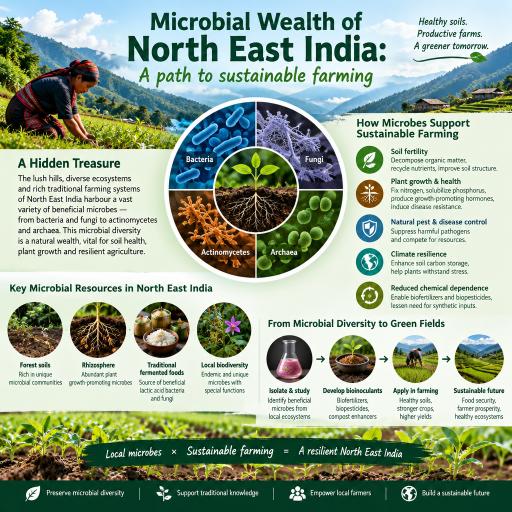
Microbial wealth of North East India: A path to sustainable farming
North East India is widely celebrated for its forests, traditional crops and rich biological diversity. Yet one of its most valuable natural assets remains largely invisible: the immense community of microorganisms living in soil, plant roots and water. These bacteria, fungi and other microscopic life forms may hold the key to a more sustainable agricultural future for the region.
As agriculture faces the twin pressures of feeding growing populations and protecting fragile ecosystems, attention is shifting toward solutions that work with nature rather than against it. In the North East, where farming systems are closely tied to local ecology, beneficial microbes offer a practical way to improve soil fertility, reduce chemical dependence and strengthen crop resilience.
Healthy soil is not an inert surface. It is a living system, constantly shaped by microbial activity. These tiny organisms break down organic matter, release nutrients for crops and help maintain the balance needed for productive farming. Some microbes also shield plants from disease, while others support root growth or help crops tolerate environmental stress. In effect, they act as unseen partners in agriculture.
This matters especially in a region as ecologically sensitive and diverse as North East India. Despite the area’s reputation as a biodiversity hotspot, public discussion often focuses on visible forms of life such as wildlife, forests and medicinal plants. Far less attention is given to microbial diversity, even though it directly affects crop productivity and long-term soil health.
For decades, chemical fertilizers and pesticides have contributed to higher agricultural output across India. Their role in boosting food production is undeniable. But overuse has also created problems, including soil degradation, pest resistance, rising production costs and health concerns linked to exposure and residues. Sustainable farming does not require abandoning modern tools altogether, but it does demand a more balanced system in which biological alternatives play a larger role.
That is where beneficial microorganisms become important. Certain fungi and bacteria can naturally suppress crop diseases. Others can target insect pests without harming the wider environment. Biofertilizer microbes can improve nutrient availability, reducing the need for synthetic inputs. Well-known examples include Trichoderma, Bacillus, Pseudomonas, Beauveria, Metarhizium, Rhizobium and Azotobacter. Used effectively, they can support both crop protection and soil regeneration.
However, discovering useful microbes in nature is only the first step. The bigger challenge is turning them into reliable farm technologies. A microorganism isolated in a laboratory becomes valuable only when it can be formulated properly, tested under local conditions, produced at scale and delivered to farmers with clear instructions. Without this pathway, microbial innovation remains trapped in research institutions instead of reaching fields.
The North East is particularly well placed to build such a model. The region already has long traditions of low-input farming and a strong cultural connection to land stewardship. States such as Sikkim have demonstrated that environmentally conscious agriculture can be pursued on a large scale. Across the region, growing interest in organic and natural farming is opening the door to wider use of microbial inputs and other biological solutions.
This is not simply a matter of branding produce as organic. Farmers need methods that are dependable, affordable and suited to local realities. Biological crop management must help maintain yields and farm incomes, not just satisfy certification requirements. That means investing in science, extension services and local production systems for biofertilizers and biopesticides.
North East India also has an opportunity to create a distinctive agricultural bioeconomy. If its biodiversity is linked with scientific research and farmer knowledge, microbial resources could support new rural enterprises, from bio-input manufacturing to advisory services and community-level multiplication units. Such a system could generate employment while reducing dependence on imported agrochemicals.
An important part of this transition is farmer education. Microbial products are not instant substitutes for chemical pesticides, nor do they behave in exactly the same way. Their success depends on correct storage, timing, field conditions and integration with broader crop management practices. Farmers should not be expected to adopt them on trust alone. They need practical training that explains what these products do, where they work best and how they fit into an overall farming strategy.
Traditional knowledge can also play a vital role. Many local practices developed over generations are now being better understood through microbiology and soil science. Fermented farm inputs used in natural farming often contain live microbial communities that support plant and soil health. Rather than treating tradition and modern science as rivals, the more promising path is to combine them. Scientific validation can refine and strengthen practices that farmers already know, helping build systems that are both productive and ecologically sound.
Still, microbial farming tools should not be romanticized. They are powerful, but not magical. Their effects are usually gradual, and performance can vary with crop type, weather, soil conditions and application methods. Unlike many chemical pesticides, they may not produce dramatic immediate results. But over time, by improving the biological balance of the farm ecosystem, they can reduce the need for repeated chemical intervention.
The broader lesson is clear: sustainable agriculture will depend on invisible life as much as visible technology. Satellites, sensors and machinery will shape the future of farming, but so will the microscopic organisms beneath our feet. In North East India, these natural allies could help create a resilient food system rooted in healthier soils, safer crop protection and stronger local economies.
If the region chooses to invest in its microbial wealth, it can move toward an agricultural model that is not only productive, but also restorative. The next great rural innovation may not arrive with loud machinery or dramatic infrastructure. It may begin quietly in the soil, where billions of organisms are already at work, waiting to be understood, cultivated and put to use for a more sustainable future.



Leave a Reply