

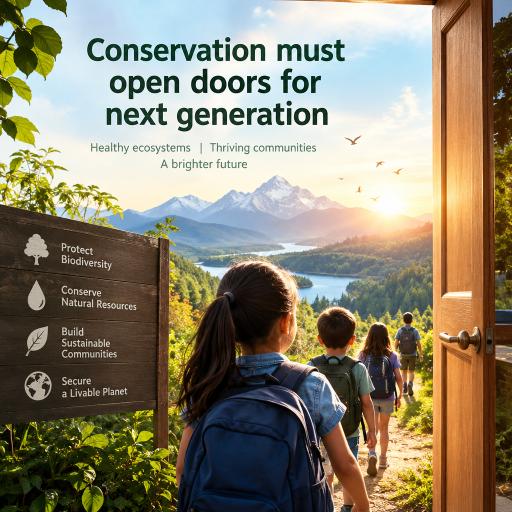
Conservation must open doors for next generation
Conservation is usually judged by visible outcomes: healthier ecosystems, stronger protection for threatened species, and well-managed protected areas. Those goals remain essential. But there is another measure of success that deserves equal attention: whether the sector is creating real opportunities for young people who want to work in nature protection.
For many aspiring conservation professionals, especially those from underserved communities, the biggest barriers are not passion or talent. They are access, exposure, mentorship and practical experience. If conservation is serious about its future, it cannot remain a field that feels closed off, distant or difficult to enter.
The long-term strength of biodiversity protection depends on bringing new people into the sector and helping them build meaningful careers. That means opening parks, institutions and training pathways to students who may never have had the chance to experience these landscapes firsthand.
A recent field-learning programme in South Africa showed how powerful that access can be. A group of university students studying nature conservation spent time in protected areas, where classroom theory was transformed into real-world experience. For many of them, it was their first direct encounter with a national park environment.
Seeing forests, coastlines, marine habitats and diverse plant life up close gave students a deeper understanding of the complexity behind conservation work. Protected areas are not simply scenic destinations. They are living systems that require constant monitoring, maintenance, scientific knowledge and sound management. Experiencing that reality firsthand helps students understand both the demands and the possibilities of the profession.
The programme blended academic learning with practical tasks. Students took part in activities such as clearing invasive alien plants, assisting with trail upkeep, identifying vegetation, examining soils and exploring coastal ecosystems. These are not just educational exercises. They reflect the daily work that keeps protected landscapes functioning and resilient.
Direct engagement with conservation practitioners added another important layer. Students were able to hear from professionals working in fields such as natural resource management and environmental protection, giving them insight into the wide range of roles that exist behind the scenes. Experiences like these demystify the sector and help young people picture themselves in it.
That matters because conservation is far broader than many students initially realize. It is not limited to rangers and scientists. It also includes restoration specialists, environmental educators, tourism professionals, fire managers, biodiversity monitors, planners, communicators, technicians and entrepreneurs. As environmental pressures grow, the field is becoming even more multidisciplinary, combining ecology with technology, data, public engagement and sustainable enterprise.
Digital communication is now part of that reality as well. Young people entering conservation are not only learning how to protect ecosystems, but also how to tell their stories. Using modern media tools to promote biodiversity awareness can strengthen public support for conservation and attract new audiences to environmental issues. In this way, communication is no longer peripheral to the sector; it is becoming one of its strategic tools.
Still, knowledge alone is not enough. If conservation is to become more inclusive, it must connect education to livelihoods. Too often, students are inspired by environmental work but remain uncertain about where it can lead professionally. The sector needs to make the economic side of conservation more visible, showing that it can support not only ecological goals but also employment, enterprise and community development.
This includes opportunities in ecotourism, habitat restoration, environmental consulting, field research support, content production, outdoor guiding and other green-economy pathways. When young people can see a future in conservation that is both purposeful and economically viable, the field becomes far more accessible and attractive.
Mentorship is another crucial ingredient. Entering the workplace can be daunting for graduates, particularly those without professional networks or family connections in the sector. Guidance from experienced practitioners and educators can make the difference between potential that fades and potential that flourishes.
Strong mentorship also creates a ripple effect. When those who have been supported go on to help the next generation, the impact extends well beyond individual careers. It builds a culture of inclusion, confidence and continuity within conservation institutions.
National parks and protected areas therefore have a dual role. They must remain strongholds of biodiversity protection, but they should also function as spaces of learning, discovery and social connection. They should not feel reserved for a select few. They should be places where students from all backgrounds can gain skills, ask questions and imagine themselves belonging in conservation.
Partnerships between higher education institutions and conservation agencies offer one of the most effective ways to make that happen. They create a bridge between theory and practice, helping students move from textbooks into the realities of fieldwork and protected area management. For students from rural and historically excluded communities, such exposure can be especially transformative.
The conservation sector often speaks about sustainability in ecological terms. But sustainability also depends on people. If the next generation is not prepared, welcomed and empowered, long-term environmental goals will be much harder to achieve.
The future of conservation will not be secured by protecting landscapes alone. It will also be shaped by every student given a first opportunity, every practical skill shared in the field, and every mentor who helps a young person step confidently into the profession. When conservation opens its doors wider, both nature and society stand to benefit.



Leave a Reply