

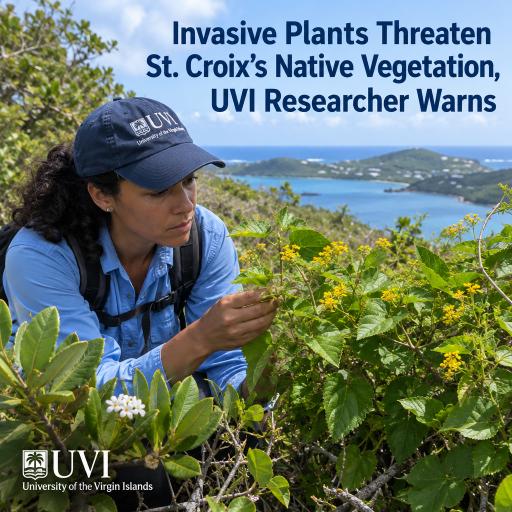
Invasive Plants Threaten St. Croix’s Native Vegetation, UVI Researcher Warns
Invasive plants are quietly reshaping the landscape of St. Croix, spreading into open land, dry hillsides and natural habitats while displacing native vegetation that supports the island’s biodiversity. That was the warning delivered by a University of the Virgin Islands agroforestry researcher during a recent public workshop, where he outlined how a number of familiar species are contributing to ecological decline.
Several plants commonly seen in yards, roadsides and abandoned lots were highlighted as particular concerns, including tan tan, snake plant, coral vine, sweet lime and chinaberry. Even more striking, some species widely appreciated by residents — including ginger thomas, the Virgin Islands’ official flower, and genip — were also identified as invasive under certain conditions.
The researcher stressed an important distinction between naturalized plants and invasive ones. Naturalized species are those introduced from elsewhere that have become established over time without seriously damaging local ecosystems. Invasive plants, by contrast, spread on their own into natural areas and significantly alter vegetation patterns and ecological processes.
Mango was cited as a good example of a naturalized plant. Though not originally from the Caribbean, it generally remains where it is planted and does not aggressively move through surrounding landscapes. Invasive plants behave differently: once established, they can expand rapidly beyond gardens or disturbed areas and begin dominating native habitats.
St. Croix is especially vulnerable because of its long history of land disturbance. Large-scale clearing for sugar cane cultivation removed much of the island’s original forest cover, leaving behind altered landscapes where aggressive non-native plants could gain a foothold. Disturbed land tends to favor fast-growing invaders, especially those capable of thriving in heat, drought and poor soils.
These species often have another advantage: in their new environment, they may leave behind the insects, diseases and other natural controls that kept them in check in their place of origin. Without those restraints, they can grow unchecked, cast dense shade, crowd out slower-growing native plants and change the structure of entire plant communities.
One of the most visible examples is ginger thomas. While celebrated for its bright yellow blooms, the tree can spread aggressively through wind-dispersed seeds. On parts of St. Croix, especially in drier areas, entire hillsides can become covered in its flowers during certain seasons. Its drought tolerance and prolific seed production allow it to expand quickly, often at the expense of native species.
Another problematic species is genip. Though culturally familiar and valued for its fruit, the plant is not native to St. Croix. It likely arrived in the Caribbean long before European colonization, carried by Indigenous peoples. But historical land clearing created ideal conditions for it to expand beyond its earlier range. Today, genip is considered a serious threat because animals readily disperse its seeds, and its seedlings are tough enough to survive in both shade and dry conditions.
Botanical experts note that this combination makes genip particularly difficult to control. Once established, it can form heavy shade that suppresses young native plants, giving it an even stronger hold over local habitats.
Snake plant, also known as mother-in-law’s tongue, was also singled out as one of the island’s most troublesome invasive plants. Originally brought from Africa for fiber and later popularized as an ornamental, it is exceptionally hardy. It tolerates neglect, grows in shade and survives under harsh conditions, making it difficult to remove once it escapes cultivation.
Tan tan presents a different but equally serious problem. Introduced as livestock forage, it can provide protein-rich leaves and even improve soil by fixing nitrogen. But in abandoned or lightly managed areas, it spreads rapidly and forms dense thickets that shut out sunlight. These thick stands can prevent other plants from establishing, reducing plant diversity across affected sites.
Other species flagged as risky for local landscaping include coral vine, sweet lime and chinaberry. Though often planted for ornamental or practical reasons, these species can escape domestic spaces and contribute to broader ecological disruption.
The message to residents was clear: what grows well in a yard is not always harmless to the surrounding environment. Home gardening choices can have consequences far beyond property lines, especially on islands where ecosystems are relatively small and vulnerable.
To slow the advance of invasive plants, residents were urged to avoid introducing known problem species into their gardens and to remove them where practical. In their place, native trees and shrubs offer a better option for supporting wildlife, preserving local plant communities and maintaining the ecological character of St. Croix.
For smaller yards, compact native species may be more suitable, while larger spaces can accommodate a broader range of trees, including some non-invasive naturalized species and robust natives. The guiding principle is simple: choose the right plant for the right place.
That approach matters because biodiversity is not just about having greenery on the landscape. Native plants provide food and habitat for insects, birds and other wildlife that evolved alongside them. When invasive plants dominate, ecosystems become more uniform, and many of those ecological relationships begin to break down.
The spread of invasive vegetation on St. Croix is therefore more than a gardening issue. It is a conservation challenge tied to land use history, ecological resilience and the future of the island’s natural heritage. Protecting native plants now, researchers say, could help preserve the distinct character and biological richness that make St. Croix unique.



Leave a Reply