

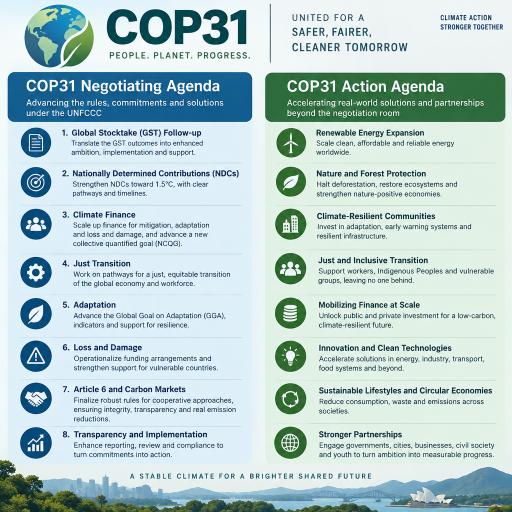
COP31 Negotiating Agenda and Action Agenda
COP31 will operate through two interconnected tracks: formal negotiations among countries and a broader Action Agenda designed to accelerate practical climate solutions. One establishes international decisions and policy frameworks; the other mobilizes voluntary commitments from governments, businesses, cities, financial institutions, researchers and civil society.
The conference is scheduled for November 9–20 in Antalya, Türkiye. Its central challenge will be to convert existing climate promises into measurable progress while maintaining cooperation among countries with different economic circumstances and responsibilities.
What is the COP31 negotiating agenda?
The negotiating agenda defines the subjects governments will formally consider under the United Nations climate process. It covers institutional business as well as major policy areas such as emissions reduction, adaptation, climate finance, loss and damage, transparency, agriculture and a just transition.
A provisional agenda is prepared before the summit and refined through consultations and preparatory meetings. The participating parties formally adopt it when COP31 opens. Some issues arrive in Antalya with advanced draft texts, while others may remain politically contentious.
Negotiations generally begin with technical discussions. Ministers and senior officials become more directly involved during the second week, when unresolved questions require political compromises. Topics that cannot secure sufficient agreement may be deferred to a later session.
Expected priorities
- Adaptation and resilience: improving national adaptation plans and strengthening protection against heat, drought, floods, fires and rising seas.
- Mitigation: closing the gap between current policies and the emissions reductions needed to pursue the 1.5°C temperature goal.
- Climate finance: directing more public and private funding toward climate action, particularly in vulnerable and developing countries.
- Loss and damage: improving assistance for communities facing climate impacts that can no longer be avoided.
- Just transition: ensuring that the move away from high-carbon economic activity protects workers and affected communities.
- Transparency: strengthening emissions reporting and the monitoring of national climate commitments.
- Food and agriculture: addressing the effects of heat, water scarcity and ecosystem decline on food security.
Türkiye holds the COP31 presidency, while Australia has a leading role in steering the negotiation process. Their coordination is expected to place particular attention on resilience, implementation and the climate risks confronting Pacific communities.
What is the Action Agenda?
The Action Agenda is the implementation-focused side of COP31. It does not create the same kind of negotiated international decisions. Instead, it encourages voluntary initiatives capable of turning climate objectives into projects, investments and partnerships.
This track widens participation beyond national delegations. Municipal governments can present urban resilience programs, companies can announce industrial decarbonization plans, banks can support clean infrastructure, and universities or community organizations can contribute research and local expertise.
The proposed priorities include:
- Zero waste: expanding circular economic models and reducing methane from discarded materials.
- Oceans and seas: protecting marine ecosystems and developing blue-carbon solutions.
- Food security: creating agricultural systems that are sustainable and resilient to climate disruption.
- Climate-resilient cities: improving buildings, infrastructure and urban planning while lowering energy demand.
- Implementation and investment: connecting national promises with finance and executable projects.
- Youth and education: strengthening climate literacy and meaningful youth participation.
- Green industry: supporting competitive manufacturing with lower emissions.
- Clean energy: accelerating electrification, modern power grids and access to reliable low-carbon energy.
- Nature and land: linking climate action with biodiversity protection and efforts against desertification.
- Public health: preparing health systems for heat, disease and other climate-related threats.
One highlighted ambition is for electricity to satisfy 35% of global energy demand by 2035. Reaching that level would also require cleaner power generation, stronger grids, energy storage and wider access to affordable technologies.
Blue zone and green zone
COP31 activities will be divided between two principal spaces. The blue zone will host official negotiations, diplomatic meetings and accredited events. It is where countries work on texts, resolve disagreements and adopt decisions.
The green zone will provide a more open setting for exhibitions, public discussions and presentations by businesses, researchers and civil society groups. Although these events are outside the formal negotiating process, they can demonstrate technologies, partnerships and community-based approaches already being applied.
Why both agendas matter
The negotiating agenda establishes common direction, rules and financial or institutional arrangements. The Action Agenda provides a faster and more flexible route for implementation. Voluntary initiatives can test solutions and attract investment, but they cannot substitute for effective public policy or international cooperation.
The credibility of COP31 will therefore depend on how well the two tracks reinforce each other. Diplomatic decisions need financing, accountability and delivery mechanisms. At the same time, voluntary projects should support agreed climate goals rather than rely on vague pledges.
Key questions
Who approves the negotiating agenda?
The parties to the United Nations climate convention adopt it formally at the opening of the conference.
Are Action Agenda commitments mandatory?
No. They are voluntary initiatives undertaken by public and non-state participants.
Can businesses take part in formal negotiations?
Only governments negotiate and adopt decisions, although accredited organizations may observe proceedings and contribute through consultations and side events.
How will COP31 be judged?
Success will depend on both the strength of negotiated outcomes and evidence that climate commitments are producing verifiable changes in energy, finance, infrastructure, ecosystems and community resilience.



Leave a Reply