

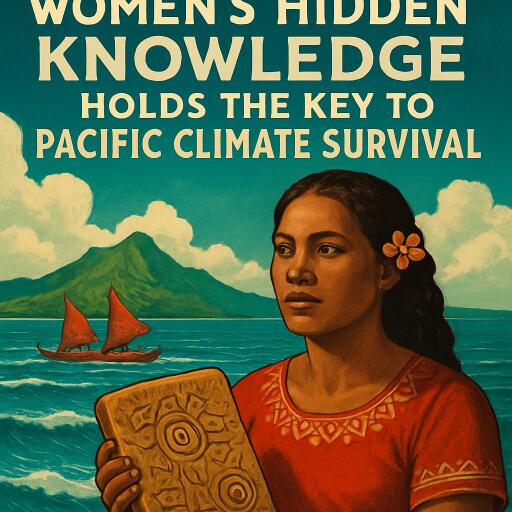
Women’s Hidden Knowledge Holds the Key to Pacific Climate Survival
Across Pacific Island communities, some of the most practical climate knowledge is carried not in government plans or scientific dashboards, but in daily work traditionally done by women. It includes knowing which crops can survive dry spells, which coastal plants can slow erosion, where freshwater can still be found during drought, and how to gather food from reefs and mangroves when storms make offshore fishing impossible.
New research reviewing evidence from across the region argues that this expertise is far more than cultural heritage. It is a critical part of climate adaptation and disaster preparedness. Yet it is often overlooked in official planning, leaving communities more exposed as seas rise, cyclones intensify, and water and food security grow more fragile.
The findings draw on studies from several Pacific nations, especially Fiji, the Solomon Islands, Tonga, Samoa, and Kiribati. Together, they show that environmental knowledge is often shaped by gender roles, with women and men developing different but complementary forms of expertise. The problem is that formal governance systems frequently recognize only one side of that equation.
Climate knowledge rooted in everyday survival
In many island communities, women play a central role in food production close to the home. They tend household gardens, select seeds, maintain crop diversity, preserve food, and monitor which plants remain reliable when weather shifts abruptly. This knowledge becomes especially valuable after cyclones or during drought, when imported supplies may be interrupted and staple foods are under pressure.
In some places, women have helped keep food systems flexible by relying on hardy crops such as wild yam, cassava, and sweet potato. They also use preservation methods that extend the life of breadfruit and root crops, turning them into flour or dried stores that can be used when fresh food is scarce. These practices, refined over generations, can make the difference between a rapid recovery and a prolonged food crisis.
Research from Tonga also points to a deeper history. Earlier farming systems combined trees, shrubs, and root crops in mixed landscapes that buffered heat, protected soils, and spread risk. Over time, outside economic pressures and colonial influence pushed many of these systems toward monocropping and narrower ideas of productivity. As that happened, women’s roles in sustaining food resilience were often misunderstood or pushed aside.
The invisible expertise of coasts, wetlands, and reefs
Women’s environmental knowledge is just as important along shorelines and in tidal zones. In parts of the Pacific, women know which mangrove species are best suited to hold unstable coasts together and where to plant them to reduce erosion. They also understand the medicinal uses of mangrove plants and other coastal species, linking ecosystem health directly to household wellbeing.
This is not abstract conservation. It is practical adaptation. Mangroves can reduce wave energy, hold sediment in place, and protect homes and gardens from shoreline loss. When elder women guide younger generations in planting and caring for these areas, they are passing on a frontline climate defense strategy.
On atolls such as Kiribati, women also hold detailed knowledge of gleaning — the collection of shellfish, crabs, and edible marine life from shallow reefs, lagoons, and mangrove edges. They read subtle signs in the sand, tide, and water movement to locate food that others might miss. After storms, when boats cannot safely go to sea, this skill becomes a crucial backup food source.
Yet these contributions are often absent from marine policy. In some communities, fishing closures and coastal rules have been designed without women’s input, even when the restricted areas overlap with places women depend on for food gathering. That exclusion can weaken both conservation efforts and community trust. If the people who use an ecosystem most intimately are not part of decisions, management plans are less likely to work.
Reading danger before disaster strikes
Women’s knowledge is also tied to early warning and crisis response. In rural Pacific communities, shifts in flowering seasons, unusual lunar patterns, and changes in water or soil conditions can be interpreted as signs of drought, floods, or strong storms ahead. These observations complement other forms of local expertise, such as offshore weather reading or structural repair skills more commonly associated with men.
When extreme weather hits, women are often central to collective recovery. They organize care, redistribute food, support children and elders, and help coordinate communal labor. In many villages, this social infrastructure is as vital as roads, seawalls, or communications equipment. Recovery depends not only on materials, but on relationships, trust, and the ability to mobilize people quickly.
The research also highlights that disaster systems built around rigid gender assumptions can fail those doing essential work. Response plans that ignore non-binary or culturally specific gender identities may exclude people from shelters, aid, or decision-making, even when they are heavily involved in relief efforts.
Why this knowledge is still being sidelined
The marginalization of women’s expertise is not accidental. Across the Pacific, colonial systems and missionary influence reshaped older social structures, often concentrating authority in male-dominated institutions and weakening women’s control over land, food systems, and customary knowledge. Many modern governance frameworks still reflect those hierarchies.
As a result, consultations on climate adaptation may prioritize male chiefs, officials, or technical experts while overlooking women who manage gardens, water access, seed knowledge, shoreline planting, and nearshore food gathering. That gap can produce maladaptation: policies that appear locally grounded, but are incomplete because they ignore some of the people with the most relevant experience.
What better adaptation would look like
The evidence points to a clear lesson: Pacific climate resilience will be stronger when women are not merely consulted as a formality, but given real authority in planning and decision-making. That means designing meetings and consultation processes around practical realities such as language, timing, transport, and caregiving responsibilities. It also means supporting community-led efforts to record seasonal knowledge, oral histories, and ecological practices while keeping ownership in local hands.
Just as importantly, adaptation programs must avoid placing even more unpaid responsibility on women. Many communities already depend on their labor to maintain food security, family welfare, and post-disaster recovery. Effective policy should recognize, support, and fairly resource that work.
The larger message is straightforward. Climate resilience in the Pacific will not come only from engineering projects, satellite forecasts, or imported development models. It will also depend on whether governments and institutions value the knowledge already embedded in everyday island life. Ignoring women’s environmental expertise means overlooking some of the region’s most tested strategies for surviving uncertainty.
For islands facing harsher storms, rising seas, and growing pressure on land and water, that is not just an issue of fairness. It is a question of survival.



Leave a Reply