

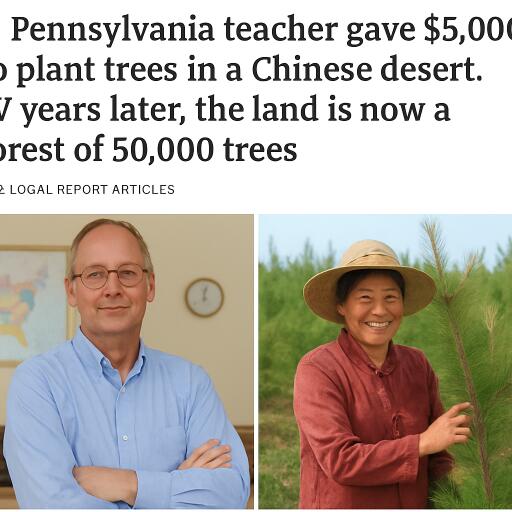
In 1999, Pennsylvania teacher Ronald Sakolsky donated $5,000 to farmer Yin Yuzhen to fund her tree-planting efforts in Inner Mongolia; 27 years later, his contribution helped transform China’s Maowusu Desert into a forest of 50,000 trees – THE LOCAL REPORT ARTICLES
A small act of support from across the world helped grow into a striking environmental success in northern China, where a once wind-scoured landscape in Inner Mongolia now supports tens of thousands of trees.
Ronald Sakolsky, a retired teacher from Pennsylvania, recently traveled back to China for the first time in more than two decades and found that an area he once helped support had changed beyond recognition. What had once been part of the harsh Maowusu Desert is now a forested zone with about 50,000 full-grown trees.
His connection to the project began in 1999, while he was teaching English in Henan province. There, he learned of Yin Yuzhen, a rural woman living on the edge of the desert who had made it her mission to hold back the sands by planting trees. She had begun the work years earlier after moving to the region with her husband, choosing to confront the advancing desert one sapling at a time.
Inspired by her determination, Sakolsky gathered $5,000 and sent it to help expand the planting effort. At the time, the sum represented a major boost to a family working in difficult conditions and facing the constant challenge of keeping young trees alive in dry, shifting soil.
The two later met, and Yin pledged that she and her family would care for the seedlings. Over the years, that promise appears to have taken root in spectacular fashion. When Sakolsky returned this year, he found a mature woodland where barren sand had once dominated the horizon.
During his visit, the pair reunited among trees that now rise high above the desert floor. Local recognition of the project has grown along with the forest, with one grove reportedly named in Sakolsky’s honor. Together, he and Yin also planted another tree, symbolizing the long partnership behind the transformation.
The reunion carried strong emotional weight. Sakolsky described the experience of seeing the forest in person as far more powerful than hearing about it from afar. For Yin, the meeting was proof that a promise made decades ago had been fulfilled through persistence, family labor, and care for the land.
The story has also drawn attention because it links personal friendship with long-term ecological restoration. At its center is not only a donation, but a shared belief that damaged landscapes can recover when people invest in them patiently and over many years.
The Maowusu region has long been associated with desertification, one of northern China’s major environmental challenges. Large-scale efforts to slow the spread of sand and restore vegetation have been underway for decades, especially in dry northern and western regions where erosion, overgrazing, and water stress have put ecosystems under pressure.
Tree planting has played a central role in those restoration campaigns. But specialists have long noted that success depends on more than simply putting seedlings in the ground. Survival rates, water availability, and the selection of species suited to local conditions all matter. Earlier large-scale programs sometimes relied on fast-growing trees that were poorly matched to arid environments, increasing pressure on scarce water resources.
More recent approaches have increasingly emphasized better-adapted species and more ecologically suitable restoration methods. In fragile drylands, experts often stress that long-term outcomes improve when projects balance tree planting with broader landscape management, including shrubs, grasses, and soil conservation.
Even so, the forest linked to Yin’s work stands as a vivid example of what sustained effort can achieve in a difficult climate. Turning even a small section of desert greener requires years of labor, repeated planting, and constant protection from drought and sandstorms. Reaching 50,000 trees is not simply a matter of funding, but of endurance.
Sakolsky has used the experience to speak more broadly about environmental responsibility. For him, the lesson is that individual actions may appear modest at first, yet can contribute to far larger changes over time. A single donation helped support a local vision; decades later, that support helped shape a living forest.
The story also resonates beyond one place because it highlights a simple truth about ecological recovery: restoration often begins with ordinary people. In this case, a teacher moved by a distant struggle and a farmer committed to defending her home each played a role in changing a landscape.
As climate change, land degradation, and biodiversity loss continue to strain ecosystems worldwide, the transformation in Inner Mongolia offers a reminder that restoration is possible, though rarely quick or easy. It depends on patience, local knowledge, and a willingness to think in decades rather than seasons.
For Sakolsky and Yin, the forest is more than a stand of trees. It is a record of trust, perseverance, and the slow work of healing land that once seemed beyond repair.



Leave a Reply