

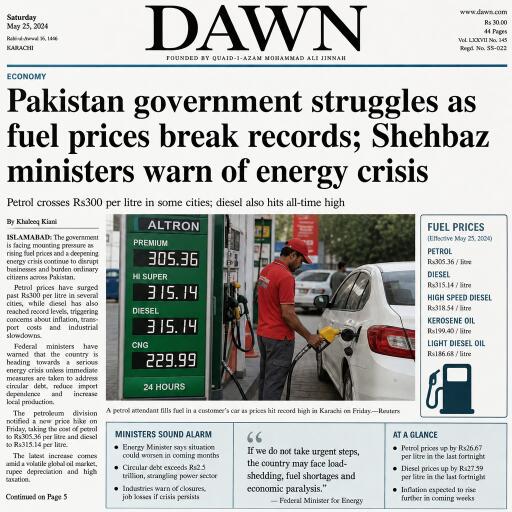
Pakistan government struggles as fuel prices break records; Shehbaz ministers warn of energy crisis
Pakistan’s fuel prices have hit new peaks as global oil markets convulse from shipping disruptions around the Arabian Peninsula, intensifying a domestic energy crunch and putting the government under acute political and economic pressure. Cabinet members have warned of supply risks and rising power costs even as the administration weighs relief measures and debates how far it can go to rein in demand without choking activity.
Record pump prices, daily repricing, and fragile supply lines
Late Tuesday, the government lifted petrol prices by PKR 4.10 per litre and high-speed diesel by PKR 6.41 per litre, taking retail rates to PKR 384.34 for petrol and PKR 415.83 for diesel. Islamabad has already shifted to a daily pricing mechanism, introduced in July, to better track volatile international benchmarks—volatility now amplified by threats to key maritime chokepoints, including the Strait of Hormuz and Bab el-Mandeb. A recent shutdown of Saudi Arabia’s East–West pipeline following an aerial attack further rattled supply expectations.
Officials say the shock is reverberating across the economy. One senior minister, Musadik Malik, acknowledged that while the government is trying to shield the most vulnerable, it cannot fully cushion households from the latest spike. A targeted relief scheme is being expanded: motorcyclists may receive subsidised petrol for up to five litres per week, and car owners could get relief on as much as 10 litres every 10 days. The aim, Malik said, is to soften the blow without overwhelming public finances.
Power sector walks a tightrope
Energy minister Awais Leghari described a power system straining to stay balanced as imported fuel prices leap. In August, roughly 72% of electricity generation came from domestic sources—hydropower, local coal, nuclear, indigenous gas, wind and solar—while 28% relied on imports, chiefly coal and re-gasified liquefied natural gas (RLNG). That domestic share has been crucial: spot RLNG cargoes have surged to about $23.25 per MMBtu, a level that would have forced steep tariff hikes had Pakistan leaned more heavily on the international market.
By diverting more local gas to power, the government says it averted deeper outages and avoided extra costs estimated at around PKR 10.6 billion that could have flowed to consumers if utilities had procured pricier RLNG or burned additional furnace oil. Even so, the margin for error is narrowing as import bills rise and hydropower swings with seasonal flows.
Demand restraint, mixed signals
With international fuel costs surging, policymakers are exploring ways to temper consumption. Ideas floated in earlier crises—such as shorter workweeks or earlier market closures—have re-entered the conversation in some quarters. But Malik pushed back on reports that a “smart lockdown” is currently on the table, stating that no formal discussions are underway. The government has, however, moved to accelerate reimbursements under the fuel relief scheme: a national steering committee led by Deputy Prime Minister Ishaq Dar has ordered payments to fuel stations within 24 hours as the programme rolls out nationwide from an initial pilot in Islamabad.
Political temperature is rising in parallel. Opposition parties have warned of nationwide protests if prices are not brought down, a reminder that energy economics and street politics are closely intertwined—especially when inflation is already stretching wallets.
The climate and energy transition lens
Pakistan’s dilemma sits at the crossroads of geopolitics, climate vulnerability and energy security. Heavier reliance on domestic generation has provided a buffer, but not a guarantee. Hydropower—central to the current mix—can be volatile as climate change intensifies heatwaves, shifts monsoon patterns and alters river flows. Meanwhile, imported fossil fuels expose the economy to shocks beyond its control, from shipping risks to price spikes.
Experts argue the country’s path out of this recurring bind rests on three tracks:
- Cutting oil demand through efficiency and mobility reforms—fuel-economy standards, mass transit, and incentives for electric two- and three-wheelers that dominate urban traffic.
- Scaling domestic renewables—solar and wind—to shave peak demand, reduce import exposure, and lower average power costs, supported by grid upgrades and storage.
- Protecting the poor with targeted relief, while phasing out broad subsidies that encourage waste and strain public accounts.
Short-term triage—daily price adjustments, limited relief, operational juggling of fuels—may steady the system for now. But without deeper reforms that lock in efficiency and accelerate clean power, each external jolt will echo through households, factories and the treasury.
What to watch next
- Shipping lanes and insurance costs: Any escalation around Hormuz or Bab el-Mandeb could push premiums—and pump prices—higher.
- Hydropower variability: Reservoir levels and seasonal flows will shape generation costs and outage risks.
- RLNG procurement: Spot prices versus long-term contracts will determine fuel mix and tariffs over the coming months.
- Policy signals: Whether demand-curbing measures reappear, how relief is targeted, and the pace of renewable capacity additions.
For now, Pakistan’s energy system remains on alert: pricier fuel is squeezing consumers, geopolitics is tightening supply lines, and the power sector is balancing on a narrow ledge—underscoring the urgency of a more resilient, climate-aligned transition.



Leave a Reply