

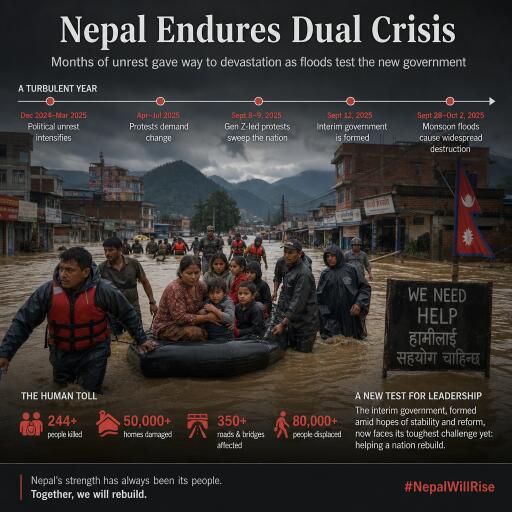
Nepal endured months of political upheaval. Devastating floods are now testing its new government
Two weeks after catastrophic flash floods ripped through Nepal’s mountain districts and river valleys, the country is tallying losses on a scale it can scarcely afford—and confronting a future in which such extremes are more likely. The destruction is immense: at least 7,500 homes obliterated, some 20,000 more in need of major repairs, and multiple hydropower plants damaged. Early assessments put the economic toll at roughly $2.56 billion—an enormous burden for a nation with a yearly budget of about $14 billion.
For a government barely settled after months of political turbulence, the timing could not be tougher. Street protests over corruption and a social media ban last year spiraled into deadly unrest and a change of leadership. In March, 36-year-old Prime Minister Balen Shah—an unconventional figure who rose from local politics—took office promising to reset the system. Now he faces an unforgiving first test: restore shattered infrastructure, reassure a bruised public, and set Nepal on a path to greater climate resilience.
Rescue and relief amid hard terrain
The army, police, medical teams, and helicopters have been deployed across the flood zones, coordinating with local authorities to evacuate people and supply aid. Thousands have been rescued. But reaching isolated valleys has proved difficult: highways are severed, bridges gone, and debris has clogged tunnels serving hydropower facilities. Shortages of specialized machinery and trained responders underscore how quickly disasters can overrun Nepal’s emergency capacity, particularly in steep, landslide-prone terrain.
Many senior officials are new to national government, and the lack of experience shows, according to Kathmandu-based observers. Nepal’s exposure to earthquakes, landslides, and floods is no secret, they note, yet institutional learning and investment have lagged behind the growing risks.
A deadly toll and wider economic shock
By midweek, more than 1,300 people were reported dead across Nepal and Tibet and about 5,000 were still missing. While search operations continue, attention is shifting to what comes next: rehousing families before winter, restoring lifelines to remote communities, and rebooting parts of the economy.
Tourism—an essential source of income—will feel the shock, especially in trekking regions where trails, lodges, and roads have been washed out. Energy is another pressure point. Floods struck a major hydropower corridor that typically provides about 10% of Nepal’s electricity, and projects still under construction in the same region represent a substantial share of the country’s future generation. Industry representatives warn that, unless rebuilt with stronger standards and better siting, the sector’s vulnerability will persist.
What triggered the disaster—and why it matters
Scientists studying the event point to a high-altitude slope collapse that mixed rock and glacial ice, unleashing a torrent of debris and water downstream. While researchers are careful not to attribute a single catastrophe directly to climate change, the broader context is unmistakable. The Himalayas are warming rapidly; glaciers are retreating; rainfall is becoming more erratic; and snowmelt patterns are shifting. In Nepal, where towns, roads, and power lines often occupy steep valleys beneath unstable slopes, these shifts turn known hazards into amplified threats.
That vulnerability is not matched by responsibility for the problem. Nepal accounts for about 0.1% of global greenhouse gas emissions. Over recent decades, it has nearly doubled forest cover, generated most of its electricity from clean sources, and advanced quickly in electric mobility. Those gains, while significant, cannot by themselves shield communities from the destabilizing changes underway in the mountains.
Rebuilding for a different climate
Members of Parliament and local leaders argue that the country must harden its defenses and rethink where and how it builds. That means modern, multi-hazard early warning systems that reach people quickly; land-use planning that keeps homes, roads, and critical facilities out of known flood and landslide corridors; and hydropower infrastructure designed for more extreme flows and sediment loads.
The preliminary damage estimate—nearly one-fifth of the national budget—does not include the full cost of reconstruction, which could run to $4–5 billion. It adds pressure on a government already tasked with funding schools, clinics, jobs, and investment. Nepal has appealed for international support, and aid has started to flow in the form of relief supplies and technical assistance. But officials and policy analysts alike say the gap between needs and resources is too large for Nepal to bridge alone.
They argue that wealthier nations should expand support for disaster recovery and climate adaptation in highly exposed countries, both as a matter of solidarity and in recognition of the unequal contributions to warming. Without sustained backing—grants, concessional finance, and expertise—Nepal risks rebuilding the past rather than preparing for the climate that is coming.
A government’s defining trial
For Prime Minister Shah, the floods compress years of governance challenges into a single season. Success will be measured not only by how quickly roads reopen and power returns, but by whether the recovery sets new standards: relocating the most at-risk settlements; enforcing safer construction; investing in weather, glacier, and landslide monitoring; and ensuring that communities, not just infrastructure, are made more resilient.
In a country where the mountains are shifting and the climate is changing faster than policies on paper, rebuilding is more than an engineering task—it is a political choice. Nepal’s new leadership has the mandate and the moment. The question now is whether it can turn tragedy into a safer future, and whether the world will stand with it long enough to make that future possible.



Leave a Reply