

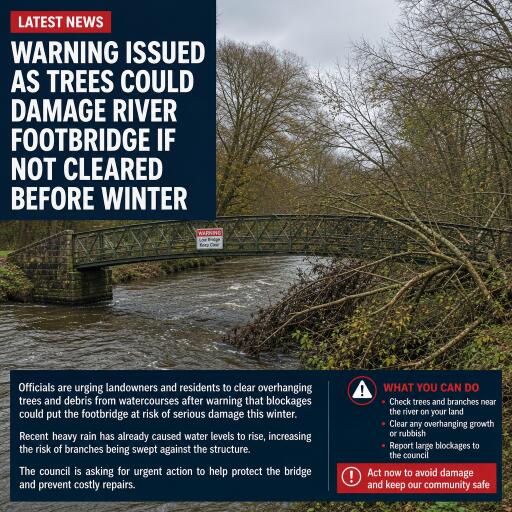
Warning issued as trees could damage river footbridge if not cleared before winter
Fallen trees clogging a stretch of the River Amman in Garnant have triggered fresh safety concerns, with local leaders urging swift action before winter storms arrive. The debris has accumulated near the Palais footbridge, raising fears that high flows could slam trunks and branches into the structure, potentially weakening or damaging it.
The call for intervention follows repeated reports of trees dropping into the river after recent bouts of severe weather. Local representatives say it reflects a broader pattern: saturated soils, stronger winds and more intense rainfall—hallmarks of a warming climate—are loosening riverbanks and uprooting mature trees more often than in past decades.
Engineers and ecologists note that large woody material in rivers can be a double-edged sword. In natural settings, it slows water, creates habitat and helps retain sediment. But when piles of debris lodge against bridges, culverts or narrow channels, they can divert flows, increase scour around foundations and add force to structures during flood peaks.
Following a site visit and a review of flood mapping, Natural Resources Wales reported no evidence that the vegetation at this location is currently heightening flood risk to nearby homes or businesses. With no increased property risk identified, responsibility for managing the obstruction falls to the riparian landowner—those who own land alongside the river and are required to keep the channel clear of blockages that could impede flow or threaten infrastructure.
Carmarthenshire County Council has confirmed that its Structures Team has issued instructions for removing the trees from the watercourse at the Palais footbridge. The council is seeking quotations from framework contractors to carry out the extraction, and, subject to availability, expects work to begin within approximately two weeks.
While immediate removal is focused on public safety, longer-term resilience will depend on adapting to the region’s shifting climate. In Wales, winters are trending wetter, and intense rainfall events are becoming more frequent. That combination accelerates bank erosion and increases the likelihood that weakened trees topple into channels. As communities upgrade bridges and pathways, experts recommend a two-pronged approach: proactive maintenance at choke points like footbridges and culverts, and nature-based solutions upstream that reduce peak flows and stabilize banks.
Such measures can include targeted planting of deep-rooted native species away from critical structures, selective coppicing, and managed setbacks for footpaths in erosion-prone areas. Where possible, retaining some woody material in low-risk sections of the river can preserve ecological benefits—nursery habitat for fish and invertebrates, shade in low-flow months, and improved channel complexity—while preventing dangerous build-ups near crossings.
Locally, residents are being asked to report new blockages, avoid entering the river to move debris themselves, and observe any temporary restrictions around the Palais footbridge while works are underway. Short-term disruption is possible during extraction, but officials say removing the obstruction before winter is the most prudent step to safeguard the bridge and ensure safe public access along the riverside.
The episode underscores a reality many communities are confronting: as weather extremes become more common, routine river maintenance and infrastructure checks must keep pace. Clearing the current accumulation near the Palais footbridge is a necessary fix; making space for water, stabilizing banks and strategically managing riverside trees will be essential to reduce repeat risks in the years ahead.



Leave a Reply