

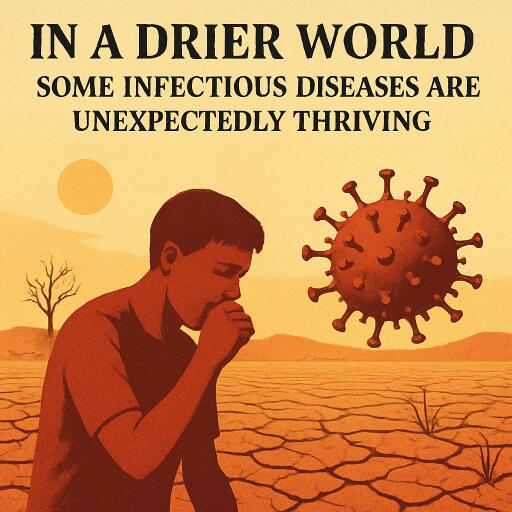
In a Drier World, Some Infectious Diseases Are Unexpectedly Thriving
As climate change intensifies, drought is no longer just a water crisis or an agricultural emergency. It is increasingly becoming a public health problem as well. Scientists are finding that in many cases, dry conditions can actually help certain infectious diseases spread, even when that seems to defy common sense.
At first glance, the idea sounds contradictory. Many parasites, bacteria, and viruses rely on water at some stage of their life cycle. Logic would suggest that less water should mean fewer infections. Yet research across humans, wildlife, fish, insects, and livestock shows the opposite can also happen: some diseases weaken during drought, while others gain ground.
This puzzling pattern is sometimes described by disease ecologists as a drought-disease paradox. Drying landscapes can suppress some pathogens, but they can also reshape ecosystems in ways that make transmission easier for others.
One major reason is concentration. When ponds, wetlands, and rivers shrink, both animals and humans are pushed toward the same limited water sources. That crowding creates ideal conditions for disease transmission. More hosts are packed into smaller spaces, more waste accumulates nearby, and the chances of encountering parasites or pathogens rise sharply.
In grazing ecosystems, for example, drought can force herds to gather around the last remaining pools. These sites often become contaminated with feces, which allows parasites that spread through dung to build up rapidly. The same ecological bottleneck can occur among birds, livestock, and even insects.
Mosquito-borne illnesses can also behave in surprising ways during dry spells. When water becomes scarce, birds and mosquitoes may interact more closely around isolated pools, increasing circulation of viruses such as West Nile. In urban regions, drought can alter human behavior too. People often store water in containers when supplies become unreliable, unintentionally creating breeding grounds for mosquitoes that carry dengue and other illnesses.
Water quality changes matter as much as water quantity. As lakes, reservoirs, and ponds recede, the remaining water can grow warmer, saltier, and more stagnant. In some situations, these harsher conditions kill off organisms that cause disease. In others, they favor dangerous microbes, algae, molds, or bacteria that thrive in stressed aquatic environments.
That means drought does not have a uniform effect. Some infections decline when their hosts or vectors disappear. Others surge because the environment becomes more favorable or because contact between species increases. The outcome depends on the biology of the pathogen, the severity of the drought, and how ecosystems and people respond.
Examples from recent years underline the complexity. Extended drought has been linked to spikes in cholera after water systems deteriorate and sanitation falters. In arid periods, dust can also become a health threat. Fungal diseases carried in soil may spread more easily when landscapes dry out and winds lift contaminated particles into the air. In other cases, prolonged drought can initially boost a microbe’s growth, only for extreme or extended dryness to wipe it out later.
Scientists are also paying close attention to rapid swings between heavy rain and intense dryness. This “weather whiplash” can be especially dangerous. Wet periods may help fungi or bacteria multiply in soil or water, while the dry period that follows helps disperse them. A disease may therefore depend not on drought alone, but on a sequence of extremes.
This emerging field of research is revealing just how tightly health is connected to the water cycle. For years, much of the discussion around climate-sensitive disease focused on rising temperatures. Heat remains a major factor, but changing rainfall patterns, shrinking rivers, failing reservoirs, and prolonged dry spells are proving just as important.
The implications extend well beyond wildlife ecology. Human infrastructure can amplify the problem. Aging pipes, interrupted water service, emergency storage tanks, irrigation systems, and dams all alter how water moves and where it lingers. Those changes can create new habitats for vectors or expose communities to unsafe water. In places already strained by poverty or weak public services, drought can magnify the risk.
Technology is expected to play a growing role in managing these threats. Satellite monitoring, remote sensing, and high-resolution climate models are helping researchers track shifting water availability in near real time. Combined with disease surveillance, these tools could improve early warnings for outbreaks tied to drought, degraded water quality, or changing animal movement.
Still, prediction remains difficult because ecosystems do not respond in simple ways. The same drought that reduces one disease can intensify another. A shrinking wetland might remove mosquito habitat in one region, while concentrating hosts and vectors in another. Local geography, species behavior, sanitation systems, and land management all influence the outcome.
What is becoming clear is that a hotter, drier climate does not necessarily mean fewer water-related infections. In many cases, scarcity can create the very pressures that help disease flourish. As warming continues to disrupt rainfall and intensify drought across large parts of the world, public health planning will need to treat water management and disease prevention as deeply linked challenges.
The lesson is a sobering one: when water disappears, disease does not always disappear with it. Sometimes, it finds new ways to spread.



Leave a Reply