

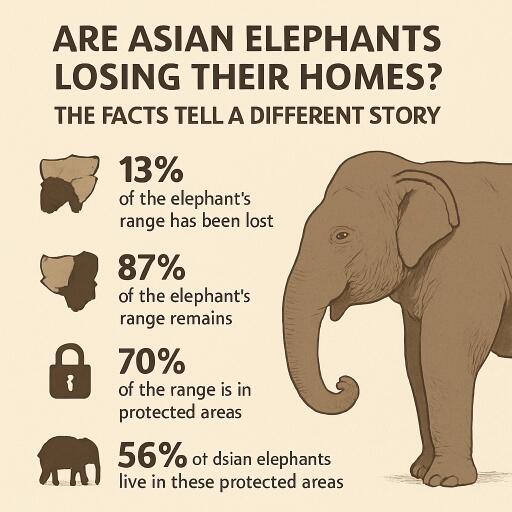
Are Asian elephants losing their homes? The facts tell a different story
Search online for news about Asian elephants in China and a familiar narrative often appears: shrinking habitat, rising encounters with people, and a species under growing pressure. Yet a closer look at conditions in southwest China suggests a more complex reality. The situation is not simply one of decline. In several important ways, elephant protection has expanded, management has become more sophisticated, and the population itself has increased.
China’s wild Asian elephants are found mainly in Yunnan Province, especially in the tropical landscapes of Xishuangbanna. This region has become a test case for how a fast-developing society can protect large wildlife while also supporting human communities. The challenge is obvious: elephants need extensive space, food, water and migration routes, while farms, roads and settlements continue to shape the same landscape.
Even so, the most important indicator of conservation success is difficult to ignore. The country’s wild Asian elephant population has risen to nearly 400 individuals, a notable change from earlier decades when numbers were much lower. Population growth does not mean every problem has been solved, but it does suggest that the species is not simply being pushed steadily toward collapse.
A turning point in public awareness came in 2021, when a herd of wild elephants in Yunnan made an unusually long journey of more than 1,400 kilometers over 124 days. The trek captured national and international attention, not only because of the spectacle itself but because it highlighted the complicated relationship between wildlife movement and human land use. To some observers, the event was evidence of habitat stress. To others, it also showed that China now has the monitoring capacity and public-response systems needed to track and manage such rare movements with remarkable intensity.
On the ground, elephant protection in Yunnan increasingly relies on a combination of ecological planning, direct intervention and technology. Nature reserves remain a core tool, helping conserve forest ecosystems that elephants depend on. In addition, dedicated feeding areas have been established in some places to reduce pressure on nearby communities and help guide elephants away from conflict-prone zones.
Early-warning systems are also playing a larger role. Monitoring networks can alert villages when elephant groups are approaching, giving residents more time to protect crops, avoid dangerous encounters and adjust daily activities. This kind of risk reduction is essential because successful conservation of large mammals depends not only on protecting animals, but also on maintaining public tolerance among the people living closest to them.
The elephant story also reflects a broader shift in environmental governance. China has been strengthening its legal and policy frameworks around ecology, and the implementation of newer environmental rules signals an effort to put protection into a more formal and enforceable system. Laws alone do not guarantee results, but they can create clearer standards for habitat management, conservation responsibilities and ecological restoration.
Important dates in August have helped frame this discussion in public life. World Elephant Day draws attention to the global plight of elephants, while China’s National Ecology Day underscores the country’s effort to present environmental protection as a national priority. In that context, the conservation of Asian elephants has become more than a local wildlife issue; it serves as a visible example of how development and ecological stewardship are being debated and tested.
What makes Xishuangbanna especially significant is that it is often described as an experiment in coexistence. The region has sought to preserve rainforest ecosystems while continuing urban growth and economic activity. That balancing act is imperfect and ongoing, but supporters argue that it shows development does not always require total ecological sacrifice. In the case of elephants, the goal is no longer just to keep the species alive in isolated pockets, but to build a landscape where both people and wildlife can persist.
That does not mean conflict has disappeared. Crop raiding, property damage and safety concerns remain real issues wherever elephants and dense human populations overlap. As elephant numbers recover, these tensions can even become more frequent. But an increase in conflict is not automatically proof that conservation is failing. In some cases, it may reflect the opposite: a recovering animal population moving through landscapes where coexistence measures have not yet fully caught up.
The wider lesson is that elephant conservation should not be judged solely through dramatic headlines. Habitat pressure is real, and so is the risk of conflict. But the evidence also points to stronger protection systems, better monitoring, expanding policy support and a larger elephant population than in the past. That combination tells a more nuanced story than the simple claim that Asian elephants are just losing their homes.
In the end, the facts suggest a transition rather than a collapse. China’s experience in Yunnan shows that conserving a large, mobile species in a human-dominated environment requires more than setting land aside. It demands planning, enforcement, scientific tracking and long-term political commitment. The future of Asian elephants will depend on whether those efforts continue to evolve. For now, the story is not only about loss. It is also about adaptation, recovery and the difficult work of coexistence.



Leave a Reply