

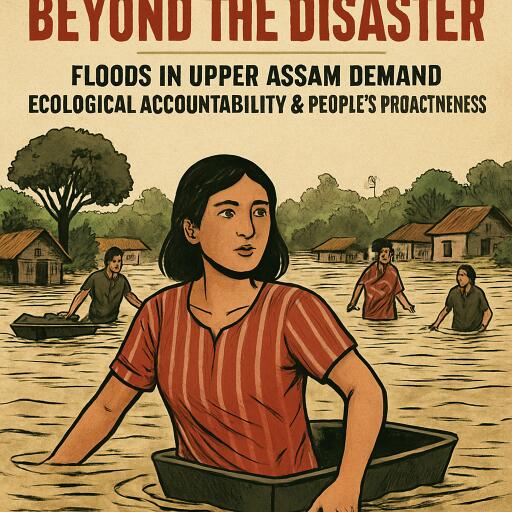
Beyond the Disaster:Floods in Upper Assam Demand Ecological Accountability & People’s Proactiveness
The recent flooding across Upper Assam, especially in Sivasagar, Jorhat and Charaideo, has exposed once again how fragile the region has become in the face of extreme monsoon events. Villages were submerged, thousands of residents were uprooted, croplands disappeared under muddy water, and roads, bridges and public utilities were badly damaged. For many families, the disaster was not only about property loss. It meant interrupted schooling, vanished incomes, broken transport links and a deep sense of insecurity about the future.
Heavy rainfall may have triggered the crisis, but rainfall alone does not explain why the damage was so severe. A deeper ecological problem is at work. Floods in Assam are increasingly shaped by what happens upstream in the surrounding hill catchments. When forests are cleared, slopes are cut recklessly, and mining expands without adequate safeguards, the land loses its capacity to absorb and regulate water. Rain that might once have been slowed by vegetation and filtered into the soil instead rushes downhill as fast runoff, carrying sediment into rivers below.
This is where the conversation must shift from “natural disaster” to ecological accountability. Degraded catchments do not simply affect the hills where the destruction occurs. They alter the hydrology of entire river systems. Soil erosion increases, streams carry more silt, and riverbeds gradually rise as sediment accumulates. Over time, rivers and tributaries lose carrying capacity, making floods more frequent and more destructive even during regular monsoon surges.
Forests function as living infrastructure. They soften the impact of rainfall, stabilize vulnerable slopes, recharge groundwater and help regulate the timing and volume of water entering rivers. Once those systems are weakened, flood risk expands downstream. In that sense, each patch of degraded hill forest becomes part of a much larger chain of vulnerability stretching into Assam’s plains. What unfolds during monsoon season is not merely a weather event, but the visible consequence of accumulated ecological neglect.
The economic fallout is immense. Agriculture, which supports a vast number of households in Upper Assam, is often the first casualty. Standing paddy, vegetable fields and small farms can be wiped out in days. Local markets slow down, transport services are cut off, businesses shut temporarily and essential services struggle to function. Recovery is rarely immediate. Even after floodwaters recede, families must deal with damaged homes, lost harvests, debt and uncertainty over the next planting season.
Yet the social costs are just as serious. Repeated displacement drains savings, disrupts children’s education and creates lasting stress for already vulnerable communities. For older residents, daily life becomes more precarious. For wage earners, every disrupted week means lost income. Floods are not isolated emergencies; they are recurring shocks that deepen inequality and weaken rural resilience year after year.
That is why flood management in Assam cannot remain limited to embankments, rescue operations and compensation packages after the fact. Those measures are necessary, but they are reactive. Long-term safety depends on addressing the ecological conditions that intensify flooding in the first place. Watershed restoration, hill-slope protection, scientific land-use planning, tighter regulation of extractive activities and continuous monitoring of environmental change in upstream catchments must become central to disaster mitigation.
Inter-state cooperation is also critical. Rivers do not recognize political borders, and neither do the impacts of deforestation, slope destabilization or sediment flow. Ecological security in Assam is tied to responsible landscape management in neighboring hill regions. This demands coordination among governments, stronger enforcement against illegal and destructive activities, and shared planning rooted in science rather than short-term expediency.
Equally important is public proactiveness. Communities cannot be treated only as victims waiting for annual relief. Residents, local institutions, student groups, farmers’ organizations and civil society all have a role in demanding environmental accountability, reporting destructive land-use practices, supporting afforestation and participating in local watershed protection. A durable response to floods requires both policy reform from above and vigilance from below.
The broader lesson is clear: environmental protection is not an obstacle to development, but one of its foundations. When forests are stripped, hills destabilized and river systems overloaded with silt, the eventual price is paid by farmers, workers, schoolchildren and entire downstream communities. Ecological damage in one landscape can quickly become a humanitarian crisis in another.
Upper Assam’s latest flood disaster should therefore be read as a warning. If destructive activities in fragile catchments continue unchecked, the region may face the same cycle of loss more often and with greater intensity. Relief camps and emergency funds cannot substitute for healthy watersheds, intact forests and responsible governance. The real challenge is not only to survive the next flood, but to reduce the conditions that make it so devastating.
Assam’s geography already makes it highly vulnerable, cradled by surrounding hills and dependent on river systems shaped far beyond its plains. That reality makes ecological foresight essential. Lasting protection will come only when the region treats forests, rivers and catchments as shared life-support systems rather than expendable resources. Until then, every monsoon will carry the risk of turning environmental neglect into public tragedy.



Leave a Reply