

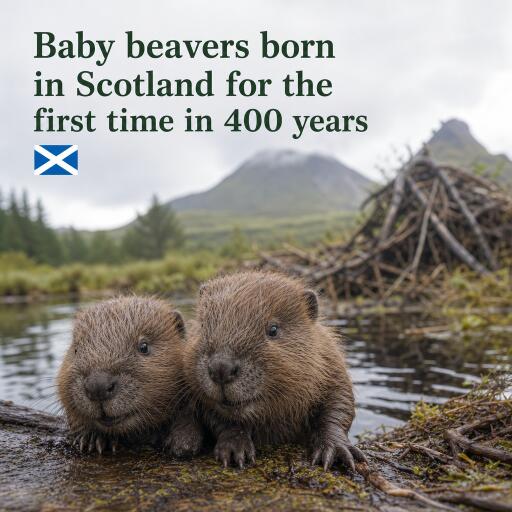
Baby beavers born in Scotland for the first time in 400 years
For the first time in four centuries, wild beaver kits have been born in the Scottish Highlands. The new arrivals were confirmed on Loch Beinn a’ Mheadhoin in Glen Affric, marking a landmark moment for ecosystem restoration in one of Scotland’s most celebrated glens.
At least two youngsters are known to be part of the loch’s growing beaver population. Field teams believe they were born in May or June and only recently began venturing from the family lodge. Because beavers are mainly active at night, direct sightings are rare, but remote cameras have captured clear footage — including a kit exploring the water alongside its mother.
A milestone years in the making
The births crown a reintroduction effort that began in 2022, led by conservation charity Trees for Life in partnership with Forestry and Land Scotland, with support from Beaver Trust. The first releases on Loch Beinn a’ Mheadhoin took place last October, when a family of five and an additional pair were settled at two sites within the Glen Affric National Nature Reserve. A second release — a family of four — followed in February. Careful site selection, health checks, and post-release monitoring were all part of the plan to give the animals the best chance of establishing stable territories.
Local beaver managers describe the births as a once-in-generations moment that signals nature’s capacity to rebound when given space and time. The first Glen Affric-born kits represent a new chapter: animals that will not only inherit the lodges and canals their parents built but will also begin shaping the landscape in their own right.
Nature’s engineers return
Beavers are renowned for their ability to transform freshwater ecosystems. By felling small trees and building dams, they slow the flow of water, create ponds and wetlands, and diversify habitat. This mosaic supports amphibians, fish, insects, and birds; filters sediments that can improve water quality; and helps store carbon in wet soils. In highland catchments that face heavier rainfall and longer dry spells as the climate warms, beaver-made wetlands can also buffer floods and sustain baseflows during drought.
Evidence from across Europe shows that where beavers return, biodiversity often follows. In Glen Affric, the expectation is similar: more wet edges for waders, more invertebrates for bats and birds, and more refuges for salmonids as water warms and river flows fluctuate. The new kits are the first generation likely to expand these benefits across the loch’s feeder streams and backwaters over the coming years.
Watching, learning, and adapting
To keep track of how the animals are settling in, a volunteer network of local residents has been established to observe bank-side activity, tree use, water levels, and lodge condition. Regular updates help the wider community understand what is changing — and why. Most beaver activity is discreet: coppiced willow and birch resprout, and canals and ponds sit tucked among reeds. Where management is needed to prevent localised flooding or protect particular trees, tried-and-tested tools — from simple flow devices to tree guards — can allow people and beavers to coexist.
Wildlife cameras continue to be central to the project’s monitoring, offering a low-disturbance way to confirm breeding success and track the kits’ development. While the animals are primarily nocturnal, dusk and dawn are the best times for quiet, distant observation. Project staff urge anyone visiting the area to give beavers ample space, keep dogs under close control, and avoid approaching lodges or dams.
Part of a national strategy
The Glen Affric project contributes to Scotland’s national beaver strategy and supports the directive for public agencies to seek suitable reintroduction opportunities on state-owned land beyond the species’ existing range. That approach aims to restore a native mammal once lost from much of the country while ensuring that reintroductions are planned, supported by communities, and responsive to any local challenges.
Four hundred years on from their disappearance, the sight of new kits surfacing beside their mother in a Highland loch is more than a conservation milestone. It’s a glimpse of a wilder, wetter future in which natural processes help Scotland’s landscapes store carbon, shelter wildlife, and soften the blows of a fast-changing climate. For Glen Affric, the newest residents are already at work — and just getting started.



Leave a Reply