

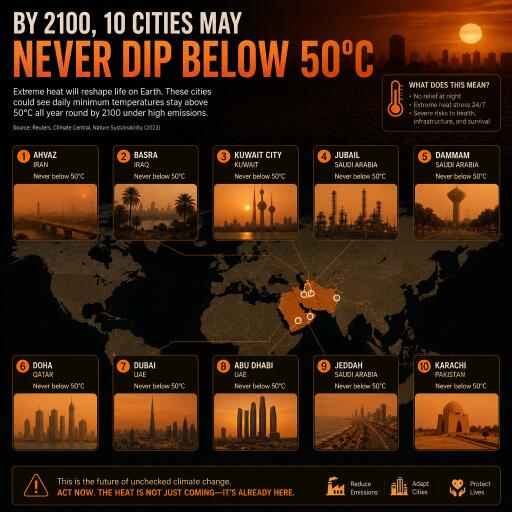
By 2100, 10 cities may never dip below 50°C
America’s cold season is fading fastest. The past winter ran far hotter than the 20th-century norm across the contiguous United States, and parts of the South and Southwest barely saw a true winter at all. That background warming is not just erasing chill; it is turbocharging summer extremes. By the end of this century, our analysis indicates that 10 major U.S. cities could endure peak-season stretches in which daytime temperatures never fall below 50°C, day after day.
Signals of this shift are already visible. Several western states logged their warmest winter on record, while mountain snowpacks in places like Colorado, New Mexico, Utah, and Wyoming fell to historic lows. That meager snow means less spring runoff, tighter water supplies, and a drier landscape primed for fire. Nationwide, the most recent December–February was roughly five degrees Fahrenheit above last century’s average—an extraordinary bump for a seasonal mean. Since the 1970s, winters have warmed by several degrees in most U.S. cities, dramatically reducing the number of freezing nights and reshaping ecosystems, agriculture, and public health.
Why does a milder winter matter for the prospect of 50°C summers? When the baseline warms, the entire distribution of temperatures shifts. What used to be considered rare heat is now more common; what was once unthinkable crosses into the possible. Add urban heat islands, expanding pavement, persistent drought, and warmer nights that offer little relief, and a 50°C ceiling that once seemed out of reach becomes a threshold some cities could face repeatedly during the hottest weeks.
How we estimated the 50°C risk
We examined long-term local temperature records from 1975 to 2025 and combined them with high-resolution climate projections. For each large U.S. metropolitan area with reliable observations, we calculated recent warming rates, then applied those trends to the hottest-month daily maximums recorded in 2025. From there, we estimated the lowest daily high likely during peak summer by late century under continued high warming. Cities where the “coolest” daytime high during extreme heat periods still exceeds 50°C form our at-risk group of ten.
This approach focuses on the intensity and persistence of peak heat—identifying places where multi-day spans may never dip under 50°C during the hottest stretches—rather than on single-day records.
Where the heat could lock in
The pattern is geographically coherent. The strongest candidates cluster in:
- The Desert Southwest, including large interior valleys and the lower Colorado River corridor
- South and West Texas, where arid ground, expanding cities, and frequent high-pressure “heat domes” compound the risk
- California’s inland basins, where stagnant summer air and low humidity can supercharge daytime highs
- Sections of the Gulf-adjacent interior during exceptional heatwaves
Elevation, coastal breezes, and vegetation still matter: higher terrain and ocean influence can blunt extremes, while sprawling, paved urban forms amplify them.
Consequences of a 50°C summer floor
- Health emergencies: Heat stroke, dehydration, and cardiovascular stress surge when daytime relief never arrives. Nighttime warmth further compounds risk, especially for older adults and outdoor workers.
- Power reliability: Air-conditioning demand spikes precisely as heat stresses transformers, transmission lines, and thermal power plants. Rolling outages become more likely without aggressive grid upgrades.
- Water security: Scant winter snow and higher evaporation drain reservoirs and aquifers, tightening supplies just as heat drives up consumption.
- Transport and infrastructure: Asphalt softens, rail lines buckle, aircraft face weight-limited takeoffs, and materials degrade faster under relentless thermal stress.
- Labor and productivity: Outdoor work hours shrink, indoor cooling costs soar, and schools and hospitals require new standards to remain safe.
- Fire and ecosystems: Prolonged heat desiccates vegetation, heightening wildfire risk and transforming habitats as species shift or decline.
Uncertainties and what could change the outcome
- Emissions pathway: Rapid, sustained cuts in heat-trapping pollution would slow warming and reduce the likelihood that 50°C becomes a persistent summer floor.
- Local adaptation: Urban trees, reflective roofs and pavements, shade structures, and water-wise planning can shave multiple degrees off neighborhood temperatures.
- Model spread and extremes: Our trend-based method captures direction and magnitude but cannot resolve every local feedback. Some extremes will outpace averages; others may be tempered by regional circulation shifts.
- Humidity and health: In some regions, lower absolute humidity can push daytime highs higher, while humid zones may reach dangerous “feels-like” heat at lower temperatures. Either pathway raises risk.
What to do now
- Cut the root cause: Decarbonize power, transport, buildings, and industry; scale storage and demand flexibility to steady the grid during heat spikes.
- Cool the city: Expand urban forests, permeable and reflective surfaces, green roofs, and shade along transit corridors and school routes.
- Protect people: Establish heat early-warning systems, cooling centers, worker protections, and building codes focused on passive cooling and ventilation.
- Harden infrastructure: Upgrade transmission, add distributed energy resources and microgrids, and design roads and rails for higher thermal tolerances.
- Secure water: Modernize irrigation, invest in leak reduction and reuse, and manage reservoirs for dwindling snowpacks and higher evaporation.
Winter’s rapid retreat is the clearest early alarm that our climate’s baseline is shifting. If current trends persist, a handful of U.S. cities could spend peak summer trapped above 50°C for days on end—a threshold with profound consequences for health, infrastructure, and livelihoods. The choices made this decade will determine whether that future becomes the norm or remains the outlier it should be.



Leave a Reply