

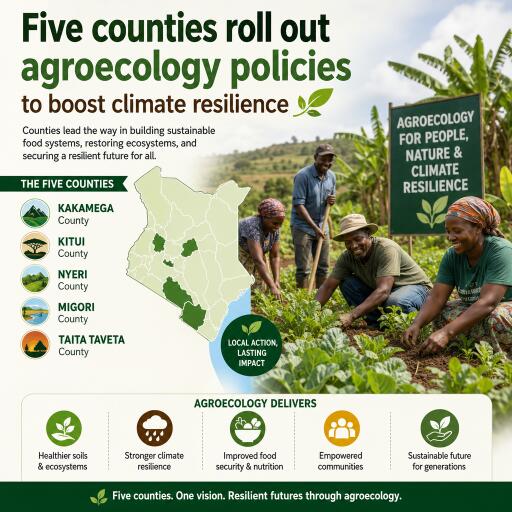
Five counties roll out agroecology policies to boost climate resilience
Kenya’s push to make farming more climate-resilient is gathering pace, with five counties formally adopting agroecology policies and several others close behind. Murang’a, Makueni, Nakuru, West Pokot and Kiambu have approved county frameworks to mainstream climate-smart, biodiversity-friendly agriculture, while Trans Nzoia, Turkana, Laikipia, Kirinyaga and Machakos are drafting similar plans.
Experts and farmer networks welcome the policy momentum but warn that progress will be measured by what happens in fields, not in county assemblies. They argue that the real test lies in budgeting for agroecology and rolling out concrete support—such as extension, farmer training, seed systems and soil restoration programmes—that can shift practices at scale.
From paper to practice
Agroecology advocates say counties must now move decisively into implementation. The approach, they note, reduces dependence on costly external inputs by building soil fertility, diversifying crops and integrating ecological processes into farm management. That matters in a season of compounding pressures: unpredictable rainfall, heat stress, emerging pests and diseases, and high prices for fuel and fertilisers.
A national coordinator with a farmer network emphasised that political commitment and financing are the missing links. Kenya has millions of smallholders, yet only a fraction currently access organised agroecology training or markets. Their organisation works with roughly 1.5 million farmers, but far more support is needed to transform the country’s food systems and protect household nutrition.
Why agroecology—and why now?
Agroecology blends science, practice and social participation. It promotes crop and livestock diversity, healthy soils, circular resource flows (such as composting and water harvesting), and locally adapted seeds and breeds. The result is farming that is more resilient to climate shocks, less input-intensive, and better for pollinators and biodiversity. Advocates also highlight health co-benefits from reduced chemical exposure and improved dietary diversity.
For Kenya, where climate extremes and market volatility often hit small farms hardest, agroecology provides a pathway to stabilise yields and incomes while regenerating degraded land. Diversified systems can buffer losses: if one crop fails due to drought or pests, another may still perform, safeguarding food and income.
Counties on the move
Counties with adopted agroecology policies:
- Murang’a
- Makueni
- Nakuru
- West Pokot
- Kiambu
Counties drafting policies:
- Trans Nzoia
- Turkana
- Laikipia
- Kirinyaga
- Machakos
National strategy, local action
At the national level, officials point to crop diversification as a cornerstone of climate resilience and nutrition. They report stepping up extension services and knowledge-sharing, while collaborating with county governments to localise the National Agroecology Strategy. Progress has been uneven, in part because agriculture is devolved and counties move at different speeds, but the expectation is that momentum will grow as more county policies take effect.
Soil health sits at the heart of these efforts. Without living, fertile soils, agricultural productivity cannot hold over time—no matter the seed or technology. Building soil organic matter, improving water retention and safeguarding biodiversity underpin the long-term viability of Kenya’s farming landscapes.
Science meets communities
Researchers working with farming communities stress that agroecology is more than “green” farming. It integrates ecological sustainability with economic viability and social equity—ensuring that practices boost livelihoods while improving ecosystem services. Participatory research, where farmers co-design and test innovations, is expanding to make solutions fit local realities—from drought-tolerant crops and biological pest management to intercropping and soil amendments using locally available materials.
Scientists also emphasise the value of indigenous knowledge and collective action. Farmer organisations, village groups and cooperatives can accelerate learning and uptake, while partnerships among counties, researchers and civil society help scale what works—without losing local nuance.
What farmers need next
Stakeholders outline several priorities to turn policy into tangible gains:
- Dedicated county budgets for agroecology, protected from mid-year cuts.
- Stronger extension: demonstration plots, farmer field schools and peer-to-peer learning.
- Access to quality, locally adapted seed and planting materials through community seed banks and certified local multipliers.
- Investments in soil health: composting hubs, training on cover crops and integrated nutrient management, incentives for terracing and water harvesting.
- Participatory research that tests context-specific packages for drylands, highlands and peri-urban zones.
- Inclusive market pathways for diverse, nutritious foods, including public procurement that rewards sustainable producers.
- Monitoring systems to track soil recovery, yield stability, dietary diversity and farmer incomes.
The road ahead
With five counties already on board and more drafting policies, Kenya has a real opportunity to retool its food system for a hotter, more unpredictable climate. The next few budget cycles will be decisive. If counties channel resources into farmers’ hands—through extension, seeds, soil restoration and market access—agroecology can move from promise to practice, helping secure food, livelihoods and landscapes for the long term.



Leave a Reply