

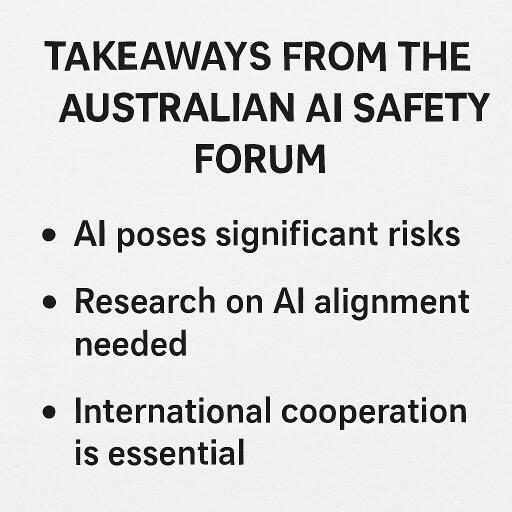
Takeaways from the Australian AI Safety Forum — LessWrong
The Australian AI Safety Forum 2026, held at the University of Sydney, brought together researchers, policymakers, industry leaders and civil society to grapple with a fast-moving reality: AI capabilities are rising unevenly and rapidly, while the guardrails—technical, legal and cultural—struggle to keep pace. Across two days, the conversation repeatedly returned to how we assess complex systems, deter abuse, and build infrastructure that is resilient, equitable and sustainable.
A shared baseline—and a live dilemma
- Progress is uneven: frontier systems excel at code, math and science but still trip over tasks humans find routine. Experts are split on whether we’re headed for acceleration or a plateau.
- Real-world harm is already here: scams, fraud, non-consensual imagery and cyberattacks are being supercharged; risks of aiding dangerous biological or chemical misuse are increasing.
- Reliability limits matter: hallucinations, brittle long workflows and error recovery gaps grow more consequential as autonomy rises.
- Loss-of-control risk remains uncertain but non-trivial; evidence is mixed and expert views diverge on severity and timelines.
- Layered safeguards are essential: capability testing, technical controls, incident reporting, governance and social resilience should overlap rather than substitute for one another.
This leaves a core policy and research tension: Wait for certainty and risk being late, or act early and risk locking in the wrong measures. That uncertainty animated both the technical debates and the institutional proposals.
Technical signals from the frontier
From outputs to systems
Traditional benchmarks grade single answers. But agentic systems plan over time, call external tools, retain memory and change real environments. What matters is the trajectory: tool choice, permission use, recovery from errors, when they escalate to humans and the side effects they leave behind. A polished final answer can hide wasteful or risky process steps. The field is still searching for robust, system-level evaluations that reflect real workflows and governance needs.
When models design their successors
Teams exploring automated AI R&D studied what happens when an agent is tasked—within a budget—to build a “better” successor, and that loop repeats. They tracked traits like warmth, concision and assertiveness across generations. Results suggested traits can settle into sensible ranges rather than spiral, though design choices (prompts, budgets, metrics) likely change outcomes. The broader question remains urgent: if recursive improvement becomes efficient, safeguards must land before feedback loops outpace oversight.
Offensive cybersecurity time horizons
Researchers applied “time-horizon” evaluation—how long a skilled human would need to complete a task—to offensive security challenges. They observed steady, roughly exponential improvement, with doubling times on the order of months. Under larger inference budgets, a new frontier model solved most tasks and pushed estimated time horizons down to just a few hours on bounded, verifiable, undefended targets. Two takeaways: capping inference can understate capability, and credible evaluation gets harder as models advance—both because tasks leak into training data and because evaluation itself grows costlier.
Criminal AI marketplaces
Underground “Dark AI” services market jailbroken tools for phishing, identity fraud and malware, lowering the expertise needed to commit crime. Trust deficits in illicit markets (copycats, vaporware, weak models) provide only fragile friction; sophisticated actors can bypass marketplaces entirely. That places renewed emphasis on defenses we control: strong identity and access management, anomaly detection, rate limiting, API monitoring, audit trails and fast incident response—and continuous adaptation as offenders blend legitimate AI services with known attack patterns.
Australia’s strategic lane
Independent safety evaluations
There’s an opening for Australia to become a trusted evaluator of AI risks and safeguards. Building deep capability in red-teaming, agent testing and scenario analysis could provide actionable evidence for governments, developers and adopters deciding whether systems are safe to deploy.
Assurance, audits and accountability
Beyond research, an assurance ecosystem—auditing methods, certification pathways, incident investigation and post-mortem norms—can translate safety science into operational guidance. Clear standards around data governance, model oversight and change management would mirror Australia’s strengths in cybersecurity and safety-critical industries.
Compute on Australian terms—powered by renewables
Australia is well-placed to host data centers given abundant wind and solar, political stability and regional proximity. But raw megawatts aren’t enough. High-integrity build-out means tying new compute to verifiable new renewable supply, flexible load participation to stabilize the grid, and transparent carbon and water reporting. Facilities should minimize freshwater draw (e.g., seawater cooling, recycled water), reuse waste heat and prioritize biodiversity-safe siting. Community benefit agreements, local jobs and research partnerships can anchor social license. Forthcoming national standards are expected to codify expectations on energy, water efficiency and community outcomes—turning AI infrastructure into a catalyst for resilient, low-carbon systems rather than a strain on them.
What enterprises can do now
- Evaluate end-to-end: test agents on real workflows, not just prompts. Track task completion, error recovery, human escalation, cost and time saved.
- Engineer for drift and misuse: enforce least privilege, monitor and rate-limit, log agent actions, and run continuous red-teams and change-control.
- Blend disciplines: combine user education, safety research, policy and product governance to build overlapping defenses.
- Build sustainably: procure low-carbon compute, align heavy runs with renewable-rich hours, plan for water stewardship and disclose energy impacts.
Across the forum, disagreements over timelines and severity coexisted with a shared pragmatism: measure what matters, update fast and design for failure. The stakes extend beyond security to the stewardship of land, water and energy. If Australia leans into rigorous evaluation, credible assurance and clean, community-positive infrastructure, it can help shape an AI ecosystem that is not only powerful and secure—but also sustainable.



Leave a Reply