

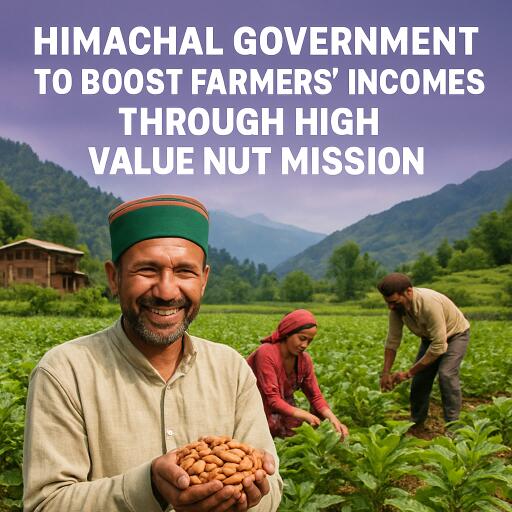
Himachal government to boost farmers’ incomes through High Value Nut Mission
The Himachal Pradesh government is preparing a new horticulture push aimed at raising farm incomes by expanding and modernising the cultivation of premium nut crops. The programme, titled the High Value Nut Mission, is scheduled to run from 2026 to 2031 and is designed to improve productivity, strengthen rural livelihoods and build a more resilient orchard economy in the hill state.
The mission will focus on temperate nut species with strong commercial potential, including walnut, almond, apricot and chilgoza pine nut. Officials see these crops as a promising route for diversification in mountain agriculture, particularly at a time when growers are under pressure from ageing orchards, inconsistent yields, climate stress and weak post-harvest systems.
At the heart of the plan is an effort to upgrade orchard management using scientific methods and better infrastructure. The state intends to cover about 1,000 hectares under the mission. Most of this, roughly 900 hectares, will involve the revival of old and poorly performing orchards. The work is expected to include canopy correction, top-working, replacement of senescent trees, improvements in soil fertility and more efficient water use.
The remaining 100 hectares will be developed as model high-density plantations. These demonstration blocks are expected to showcase modern cultivation systems using quality planting stock, micro-irrigation and climate-aware production practices. The idea is to create practical examples that farmers can replicate in suitable areas.
A key part of the mission is the supply of reliable planting material. To support this, the government plans to set up four hi-tech nurseries and two Centres of Excellence in major nut-growing belts. These facilities are expected to provide certified, disease-free saplings while also serving as hubs for training, field demonstrations, research and advisory support.
For farmers, that could mean easier access to improved varieties and a better understanding of orchard technologies that are often difficult to adopt without hands-on guidance. In mountainous states like Himachal Pradesh, where terrain and fragmented holdings complicate farm operations, such institutional support can be as important as financial assistance.
The mission also addresses a major weakness in horticulture value chains: what happens after harvest. The plan includes the creation of 10 modern units dedicated to collection, grading, sorting, packing, processing and value addition. If implemented effectively, these facilities could reduce post-harvest losses, improve consistency in quality and help growers connect with more rewarding markets.
That post-harvest focus reflects a larger shift in agricultural policy. Simply producing more is no longer enough; profitability increasingly depends on storage, branding, packaging and the ability to sell processed or premium products. By investing in these links, the state hopes to move growers beyond raw produce sales and toward higher-value returns.
The programme will also encourage the formation and strengthening of Farmer Producer Organisations, while seeking private participation through public-private partnership models. Access to institutional finance is expected to be supported through existing agricultural infrastructure schemes, giving growers and collectives more room to invest in modernisation.
One of the mission’s most distinctive elements is its attention to chilgoza, a high-value pine nut with both ecological and economic importance in Himachal’s tribal regions. The government has signalled that chilgoza conservation and regeneration will receive special priority. Proposed measures include assisted natural regeneration, community-led forest management and propagation systems to improve seed germination and plant establishment.
This approach gives the mission an environmental dimension beyond conventional horticulture expansion. Chilgoza landscapes are closely tied to biodiversity, fragile mountain ecosystems and local livelihoods. Supporting their regeneration could help protect forested areas while also creating income opportunities for communities that depend on them.
State leaders have framed the initiative as a long-term effort to modernise horticulture and make it more technology-driven, market-oriented and climate-aware. The government expects the mission to improve yields, increase farm profitability and open up new employment opportunities, especially for rural youth.
There is also an emphasis on inclusion. The planned interventions are expected to support not only orchard owners, but also women farmers, tribal communities and producer groups that often face barriers in accessing technology, markets and formal finance. If these groups are effectively integrated, the benefits of the nut mission could spread across a much wider section of the rural economy.
For Himachal Pradesh, where horticulture already plays a central role in livelihoods, the High Value Nut Mission represents a strategic bet on diversification. By combining orchard rejuvenation, modern nurseries, better water management, post-harvest infrastructure and ecological conservation, the state is attempting to build a more profitable and sustainable future for mountain farming.
If the programme delivers on its goals, premium nut crops could emerge as a stronger pillar of Himachal’s rural economy in the years ahead, offering farmers not just higher production, but better value from every harvest.



Leave a Reply