

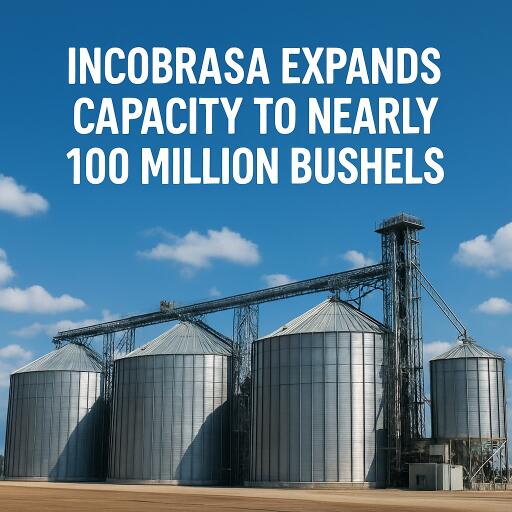
Incobrasa expands capacity to nearly 100 million bushels
In Gilman, Illinois, a major upgrade to Incobrasa Industries’ soybean complex is now online, doubling the company’s annual processing capacity and tightening the link between Midwestern farms and the fast-growing market for low-carbon fuels. The $250 million buildout adds a 170,000-square-foot processing facility next to the company’s existing operations, creating 40 new full-time positions while retaining about 200 current jobs.
A bigger crush for a growing market
The new plant is engineered to handle nearly 100 million bushels of soybeans a year once fully ramped, positioning the site among the country’s largest single-location crush operations. By the company’s projections, daily throughput could reach roughly 300,000 bushels, offering a dependable outlet for thousands of area farms and helping stabilize regional demand for Illinois-grown soy.
Inside the expanded complex, soybeans are separated into two essential products: high-protein soybean meal for animal feed and soybean oil destined for refining into biodiesel and other renewable fuels. The scale-up aligns with surging interest in cleaner-burning fuels and protein-rich feed as livestock and aquaculture sectors continue to expand.
On-site solar and lower-carbon energy
To shave emissions and operating costs, Incobrasa has paired the crush expansion with a 50-acre solar array capable of generating up to five megawatts of electricity. Depending on operating conditions and grid needs, power from the array can be used directly at the facility or exported to the local grid. While the plant’s energy demand will fluctuate with production cycles, on-site renewables can help buffer against price volatility and reduce the carbon intensity of the company’s products.
From a climate perspective, shifting more soybean oil into biodiesel and other renewable fuel pathways can deliver notable lifecycle greenhouse gas reductions compared with petroleum diesel, especially when facilities incorporate efficiency upgrades and zero-carbon electricity. Realizing these gains at scale also hinges on agronomic practices that protect soils, curb nitrogen losses and avoid land-use change—areas where Illinois producers have increasingly adopted conservation measures.
State support and economic signals
The expansion benefited from Illinois’ Economic Development for a Growing Economy (EDGE) program, which provides performance-based tax credits for companies that create or expand jobs within the state. Under a 2023 agreement, Incobrasa qualified for EDGE incentives tied to the project’s hiring and investment targets. State officials say companies participating in the program so far this year have pledged thousands of new jobs and billions in capital investment, underscoring the broader push to anchor value-added agricultural processing in Illinois.
Local leaders view the Gilman project as a case study in how advanced ag manufacturing can deliver durable employment while accelerating the transition to cleaner fuels. With on-site solar, expanded crush capacity and direct ties to the biodiesel supply chain, the facility is designed to meet both market demand and emerging sustainability standards.
Why it matters for farmers and the fuel transition
For growers, stronger in-state crush capacity can translate into tighter basis, reduced transport distances and more predictable offtake—advantages that are especially important during harvest peaks. The added processing volume also lifts demand for soy across multiple product streams: meal supports regional livestock producers, while oil feeds refineries supplying biodiesel blenders and, increasingly, aviation and marine sectors exploring lower-carbon options.
As clean-fuel policies and voluntary corporate targets expand, processors that can certify lower lifecycle emissions and resilient supply chains are likely to capture a premium. Pairing renewable electricity with efficient processing, tracking sustainable farming practices and optimizing logistics all contribute to that advantage.
Illinois: a soybean powerhouse
Illinois consistently ranks as the nation’s top soybean producer and outpaces most countries—only China, Argentina and Brazil harvest more soy annually than the Prairie State. With Incobrasa’s expansion, roughly one out of every six rows of Illinois soybeans could be processed at the Gilman complex when operating at full capacity. That concentration of throughput amplifies the state’s role in supplying feed markets and the clean-fuels transition, while anchoring jobs and investment in rural communities.
The road ahead
Scaling to nearly 100 million bushels per year is more than a milestone for one company; it’s a signal that value-added agriculture and renewable energy are increasingly intertwined. As the new plant hits its stride, watch for three indicators of long-term impact:
- Market stability for growers: consistent demand and pricing dynamics through harvest and beyond.
- Carbon performance: verifiable reductions in the carbon intensity of both electricity use and fuel outputs.
- Local benefits: sustained job growth, workforce training and community investment around Gilman and neighboring counties.
In a period marked by volatile commodity cycles and ambitious decarbonization goals, projects that marry scale, efficiency and renewables are setting the pace. For Illinois, and for the farmers who supply its crush plants, that makes Gilman’s newest facility more than a ribbon-cut—it’s a strategic bet on where food, fuel and climate priorities converge.



Leave a Reply