

Australia’s giant batteries are flattening the notorious ‘duck curve’ and cutting peak power prices
Australia’s rapid build-out of grid-scale batteries is reshaping the daily rhythm of the power market, turning a once-troublesome solar surplus into a stabilising force that is already softening peak prices—especially in Victoria.
From duck curve to smoother days
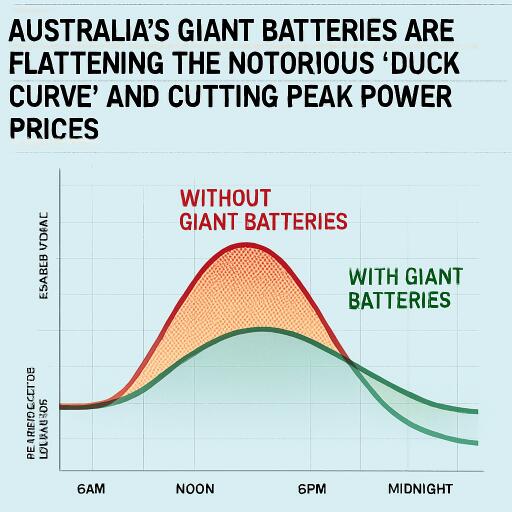
For years, solar power created a “duck curve” in demand and pricing: midday electricity was so abundant that wholesale prices sometimes crashed into negative territory, then surged in the evening when the sun set and demand stayed high. Recent market patterns in Victoria show that this profile is flattening. Midday prices are no longer plunging as deeply, and the typical morning and evening spikes are less severe than they were just a few years ago.
The difference is storage. Large batteries—many designed to discharge for two to four hours—now soak up excess solar around noon and push that energy back into the grid during the evening peak. By shifting supply across the day, these systems reduce the amplitude of daily price swings and help the grid rely less on costly, fast-start gas generation when demand ramps up after sunset.
Why the shift matters
Flattening the curve delivers benefits on multiple fronts:
- Lower bills over time: When evening peaks are moderated, the costliest hours on time-of-use tariffs (commonly 5–10 p.m.) become less expensive, creating headroom for retailers to pass through savings.
- More efficient use of renewables: Instead of curtailing solar when the grid is saturated, batteries store surplus energy and redeploy it later, trimming waste and improving the value of every megawatt-hour generated.
- Operational stability: Smoother intraday price and demand profiles make it easier for network planners to schedule maintenance, manage congestion, and integrate more variable renewables.
- Cleaner peaks: Displacing peaking generators with stored renewable energy can reduce emissions and local air pollution during high-demand periods.
These advantages are showing up first where battery fleets are most advanced. Victoria, in particular, has registered a visible reduction in both the depth of midday price troughs and the severity of evening spikes this year. While price outcomes vary day to day, the broader trend points toward a market where storage cushions volatility driven by rooftop and utility-scale solar.
How the batteries are working
Most of the new installations are lithium-ion systems sized to manage “intraday” swings—charging for a few hours and discharging for a few hours. Their superpower is speed: they can respond within milliseconds to grid signals, provide frequency control services, and arbitrage power between low- and high-price windows. By charging when solar floods the system, they limit negative pricing and suppress the need to curtail generation. By discharging into the evening, they shave the peak.
Importantly, even short-duration batteries can stack multiple value streams: energy arbitrage, ancillary services, and network support. That revenue diversity is helping more projects pencil out, accelerating the cycle of deployment and impact.
The next frontier: longer-duration storage
With intraday variability increasingly under control, attention is turning to the longer gaps—cloudy evenings, wind lulls, and multi-day weather events. State planners and market participants are now exploring eight-to-12-hour systems and beyond. Options range from advanced lithium-ion configurations to emerging sodium-ion batteries, vanadium and zinc-bromine flow batteries, and complements such as pumped hydro.
Longer-duration storage would deepen the evening cushion, mitigate price risk during extended periods of low renewable output, and reduce reliance on thermal peakers. It would also advance Australia’s broader transition goals by firming higher shares of wind and solar without sacrificing reliability.
What consumers and communities can expect
As storage expands, households and businesses should see:
- More stable retail tariffs over time, with less exposure to sharp evening price spikes.
- Improved reliability as batteries help ride through disturbances and support frequency control.
- Greater integration of local renewables, cutting curtailment and unlocking community-scale solar and storage opportunities.
For regional economies, batteries also create construction and operations jobs, and reduce the need for new fossil-fuel peaking assets, which can be expensive to build and operate for limited hours of use.
From problem to advantage
Solar once forced the grid into an awkward daily contortion: too much electricity at noon, too little after dark. Australia’s battery boom is steadily transforming that mismatch into a managed resource. By catching the midday wave and releasing it at night, storage is turning volatility into value—cutting the cost of peaks, curbing waste, and clearing the path to a cleaner, more resilient power system.
If today’s trends continue and longer-duration projects scale, the infamous duck may soon be an endangered species—replaced by a smoother, flatter curve that reflects a grid learning to make the most of abundant, affordable renewable energy.



Leave a Reply