

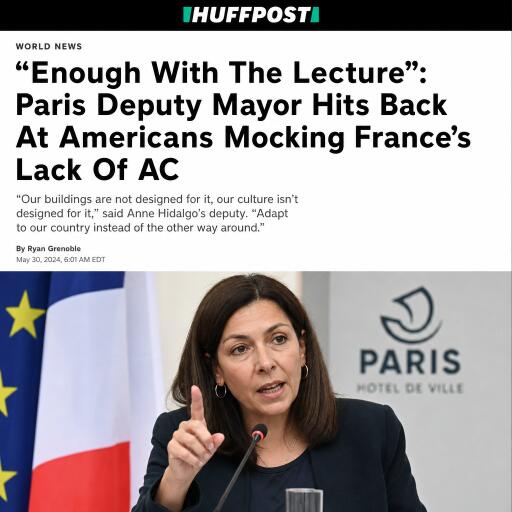
“Enough With The Lecture”: Paris Deputy Mayor Hits Back At Americans Mocking France’s Lack Of AC
As record heat grips Europe, a senior Paris official has pushed back against Americans poking fun at France’s limited air-conditioning. The deputy mayor argued that it is striking to be lectured by a country responsible for a large share of historical greenhouse gas emissions, where air conditioning saturates daily life, even as those same emissions fuel the very heatwaves now scorching Europe.
Her message was blunt: with roughly nine in ten U.S. homes using air conditioners, widespread cooling comes with a heavy energy and climate tab—especially when electricity grids are still partly powered by fossil fuels. She contended that cities actively cutting emissions should not be derided by countries whose lifestyles and infrastructure have long driven global warming.
Paris’ Strategy: Cool the City, Not the Planet
Paris has leaned into measures that lower temperatures without supercharging energy demand. City officials point to a portfolio of changes designed to dial down urban heat while shrinking emissions:
- Expanding tree canopies, parks, and shade to reduce the urban heat island.
- Cutting car traffic and reclaiming streets for pedestrians and cyclists.
- Accelerating building retrofits to improve insulation and ventilation, and to lower cooling needs.
- Encouraging sustainable, local food systems and urban agriculture that also cools neighborhoods.
These steps, the deputy mayor suggested, are part of an ecological transition that prioritizes resilience. Her challenge to U.S. critics was clear: if American cities matched the scale and speed of these efforts, global climate risks—and the severity of heatwaves—would diminish for everyone.
France’s Uneasy Relationship With Air Conditioning
France has historically been cool toward AC. Only about a quarter of households have units, a fraction of U.S. levels. That restraint reflects environmental concerns, a building stock designed for temperate climates, and cultural preferences for natural ventilation. But summers are no longer what they were: heatwaves arrive earlier, last longer, and push nighttime temperatures dangerously high. As conditions change, public demand for cooling is rising.
This shift has intensified a national debate. Many on the left argue for urban greening, deep building retrofits, reflective roofs, shading, and district cooling over a rush to install millions of individual units. Others, especially political opponents, are pushing for a large-scale subsidy program to put AC in homes and businesses quickly. The crux of the dispute is not whether people need relief—it’s how to deliver it without locking in higher energy use and emissions for decades.
A Heatwave With a Deadly Toll
The political clash is unfolding as France endures one of its most punishing heatwaves in memory. Public health data indicate at least 1,300 excess deaths since June 21, with older adults and people with underlying health conditions hardest hit. Authorities warn the toll could grow as final records are compiled.
Climate scientists who conduct rapid attribution studies say the exceptional intensity of this heat event would have been extraordinarily unlikely without human-caused warming. Europe, they note, is heating faster than the global average, making extreme temperatures more frequent, longer-lasting, and more dangerous. The current crisis has revived painful memories of 2003, when a catastrophic heatwave claimed around 15,000 lives in France.
Cooling Smarter, Not Just More
The immediate need to protect health is undeniable: cooling centers, targeted AC for the most vulnerable, and clear public guidance save lives. But the deputy mayor’s retort underscores a broader dilemma. Air conditioning is both a lifeline and, if deployed indiscriminately and inefficiently, a feedback loop—pushing up electricity demand, stressing grids, and adding heat and emissions to an already warming world.
There is a middle path. High-efficiency heat pumps powered by cleaner grids, better building envelopes, shading and reflective materials, night ventilation strategies, and urban trees can cut cooling demand dramatically. District cooling systems, water-sensitive design, and reimagined public spaces offer relief at neighborhood scale. Combined with traffic reduction and efficient public transport, these measures curb both heat and the pollution that amplifies it.
Mockery misses the point. The question is not whether people deserve to be cool—it is how to keep cities livable without deepening the crisis. On that score, Paris is betting on structural changes that reduce the need for AC in the first place. The deputy mayor’s message to American critics distilled that urgency into a challenge: less lecturing, more action. If cities on both sides of the Atlantic commit to cutting emissions and building heat-resilient neighborhoods, the benefits will be felt from Parisian boulevards to American suburbs—especially during the next heatwave that, in a warming world, is never far away.



Leave a Reply