

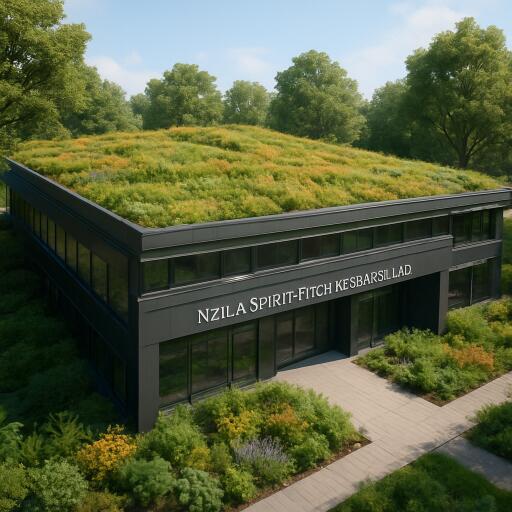
Living Green Roof Concept for the Proposed Nzila Spirit-Tech Research Lab
The proposed living roof for the Nzila Spirit-Tech Research Lab is designed as far more than a protective layer atop a building. It is imagined as a working ecological platform where scientific research, environmental design, and cultural knowledge meet in one shared space. Instead of treating the roof as unused overhead area, the concept turns it into an active landscape that supports experimentation, learning, and restoration.
At the heart of the idea is a simple shift in architectural thinking: the building itself becomes part of the research mission. The rooftop is planned as a place where vegetation, renewable energy, water management, and biodiversity can function together. In this setting, researchers and students would not be separated from the ecosystems they study. They would move through them, observe them, and test how natural and engineered systems can coexist productively.
This elevated landscape would host a mix of indigenous African medicinal species and other research plants selected for resilience, ecological value, and educational use. These planted zones could support botanical study while also preserving important traditional plant knowledge. The roof therefore serves both science and cultural continuity, presenting plant life not as decoration but as living data, habitat, and heritage.
Solar technology is another core element of the concept. Photovoltaic systems integrated into the roof would generate clean energy for portions of the laboratory while demonstrating that advanced engineering can be embedded in ecologically sensitive design. Rather than competing with the planted systems, the energy infrastructure would be arranged to work alongside them, showing how renewable power and living landscapes can share the same footprint.
The design also prioritizes access and interaction. Paths, viewing points, and open-air collaboration areas would allow users to move through the roof as both a field site and a meeting place. Informal conversations, interdisciplinary teaching, and direct environmental observation could all happen within this space. Such a layout encourages a mode of research that is less isolated and more responsive to living conditions on the ground.
Main Elements of the Green Roof Vision
- A planted roof system that supports habitat creation and ecological stability
- Garden areas dedicated to indigenous medicinal and research-relevant plant species
- Integrated solar energy infrastructure for on-site renewable power generation
- Outdoor zones for environmental monitoring and field-based scientific study
- Walkways and observation routes that promote reflection, exchange, and discovery
- Climate-responsive design that helps improve insulation and reduce heat gain
- Water capture and natural drainage strategies to support efficient resource use
- Open-air areas for teaching, demonstration, and collaborative discussion
- Elevated observation opportunities connected to the surrounding landscape
- A direct fusion of sustainable architecture and research infrastructure
Environmentally, the roof concept offers several practical benefits. Vegetation can help shield the structure from extreme heat, lowering internal cooling demands and improving thermal performance. Rainwater capture and controlled drainage can reduce runoff while supporting the planted systems. The presence of layered vegetation may also create habitat for insects and birds, strengthening local biodiversity in a setting often dominated by hard surfaces and conventional construction.
Just as importantly, the roof is conceived as a scientific instrument. Monitoring stations and research plots could be embedded across the space to track soil moisture, temperature, pollinator activity, plant adaptation, and energy performance. This would turn the rooftop into a small but highly visible experimentation zone where ecological intelligence is not discussed abstractly but measured in real time.
The project also carries a strong educational dimension. By bringing together sustainable technologies and indigenous botanical knowledge, the design creates opportunities for cross-disciplinary engagement. Environmental scientists, engineers, architects, students, and traditional knowledge practitioners could all find reasons to work within the same setting. The rooftop becomes a bridge between knowledge systems that are too often treated separately.
An Architecture That Reflects a Research Ethos
The broader significance of the living roof lies in what it says about the identity of the proposed lab. It suggests that technology should not be understood only as machinery, hardware, or enclosed infrastructure. It can also mean the thoughtful creation of systems that operate in partnership with ecological processes. In this vision, innovation is not detached from nature; it is guided by it.
By combining renewable power, restorative planting, environmental observation, and outdoor collaboration, the roof embodies a model of research architecture that participates in knowledge-making. The building is no longer a passive container for scientific work. It becomes a working component of that work, contributing to energy production, biodiversity support, climate adaptation, and public demonstration.
For the proposed Nzila Spirit-Tech Research Lab, this approach offers a compelling architectural statement. The roof is envisioned as a space where sustainability is visible, measurable, and usable every day. It is a place where ecological care and technological experimentation are not opposing ambitions but mutually reinforcing ones.
Ultimately, the concept presents a future-facing model for research facilities in which design, science, and environmental stewardship are integrated from the outset. The result is a rooftop that does more than shelter a laboratory: it extends the laboratory into the living world.



Leave a Reply