

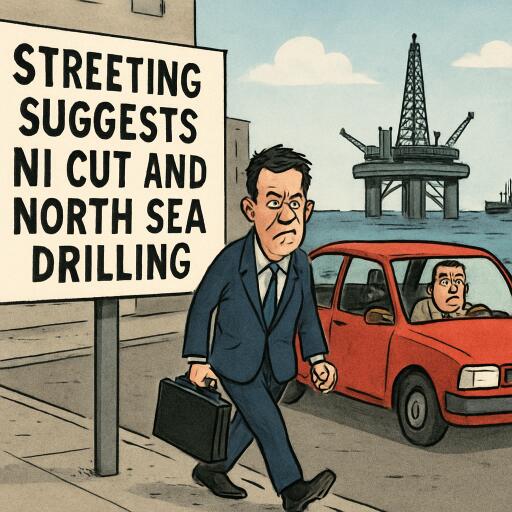
Streeting suggests NI cut and North Sea drilling
Britain’s economic and energy debates converged this week as proposals to jump-start youth employment met renewed arguments over whether to unlock more oil and gas in the North Sea. Shadow health secretary Wes Streeting signalled support for approving certain offshore projects while backing incentives to bring young people into work, underscoring a policy crossroads: how to fund public services and lower bills today without derailing the clean-energy transition needed tomorrow.
Youth employment boost: grants to lower hiring costs
A new “youth jobs grant” would offer employers £3,000 for each 18- to 24-year-old they hire who has been on benefits and actively seeking work for at least six months. The aim is to chip away at long-term unemployment by reducing the up‑front cost of recruitment for firms, especially in sectors where entry-level training can be a barrier. Backers of the plan frame it as a pragmatic way to pull more people into the labour market quickly, while critics question whether temporary hiring subsidies translate into sustained careers without complementary skills investment.
For an economy wrestling with sluggish productivity and persistent regional inequalities, the measure could help bridge young people into the workplace at pace. Its ultimate impact will depend on how effectively employers pair the grant with real training pathways—ideally in growth areas such as energy efficiency, advanced manufacturing, and low‑carbon infrastructure that are expected to expand over the next decade.
North Sea crossroads: revenue today, transition tomorrow
On energy, Streeting has set himself apart from Labour’s manifesto pledge not to issue new licences to explore fresh fields, a stance originally justified on the grounds that additional exploration would not reduce household bills, would not deliver energy security, and would accelerate climate risks. He indicated that he favours moving ahead with certain approvals, particularly where applications were lodged before the change of government, suggesting the Energy Secretary is likely to reach the same conclusion.
Two projects—Jackdaw and Rosebank—have become emblematic of this debate. Applications for both predate the current administration, prompting arguments that these are not truly “new” ventures even if final approvals are outstanding. Streeting has acknowledged that greenlighting such projects won’t automatically translate into lower energy bills, but he argues they could bolster tax receipts at a time of intense pressure on the public finances.
Conservative and Reform voices have ramped up calls for more domestic extraction, casting restraint as irresponsible in light of energy price volatility linked to geopolitical tensions involving Iran. Their case leans on the notion of sovereignty over resources: if the UK has hydrocarbons in its backyard, why not use them? But this framing collides with climate arithmetic and the economics of global commodities markets, where the price Britons pay is largely set internationally, not at the wellhead.
Labour’s balancing act
Labour’s leadership maintains that oil and gas will continue to be produced from the North Sea for some time, regardless of the immediate licensing decisions. The central question, they argue, is how to deliver cheaper bills and energy security in the medium to long term. Their answer is to accelerate renewables—onshore and offshore wind, solar—backed by nuclear power to provide firm, low‑carbon capacity.
From an ecological and systems perspective, this focus aligns with the cheapest new power sources now available in the UK. Scaling them, however, requires modernised grids, faster planning and permitting, robust domestic supply chains, and investment in flexibility—long‑duration storage, interconnectors, and demand response—to balance variable generation. Without these enablers, the promise of lower costs from clean energy can be delayed by bottlenecks rather than technology.
Climate, cashflow, and credibility
The case for approving legacy North Sea applications tends to rest on short‑term fiscal benefits and industrial continuity, including safeguarding existing jobs and supply chains. The environmental case against hinges on carbon lock‑in and the risk that additional fossil supply extends dependence precisely when the UK needs to halve emissions this decade to stay on course for its climate commitments.
There is also a policy credibility dimension. If the government argues that new exploration doesn’t cut bills or enhance true energy security, approving projects—however narrowly defined as “not new”—can muddle the message unless paired with unmistakable acceleration in clean-energy build‑out. That places a premium on visible wins: faster renewable connections, more storage projects reaching final investment decision, streamlined offshore wind consenting, and concrete support for zero‑carbon heating and industrial electrification.
Jobs today, green economy tomorrow
The youth employment grant could be a bridge between these agendas. While the measure is sector‑agnostic, it can be most impactful if employers deploy it in roles that underpin the transition—retrofit installers, grid technicians, turbine and blade manufacturing, heat pump engineers, and nature restoration. Done well, it turns a short‑term hiring nudge into long‑term capacity for the net‑zero economy.
In the end, the UK’s strategy will be judged on whether it lowers costs for households, secures reliable supply, and reduces emissions at speed. Approving pre‑existing North Sea projects may offer immediate revenue relief, but only a decisive, scaled build‑out of renewables and nuclear—paired with modern infrastructure and skilled workers—will deliver durable energy security and climate credibility. Streeting’s signals suggest a willingness to straddle both imperatives; the test is whether the follow‑through on clean energy is fast and focused enough to make the bridge worth crossing.



Leave a Reply