

Watching climate patterns may help bolster dengue response – Society – The Jakarta Post
Indonesia’s long battle with dengue shows few signs of easing, even as the nation aims for zero dengue fatalities by 2030. By mid-April this year, health authorities had registered 30,465 cases and 79 deaths, with infections reported in 401 of the country’s 514 regencies and cities. The disease’s reach is national, but its timing and intensity are not uniform—an insight that could reshape how the country prepares for outbreaks.
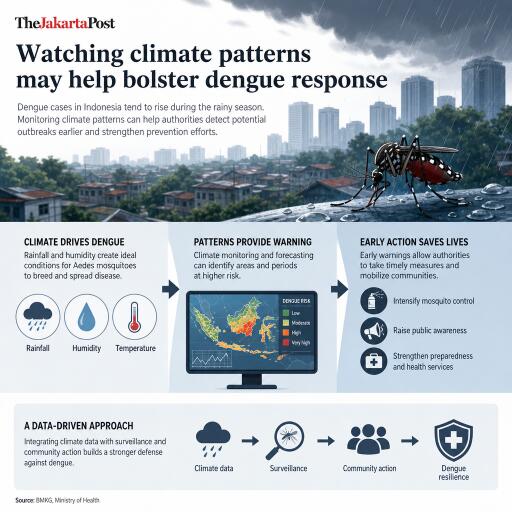
New analyses point to a powerful ally in anticipating dengue surges: the climate. By tracking cues such as rainfall patterns and El Niño-driven temperature shifts, researchers have demonstrated that dengue risk can be forecast more precisely—especially when models account for provincial differences rather than treating the archipelago as a single epidemiological unit. That approach could underpin early warning systems that help local governments time interventions before hospitals fill and case counts climb.
Climate signals as an early alarm
A nationwide review of dengue surveillance from 2010 to 2024, matched with local and regional climate variables, reveals distinct seasonal signatures across Indonesia. Western provinces display a consistent rhythm, but the “when” of peak transmission varies widely. In Sumatra, for instance, outbreaks can crest up to four months earlier than in Java and Bali. One notable pattern: North Sumatra tends to see a peak around October, whereas Jakarta, West Java and Bali often reach their highest case loads in April.
Such differences make sense biologically and meteorologically. Heavier rains create more standing water for Aedes mosquitoes to breed. Warmer and more humid conditions can accelerate mosquito lifecycles and enhance viral replication within the vector, shortening the time to transmission. El Niño events, which reshape rainfall and temperature across the tropics, can tilt the odds in favor of mosquitoes in some places and dampen them in others. Layer on dense urbanization, inconsistent water storage, and patchy waste management, and localized risk profiles begin to diverge sharply.
From forecasts to action
Provincial- and district-level early warning systems could convert these insights into lives saved. Rather than relying on national averages, authorities can:
- Tailor the dengue calendar: schedule community clean-ups, larval source reduction, and insecticide campaigns in the weeks before local peak risk.
- Pre-position resources: ensure hospitals and clinics are staffed and stocked when forecasts flag an approaching surge.
- Time public messaging: coordinate school and neighborhood outreach to align with local transmission windows.
- Strengthen surveillance: intensify case finding and vector monitoring when climate thresholds are crossed.
In practical terms, that might mean ramping up vector control in parts of Sumatra late in the dry season and during early rains, while Java and Bali focus preparedness ahead of the transition to the April peak. Even simple climate indicators—cumulative rainfall over recent weeks, temperature anomalies, humidity—can serve as triggers. More advanced approaches might blend satellite-derived precipitation, local weather station data, and health surveillance in models that learn and update over time.
Building smarter systems
For climate-informed dengue preparedness to work, data must flow fast and freely between public health and meteorological teams. Investments in local weather networks, consistent vector surveillance, and interoperable databases will pay dividends when integrated into routine decision-making. Equally important is community participation: without household-level action to eliminate standing water, even the most accurate forecast will have limited effect.
The country’s zero-death target is ambitious but not out of reach if prevention tools are deployed at the right place and time. Alongside climate-based early warnings, core strategies remain essential: sustained vector control, reliable primary care and referral pathways, and the careful, context-specific use of preventive measures, including vaccines where appropriate and available. Clear clinical guidance and rapid diagnostics can further reduce severe outcomes by speeding treatment for those who do become ill.
Planning for a shifting climate
Climate change is likely to complicate dengue dynamics by altering rainfall patterns, elevational ranges, and the duration of favorable conditions for mosquitoes. More frequent extremes—prolonged droughts followed by intense downpours—can produce unpredictable breeding pulses. Adaptive forecasting systems that incorporate both seasonal variability and long-term warming trends will be critical to stay ahead of shifting risk.
Ultimately, watching the sky may become as important as watching the clinic. By pairing climate intelligence with targeted public health action, Indonesia can better anticipate where and when dengue will strike—and move closer to a future where outbreaks no longer claim lives.



Leave a Reply