

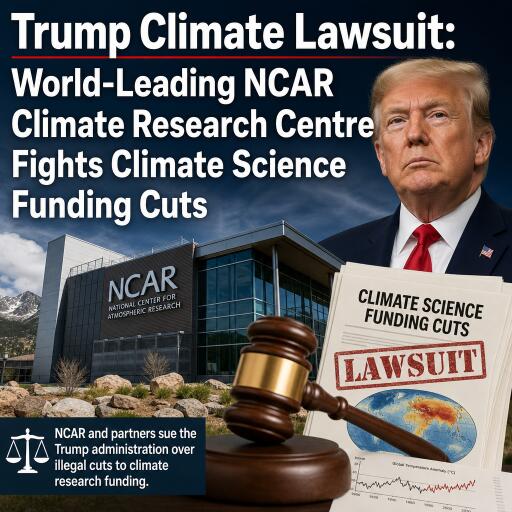
Trump Climate Lawsuit: World-Leading NCAR Climate Research Centre Fights Climate Science Funding Cuts
One of the most influential climate science institutions in the United States has taken the Trump administration to court, challenging a series of actions it says undermine the nation’s capacity to study a warming planet. The case, centered on climate science funding cuts and alleged political interference, carries high stakes for weather forecasting, climate monitoring, and environmental policy at home and abroad.
At the heart of the dispute: science under pressure
The National Center for Atmospheric Research (NCAR), known globally for its cutting-edge climate models and atmospheric research, argues that curtailed budgets and shifting federal priorities jeopardize the scientific backbone that underpins public safety and long-term planning. The lawsuit contends that abrupt reductions in support for climate programs could weaken the United States’ scientific infrastructure, affecting how communities prepare for hazards from heat waves and drought to hurricanes and wildfire smoke.
Why NCAR matters
NCAR’s work touches nearly every corner of modern environmental decision-making. Its teams run some of the world’s most sophisticated Earth system models, steward massive climate datasets, and collaborate closely with agencies such as NASA and NOAA, as well as universities and emergency management offices. Many of the center’s tools are used daily by researchers, utilities, insurers, farmers, and public health officials.
What NCAR’s tools enable
- High-resolution weather prediction and hurricane track guidance that feed into emergency planning.
- Global climate projections that inform infrastructure design, water management, and coastal resilience.
- Air quality and wildfire smoke modeling that supports public health advisories.
- Seasonal outlooks for heat, precipitation, and drought to guide energy and agricultural planning.
- Community modeling frameworks—such as widely used weather and climate models—maintained for researchers worldwide.
These capabilities rely on uninterrupted observations and stable staffing. Climate science depends on long, continuous records—breaks in measurement series or the loss of experienced analysts can degrade the accuracy of both near-term forecasts and long-term projections.
The legal flashpoints
The lawsuit challenges federal actions that reduced or delayed funding for climate research and altered environmental priorities. Scientists and advocacy groups warn that sudden funding contractions, hiring freezes, or constraints on communicating scientific findings can undermine the independence and quality of research. Supporters of the administration’s approach argue that federal spending and regulations should be reassessed to reduce costs and streamline programs.
Key concerns raised by researchers
- Disruptions to long-term climate and weather observations, creating gaps that are difficult or impossible to repair.
- Loss of specialized staff and technical expertise built over decades.
- Delays to model upgrades and supercomputing access that reduce forecast skill.
- Reduced transparency and public communication about environmental risks.
- Weakened collaboration with domestic and international partners who rely on shared data and tools.
Why continuity is critical
From satellite records of sea level rise to ground-based measurements of atmospheric chemistry, many datasets guiding modern society are only meaningful because they stretch across decades. Breaks in funding can shutter field campaigns, create blind spots in observations, and introduce biases into climate baselines. The consequences show up in practical ways: less accurate hurricane intensity forecasts, fuzzier drought outlooks, and wider uncertainty in infrastructure design standards meant to handle future extremes.
Broader implications for public policy
The outcome of the case could extend far beyond a single research center. Courts may clarify how far federal agencies can go in reshaping scientific portfolios and what protections exist for research independence. Potential ripple effects include:
- Rules governing how federal science programs weigh political directives against scientific integrity policies.
- Precedents on public access to climate data and models, crucial for state and local planning.
- Signals to international partners about the reliability of U.S. contributions to global observing systems.
- Impacts on procurement and continuity for satellites, ground sensors, and supercomputing that support operational forecasting.
As extreme weather becomes more frequent and costly, community leaders, utilities, and insurers are increasingly dependent on reliable projections to set rates, harden infrastructure, and plan evacuations. Any erosion in the quality or availability of climate information can push costs higher and increase risks for the most vulnerable communities.
What happens next
Legal analysts expect the case to revolve around administrative law and questions of whether federal actions were arbitrary, capricious, or inconsistent with established procedures and scientific integrity commitments. Early steps could include fights over standing, requests for preliminary injunctions to prevent further disruptions, and discovery into how funding and policy decisions were made.
NCAR’s collaborators and users—ranging from local emergency managers to international research teams—are closely watching. If the court compels restoration of funding streams or sets limits on political interference in science, the decision could stabilize research planning for years. If the administration’s discretion is upheld, climate programs may face continued volatility, making long-term projects harder to sustain.
A test for science in a polarized era
This lawsuit highlights a growing divide over environmental governance in the United States, where climate science often sits at the crossroads of energy policy, economic strategy, and public safety. Whatever the legal outcome, the case underscores a simple reality: robust, transparent, and continuous climate research is fundamental to protecting lives and livelihoods in a rapidly changing world.



Leave a Reply